Hi QAVVERS,
I hope you’re having a great week. My thighs hurt from an insane kung fu session on Wednesday night (lots of squats and low horse stance) but, apart from that, I’m doing well.
I’ve started a new mental health routine this week that I can recommend – something that I heard from a friend who heard it from Brian Eno. First thing in the morning, I take my coffee out on the deck and write in a journal. No phone. No tablet. No laptop. Just a notebook and a pen. I’m trying to clear my mind before I sit down and start work for the day and get swamped by everything I have to do. I’ve find myself looking forward to it every day. Just sit and write. No agenda. No plan. Just write whatever comes to mind. Try it out.
AUSTRALIAN MARKET UPDATE
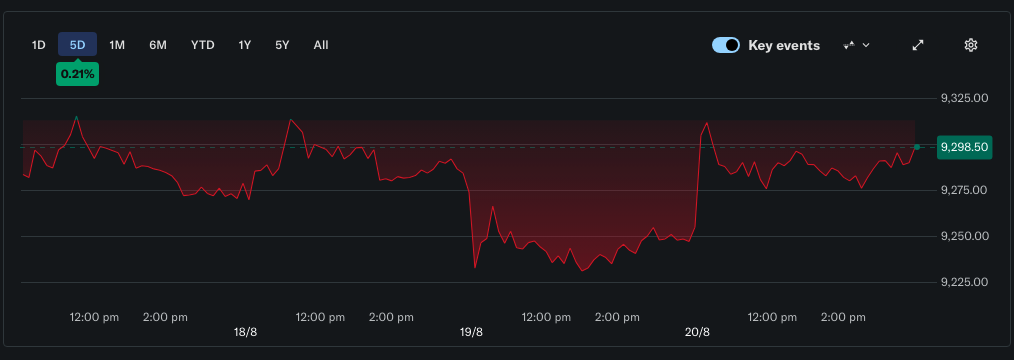
The All Ordinaries edged up approximately 0.2% for the last seven days to close near 9,298 points. Nothing to write home about.
US MARKET UPDATE
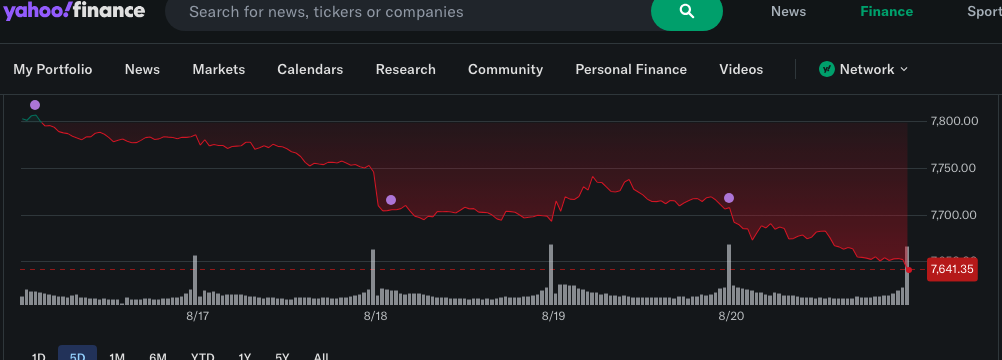
The S&P 500 pulled back this week, retreating from its record high of 7,798.99 set on August 13 to close around 7,641 on August 20.
-
The Treasury Department announced it would more than double repurchases of 10-, 20- and 30-year debt over the coming months, after the 30-year Treasury yield had jumped to its highest level in nearly 20 years earlier in the week.
-
Oil prices climbed to their highest level in over two weeks after President Trump said he intends to inflict more economic pain on Iran and threatened action over the Strait of Hormuz, despite having claimed he’s won the war 47 times in the last six months, with Brent crude trading near $91 per barrel and WTI rising to $84 per barrel.
So, let’s get into my weekly updates and see where we are at.
All the Best,
Cam
QAV MYTH KILLERS
Works Both Ways
Morgan Housel has a blog post called “100 Little Ideas”. It’s a list of concepts from different fields that help explain how the world works, and number 52 on the list is ‘Feedback Loops’.
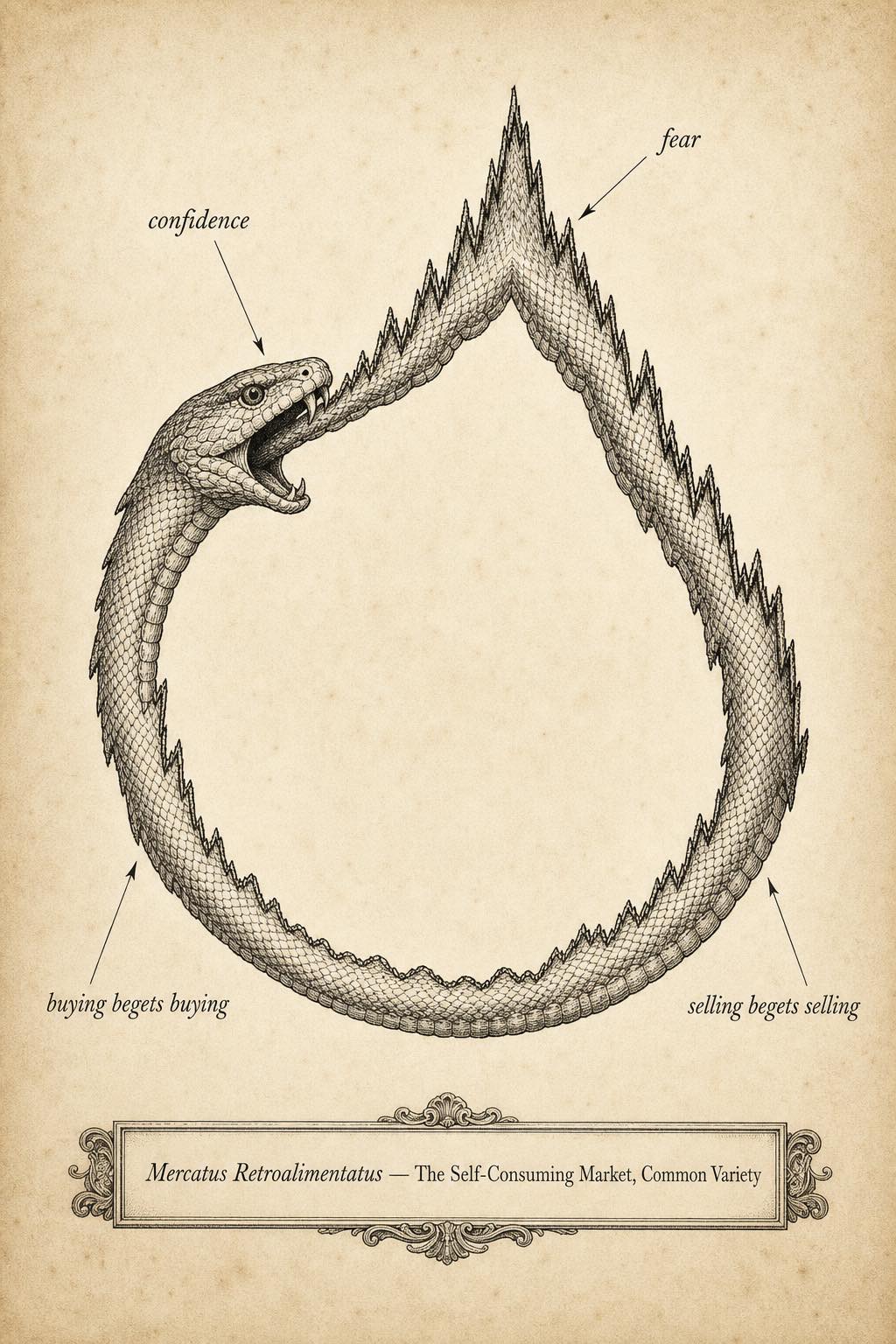
“Falling stock prices scare people, which cause them to sell, which makes prices fall, which scares more people, which causes more people to sell, and so on. Works both ways.”
We capture this in QAV with our three-point trend lines. The checklist might turn up a company with terrific looking numbers, but if the chart is heading in the wrong direction, there’s not much sense buying into it until it turns around. We could get killed by a negative feedback loop.
You’ll hear people say that markets are rational because everything is known and priced in. The flaw in that theory is that markets are made of humans…. and humans aren’t rational. If I was rational, I wouldn’t be making history podcasts for a living. I’d get a real job.
Daniel Kahneman put it about as plainly as it can be put in Thinking, Fast and Slow. Every time a share changes hands, one person is buying and another is selling, at the same price, on the same day, with the same public information sitting in front of both of them. Both can’t be right.

“The puzzle is why buyers and sellers alike think that the current price is wrong. What makes them believe they know more about what the price should be than the market does? For most of them, that belief is an illusion.”
I guess both can be rational, making the best decision they can based on the data they have and their operating thesis for the stock. But they obviously think they know better than the market. As do we – so does that make us irrational? Or just more confident in our model?
You might think amateurs panic and the professionals sit there confidently hoovering up whatever the amateurs dump… but I debunked the value of confidence in a recent article.
A few weeks ago I wrote about Richards Heuer’s Psychology of Intelligence Analysis and those eight horserace handicappers who were given more and more data about each race. Their accuracy didn’t move. Their confidence climbed the whole way. On five pieces of information their confidence was roughly calibrated to how well they were actually doing. By forty they were badly overconfident. The clinical psychologists did the same thing, and so did the doctors. Being a professional doesn’t exempt you from that. More screens and more data buy you conviction rather than accuracy, and conviction is the fuel a feedback loop runs on. You might look busy. You might feel busy. But you’re still wrong.
Our three point trend lines also leverage the upside of positive feedback loops. There’s a well-known paper from the Journal of Finance in 1990 arguing that, when enough people are trading on price direction rather than value, the rational move for a sophisticated investor is to get in front of them, buy early and ride it. That’s why our checklist gives an extra point if there’s a new three point upturn. Of course, we’re only buying a stock if it stacks up well enough on other metrics to have a strong QAV score, we’re not just trading on sentiment alone.
The cleanest demonstration of the power of feedback loops is crypto, which we have talked about a lot on the show. Our fundamental issue is that no-one can tell you what a single Bitcoin is worth. There’s no cash flow to discount, no assets to count, no earnings to multiply. There is no rational model available for working out whether today’s price sits above or below intrinsic value, because there’s nothing to model.
And yet the price moves violently, up, down, based purely on feedback loops, nothing else.
It works at the level of an entire market, too. On the 19th of October 1987 the Dow fell 508 points in a single session, 22.6%. The Federal Reserve’s own history of the crash describes the mechanism in one sentence: “An initial price decline starts a vicious circle by causing portfolio insurers to sell, causing further price declines, causing portfolio insurers to sell again, and so on.” The official inquiry, the Brady Report, called it “a self-reinforcing contagion of fear”.
We see it happen on a smaller scale all of the time when a stock goes ex-dividend. The price will drop as people who were holding out for the dividend sell their holdings. But then the price continues to drop, well below the value of the dividend. Why? Feedback loops. The price is falling so people (and algorithms) sell. It’s easy for an investor to get caught up in the emotion and the panic.
Which is why our trend lines exist.
The checklist tells us if a business contains a good balance of quality and value. It has nothing to say about what several thousand other people are going to do with the share price over the next few months. Some of them are selling because the chart looks bad. Some of them are buying because the chart looks good. Whether that’s rational or not doesn’t much matter, because they both affect our investment.
The trend lines recognise groupthink, but they also allow for the possibility that a stock falling despite good numbers on paper might be falling for perfectly rational reasons that we’re simply not aware of, because we’re not experts in that company or its sector or what its competitors are up to.
And we don’t want to be experts. We don’t have to be. We’re experts at using the system. That, as it turns out, is enough.
The sell line tells us the market has turned pessimistic on a stock, rightly or wrongly. The buy line tells us there’s enough support behind it that the market isn’t rejecting the thesis. Neither one is a forecast. They’re a reading of where things stand today.
Works both ways.
STOCK ANALYSIS OF THE WEEK
Australian Members can check out the stocks we traded in QAV Australian Light portfolios this week.
American Members can check out the stocks we traded in QAV American Light portfolios this week.
No pulled pork from Tony this week due to our interview with Alan Kohler.
On the American podcast this week, I did a pulled pork on an interesting Florida home insurance company, SLDE. The podcast link is down below if you want the full analysis.
BUY LIST

Each week, we produce a buy list based on our value investing system that we share with our QAV Club members. The intended primary purpose of this buy list is for club members to use as a reference for comparing their own buy list. In theory, all of our buy lists should look pretty similar each week.
AUSTRALIAN BUY LIST
QAV Value Investing Buy List (AU) 2026-08-15
U.S. BUY LIST
QAV Value Investing Buy List 2026-08-18
PORTFOLIO PERFORMANCE
We compare our performance to what we think is the most relevant benchmark (SPDR 200 in Australia, S&P500 in the USA), but if you’re new to investing, these comparisons might not mean much. Instead, you can compare our performance to the top-performing Super Funds in Australia and see why an amateur active investor (who has a system to follow) can out-perform most of the “professionals”.
We publish a fresh performance snapshot once a month. Weekly noise doesn’t tell you much in a value-investing system — what matters is the trend.
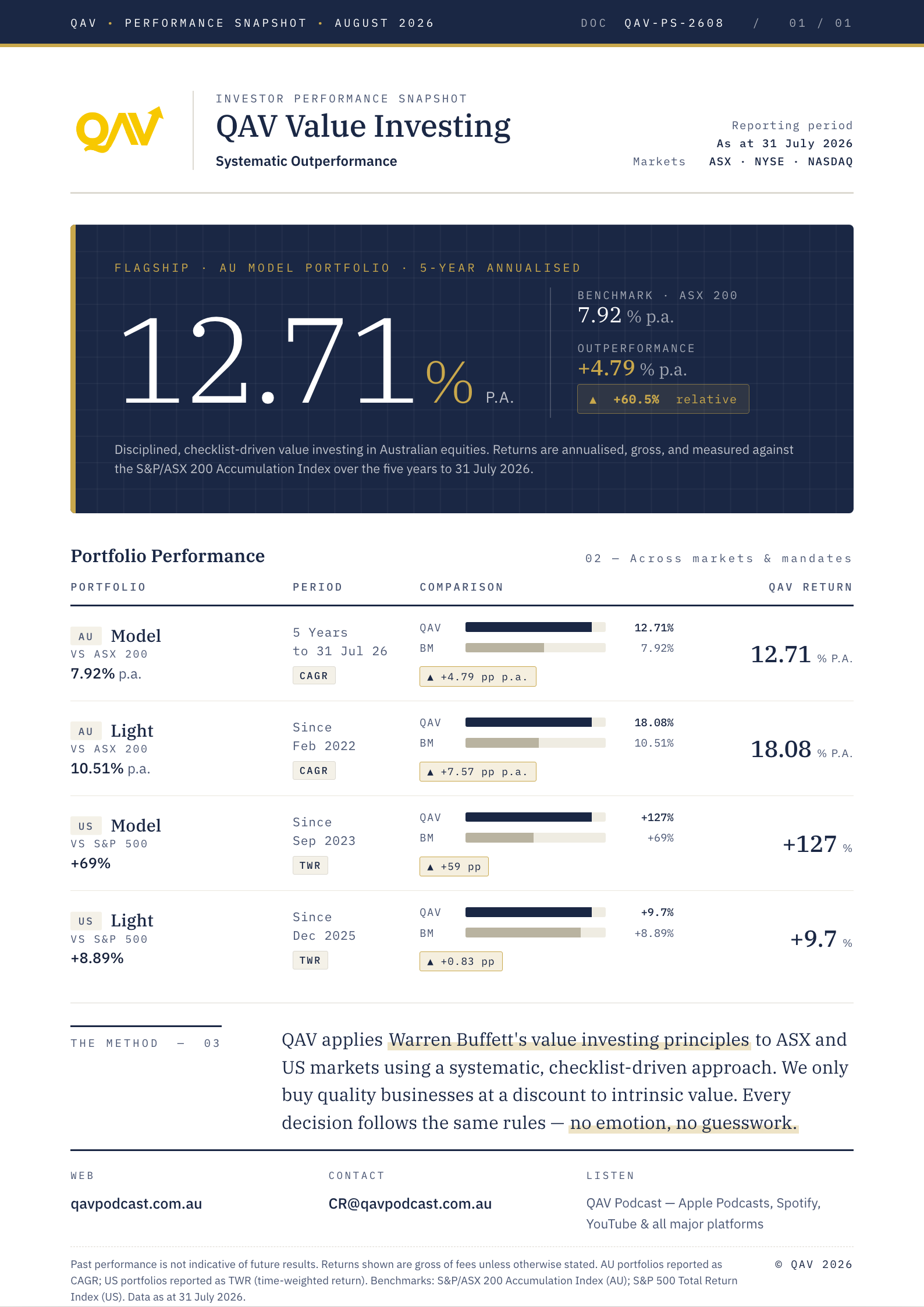
August 2026 performance snapshot.
Australian Model Portfolio: No trades this week.
American Model Portfolio: No trades this week.
Become a QAV Light Member today and start your investing on the right track
If you want to find out what we’re trading in QAV Light each week, sign up to become a member. You’ll get an email from me every Monday letting you know what we’re buying and selling in that portfolio. You can choose to copy our trades or not. It’s the easiest way to start your rules-based investing career… and you don’t even need to know the rules. I’ll follow the rules for you. It’s a good first step to eventually becoming a QAV Club member and learning how to run the system by yourself.
QAV LIGHT: He already knows where they are.

(Note: Americans interested in joining QAV Light or Club please go here instead.)
Add QAV America — US stocks, the same QAV method
Already a QAV member? You can add QAV America as your second membership at 50% off — US-listed stocks, the same QAV approach, billed in AUD through this site (just one payment to keep an eye on). Add QAV America →
Not a QAV member yet? Join QAV first, then you can add QAV America at the 50% member rate.
THIS WEEK’S EPISODES

Alan Kohler Returns: Bubbles, Housing, and Why ETFs Won’t Save You — QAV AU #933

STOCK NEWS AND UPDATES
COMMODITIES
This week the big changes to commodities were the following:
| Commodity | Status |
|---|---|
| Iron Ore | SELL |
| Coal (coking) | JOSEPHINE |
| Wheat | BUY |
| Lithium | BUY |
DISCLOSURE
Please review our trading and disclosure policy.
SIGNING OFF
SSDD!
- Cam
That’s it for the week!
QAV A GOOD SHAREMARKET!
Got a question? info@qavamerica.com