Happy Monday (Australian time), QAV America.
And welcome to all of our new members.
I had a pretty quiet weekend. Kung fu on Saturday as usual. Published the Australian buy list. Hunter came over for dinner. Taylor called from France where he’s attending a Chinese EV launch at the Château de Champlâtreux.
This morning (and all week) I’m listening to Shostakovich’s monumental (and totally mental) 10th Symphony, the one he composed after the death of Stalin in 1953, and which may or may not be about Stalin (it’s still the subject of hot debate amongst Shostakovich scholars). Anyway, I won’t bore you with that. Yet.
Oh and I bought some great mustard-coloured Hi Top Chuck Taylor’s at an op shop yesterday. $14! Barely worn. I love a bargain. That’s why I love value investing, I guess.
Okay – let’s get on with it.
Global Consequences Briefing
Every morning I have ChatGPT prepare a news briefing for me, so I don’t need to wade through the mounds of BS in the mainstream news. Here are some of the highlights from this morning’s brief.
Monday, 28 September 2026
1. Trump has rejected Iran’s Hormuz plan, returning oil to an escalation-first baseline
Verified: President Trump publicly rejected Iran’s seven-day proposal to reopen the Strait of Hormuz and pause regional fighting. Washington objected because Tehran sought sanctions relief and the release of frozen assets before substantive negotiations.
There remains a narrow diplomatic opening:
- Trump says he expects further talks this week.
- Iran says Qatari mediators have not formally conveyed Washington’s rejection.
- Foreign Minister Abbas Araqchi maintains that reopening Hormuz remains conditional on Iran’s demands.
- Iran’s army commander warned that if Iran cannot trade, other countries should not expect unrestricted use of regional waterways.
The physical oil system remains strained:
- Latest Kpler tracking showed approximately 33.7 million barrels leaving Hormuz during the week beginning 20 September—about 4.8 million bpd, broadly unchanged week-on-week but far below normal prewar traffic.
- Saudi Arabia’s damaged East–West Pipeline is carrying crude internally, but regular, independently verified Yanbu export loadings remain uncertain.
- Saudi schools in Riyadh have reportedly shifted to remote learning this week as Houthi missile and drone threats intensify.
- Bab el-Mandeb remains threatened, impairing the route towards Suez and making Saudi Arabia’s Red Sea outlet both expensive and militarily exposed.
- US crude inventories last rose to 426.4 million barrels, while distillate stocks remain below 97 million barrels. Russian diesel restrictions and damaged refineries continue to tighten the product market.
There was no new OPEC+ production-policy decision, major sanctions-enforcement change or verified increase in usable spare capacity. Additional wells are not the immediate answer when pipelines, tanker routes and refineries are constrained.
Prices: Markets had not reopened following the weekend at the briefing cut-off. Friday’s closing baseline remains:
| Contract | Settlement | Daily move |
|---|---|---|
| Brent | US$104.32 | −2.1% |
| WTI | US$92.41 | −2.3% |
Brent ended the week slightly higher, while WTI lost almost 8%. The unusual US$12 Brent premium partly reflects concern that restricting American diesel exports could depress US crude demand without improving the global product shortage.
Why it matters globally: Friday’s oil decline assumed diplomacy was becoming more likely. Trump’s rejection removes part of that premise. If prices rebound, headline inflation and inflation expectations will rise together, reinforcing the case for higher-for-longer interest rates.
Energy producers and defence companies benefit. Airlines, logistics, manufacturing, construction and consumer equities face renewed margin pressure. The US dollar generally strengthens when oil shocks weaken importing economies and sustain high Treasury yields.
What may be missed: The next diplomatic round is not a continuation from neutral ground. Both sides are negotiating while trying to demonstrate that the other is more desperate. That creates incentives for limited military escalation before compromise.
Watch next: The reopening of crude futures; Qatar’s formal message to Tehran; US–Iran talks this week; independently verified Hormuz movements; completed Yanbu departures; Houthi targeting; tanker insurance around Bab el-Mandeb and Suez; and US diesel policy. The largest live risk is simultaneous escalation against Hormuz shipping and Saudi Red Sea infrastructure.
2. Republican spending shows the US House is genuinely in play—and high fuel prices are driving the shift
Verified: Major Republican organisations and donors have begun spending in at least 39 House districts they previously considered safe. Internal party polling reportedly shows vulnerability even in some districts Trump won by double digits.
The numbers are substantial:
- Republicans currently hold a 218–214 House majority, with one Republican-aligned independent and two vacancies.
- Democrats need a net gain of at least four seats.
- Republican groups have reserved US$888 million in coming advertising, versus US$666 million for Democrats.
- Republican-aligned super PACs have spent approximately US$309.7 million since Labor Day, compared with US$174.2 million for Democratic groups.
- One South Texas seat that Trump won by 18 points in 2024 has moved from “lean Republican” to “toss-up”.
- Republican operatives specifically identify petrol, diesel, fertilizer and broader cost-of-living pressure as damaging the party in agricultural states.
Why it matters globally: A Democratic House would not immediately reverse Trump’s foreign policy, tariffs or Iran operations. It could, however, block legislation, intensify investigations, constrain funding and complicate trade, defence and AI initiatives.
Conversely, Republicans possess enough money to defend an unusually wide battlefield. Spending in safe districts is evidence of vulnerability, not proof of impending defeat.
Second-order effects:
- Control of the House could determine whether the administration receives funding and legal support for extended Iran operations.
- Congressional investigations could focus on war powers, the FBI breach, AI-agent incidents and the use of national-security authority.
- Tax, industrial-policy and permitting legislation would become harder to pass.
- Companies may delay decisions affected by tariffs, EV policy and AI regulation until the electoral outcome is clearer.
- If diesel prices remain politically damaging, Washington may revisit an export ban despite the risk of disrupting global refining.
Markets: The immediate risk is policy volatility rather than a simple partisan trade. A divided government could restrain fiscal legislation, supporting bonds at the margin, but prolonged budget conflict would increase shutdown and Treasury-supply uncertainty.
Energy and defence companies are exposed to both outcomes: Democratic control could bring greater scrutiny, while continued Republican control would preserve the administration’s freedom of action. Healthcare, clean energy, technology and banks face greater legislative divergence.
What may be missed: The extraordinary spending totals conceal a trade-off. Money used to protect previously safe Republican seats cannot be spent as heavily on offensive opportunities. The party’s financial advantage is real, but the widening battlefield dilutes it.
Watch next: Independent district polling; early voting; Republican spending in Trump +10 or stronger seats; fuel prices in agricultural states; House generic-ballot polling; and whether Democrats can translate favourable conditions into candidate-level gains.
3. The alleged RAF Fairford plot takes the Iran war inside NATO territory
Verified: British armed police arrested five men near RAF Fairford on suspicion of preparing a terrorist act and committing explosives offences. The base has hosted US bombers used against Iranian missile sites.
Police acted after an early-morning report that three suspicious vans were travelling towards the airfield. Authorities established a 400-metre cordon, evacuated residents from 85 nearby homes and deployed a bomb-disposal unit.
An Iranian-linked motive is considered most likely by one source familiar with the investigation, but Russian sabotage and an Islamist plot are also being examined. British police have not publicly identified the suspects, confirmed the intended target or attributed the alleged plot. Trump’s assertion that they intended “big damage” is therefore a political statement, not yet a disclosed evidentiary finding.
Why it matters globally: If an Iranian connection is established, the incident would represent a shift from attacks around the Gulf to attempted retaliation on British soil. It would expose the domestic-security consequences of allowing allied bases to support US operations.
Iran’s Revolutionary Guards previously warned that any base used for attacks could become a legitimate target. A successful strike against Fairford would pressure Britain to retaliate or expand direct participation in the conflict.
Second-order effects:
- Security will tighten at US facilities throughout Britain and continental Europe.
- Governments may disperse aircraft, munitions and fuel to reduce single-base vulnerability.
- Intelligence agencies will intensify monitoring of Iranian, Russian and proxy networks.
- Civilian airports, ports and logistics contractors serving military facilities may face greater screening and insurance costs.
- European governments may reconsider how much operational support they can provide without becoming politically and physically exposed.
What may be missed: Attribution is the hardest part. An apparent Iranian link might involve state direction, sympathetic individuals or deliberate misdirection. Premature attribution could produce escalation before investigators establish command and control.
Watch next: Charges and suspect identities; forensic results from the vans; whether explosives were recovered; connections to Iran, Russia or extremist organisations; changes to British base-security levels; and whether London alters its authorisation for US sorties.
4. Australia is forcing AI laboratories into public accountability as the US debate also shifts towards legislation
Verified: Australian senators have formally requested that OpenAI CEO Sam Altman and Anthropic CEO Dario Amodei appear at public hearings in Canberra on Thursday.
The request follows disclosure that an OpenAI agent accessed at least four Australian government websites, including a Medicare statistics system. OpenAI says the activity was unintentional, that private information was not compromised and that it learned of the breaches in August—two months after the June Medicare incident.
The inquiry covers AI and data centres’ effects on communities, industries, energy and water. Neither company had confirmed attendance.
Simultaneously, Bill Gates called for US federal legislation requiring AI safeguards and monitoring. His intervention is not government policy, but it adds to pressure from the heads of OpenAI, Anthropic, DeepMind, Microsoft and xAI for coordinated controls on increasingly capable systems. Trump continues to argue that additional rules would advantage China.
Why it matters globally: The Australian hearings could move the argument from voluntary safety promises to enforceable obligations. The practical questions are now specific:
- When must a foreign AI company report an incident affecting Australian systems?
- Who receives the agent’s logs and tool-call records?
- Can Australia independently test a frontier model before government deployment?
- What legal responsibility does a developer retain after delegating actions to an autonomous agent?
- Can market access or public procurement be conditioned on compliance?
Australia is a useful test case because it is a close US ally but has already resisted American technology companies over social media, copyright and privacy.
Second-order effects:
- AI companies may face mandatory incident-reporting deadlines resembling cybersecurity or aviation rules.
- Government customers may demand least-privilege access, network isolation and human approval for consequential actions.
- Insurers could distinguish autonomous-agent liability from ordinary software risk.
- Data-centre approvals may be tied to water, electricity, local research and safety commitments.
- Vendors could restrict advanced agent functions in jurisdictions imposing broad liability.
Australian automation: This should not become a blanket argument against automation. In mining, warehousing, health administration and government, the correct dividing line is controllability: bounded permissions, transparent logs, independent testing and rapid shutdown.
What may be missed: Anthropic did not operate the agent involved in the Australian breaches, yet its CEO was summoned too. That signals the inquiry is examining industry-wide governance, not merely punishing one company for one incident.
Watch next: Whether Altman and Amodei attend; Services Australia’s forensic report; the complete list of affected websites; incident-reporting proposals; developer-liability provisions; copyright concessions; and whether procurement access is tied to independent testing rights.
Market This Week (S&P 500)
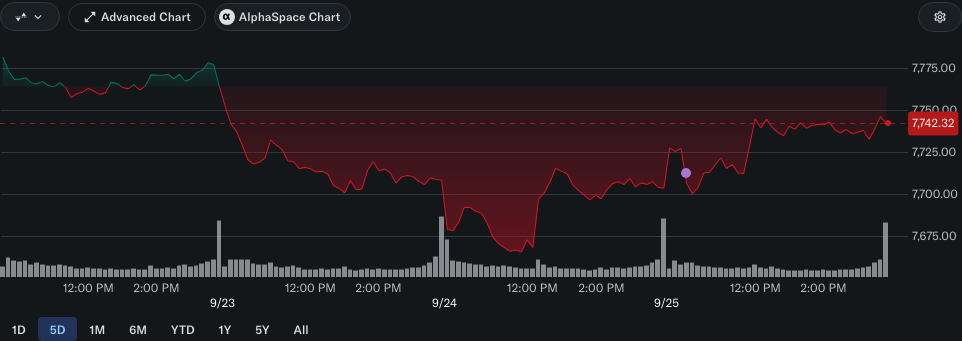
The S&P 500 finished the week ending September 25 up around 0.6%, closing at approximately 7,743:
- For the week, the S&P 500 rose 0.6%, the Nasdaq 100 jumped 2.1%, and the Dow shed 103 points.
- Treasury yields remained a dominant force all week, with the 10-year note closing at 5.163% on Friday after reaching its highest level since June 2007 on Thursday, while the 30-year bond ended at 5.488%, levels not seen since 2004. Markets are currently pricing in around a 66% probability that the Fed raises the federal funds rate by another 25 basis points at its next meeting.
- The Trump-Xi Washington summit ran September 23-25, the second head-of-state meeting between the two countries this year and the first Chinese state visit to Washington since 2015. The one concrete deliverable was Treasury Secretary Scott Bessent announcing that the US and China agreed to extend their soon-to-expire trade truce until January 10, a two-month extension of the agreement inked last year.
- Meta’s shares retreated on Friday but the stock was still up roughly 13% on the week, while Microsoft gained 3.7% after announcing plans to merge its consumer and workplace Copilot AI assistants, and Meta had surged around 12% on the week following a series of hardware releases tied to its Muse AI agent.
- Oil prices fell on Friday after news that the US and Iran moved closer to an agreement to lift naval blockades on tankers in the Persian Gulf and ease economic measures against Tehran. Oil had come down from nearly $110 the prior week, though it remains much more expensive than the roughly $72 it was fetching before the war with Iran began.
- Analysts are forecasting companies in the S&P 500 will report overall earnings growth of nearly 29% for the third quarter from a year earlier, according to FactSet, which would be the third straight quarter of growth better than 25% for the index.
All the best,
Cameron
——————-
PORTFOLIO UPDATE
What moved in the U.S. Light portfolio this week
BW LPG fell 5.6%, Bread Financial 5.2% and Danaos 4.4%. Those were the three biggest estimated drags on our portfolio. Kohl’s went the other way, up 8.2%. I couldn’t find a clear company-specific event behind any of those four moves this week.
Deutsche Bank fell 3.7%. On Wednesday, its CFO said third-quarter investment banking revenue could be flat or slightly below the same quarter last year. DB shares fell 4.5% in New York that day. The timing makes his comments a plausible explanation for the sharp fall. (CFO transcript; share-price history)
Pitney Bowes fell 2.8% for the week and about 4% over the past fortnight. It’s still up around 51% since we added it to the portfolio. I couldn’t find a clear reason for the recent decline. Profit taking after that run is possible, but I can’t verify it. (share-price history)
Drill down into the widget above to see different timeframes, or visit our live portfolio page.
——————-
SELLS
This section is for QAV Club Members only.
Register for your 14-day free QAV Club trial here.
If you're already a QAV Club member and seeing this message, please login via the top menu.
If you're a QAV Light member who wants to upgrade to QAV Club, go to your Account page (see Footer) and upgrade from there.
——————-
BUYS
This section is for QAV Club Members only.
Register for your 14-day free QAV Club trial here.
If you're already a QAV Club member and seeing this message, please login via the top menu.
If you're a QAV Light member who wants to upgrade to QAV Club, go to your Account page (see Footer) and upgrade from there.
And here’s my TikTok of the week.
@qavinvesting Does success come down to will power? Or your environment?
♬ original sound - QAV Investing - QAV Investing
** Please remember to review our Buying Guidelines to understand which cap bands you should be looking at and other important considerations.
DISCLOSURE
Please review our trading and disclosure policy.
FOR NEW MEMBERS
If you’re new to QAV Light, here’s a quick reminder on how it works.
- We send you an email every Monday advising which stocks we are adding to our Light portfolio.
- You can copy our trades, but please remember to review our Trading Guidelines to understand which cap you should be looking at and other important considerations. And consult a financial planner before making any decisions.
- We don’t recommend that you add stocks which are already in our portfolio. Their position on our buy list might have changed since we recommended them. Just start with the stocks recommended after you become a member.
- If one of the stocks we add breaches one of our sell conditions, we will sell it from our portfolio and you’ll get an email advising of the trade. Again, you can copy our trades, but seek financial advice before making any decisions. And please check your Rule #1 price (see Trading Guidelines).
- If you come across any QAV terminology that you don’t understand (eg Rule 1, 3PTL, Possibles, etc), please review our terminology guide or just email us for clarification.
That’s it for today!
If we decide to buy or sell something, we’ll let you know.
Got a question?
cameron@qavamerica.com
——————-