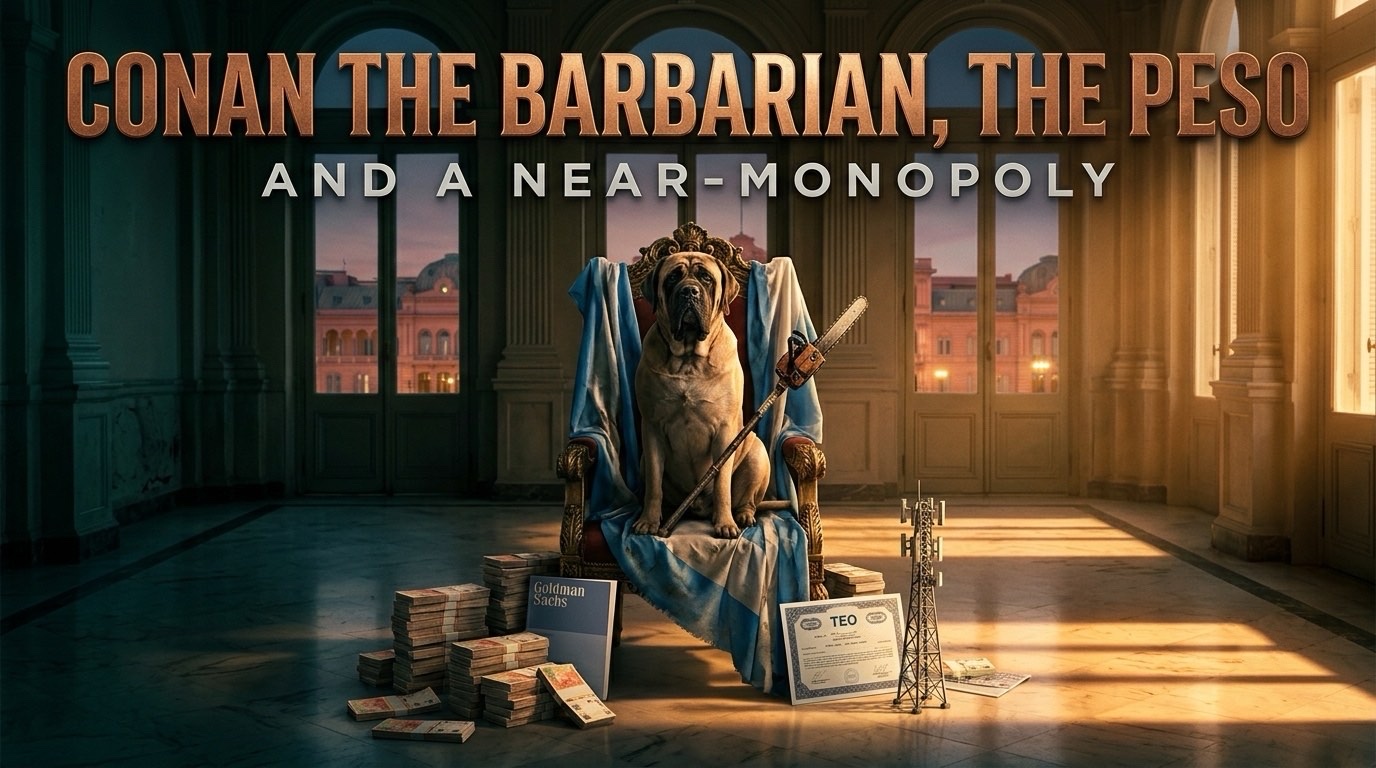
This week we do a full Pulled Pork on Telecom Argentina (TEO), a near-monopoly telco that owes much of its shine to one of the most unhinged political stories on the planet right now. Cameron walks through the Javier Milei backstory, dead dogs, clones, chainsaw economics and all, before getting into the actual numbers, which are genuinely solid. We also cover IBM’s ugly 25% overnight drop, Leslie’s pool company going haywire with trading halts every five minutes, and what the Strait of Hormuz chaos means for oil prices.
This week’s full episode is for QAV Club members only. The free episode is available below. Also check out our podcast archives link and our pages on Apple Podcasts or Spotify or watch clips on TikTok. Or visit our homepage to learn more about QAV and how it works as a value investing system that you can learn and apply to beat the market.
Transcription
QAV AMERICA 61 CLUB VIDEO
Cameron: [00:00:00] Welcome back to QAV America, episode 61, the 16th of July, 2026. TK, duh, how many ships passed through the Strait of Hormuz in the last 24 hours? Tony, do you wanna take a guess?
Tony Kynaston: could not guess. How many pass through safely, I think, is probably the answer. I’ll say none
Cameron: Well, it’s hard to tell. As we talked about the other day, I mean, you know, the US have been claiming they’ve been sneaking ships through. But according to everything I’ve read, maybe about 10 passed through in the last 24 hours, which is more than I would imagine. I don’t know how they’re not getting bombed or attacked, and the US has put a blockade on them apparently, but they’re getting through, so I don’t know.
I don’t know what the real– like with all of this stuff, no one knows what the real story is. You can’t trust any of them. They’re all crazy. It’s all lies and propaganda and fog of war and craziness going on
Tony Kynaston: Gee, I’d, I’d want to be paid a lot to be a ship [00:01:00] captain going through the Straits of Hormuz
Cameron: Right? Yes
Tony Kynaston: the only guarantee that Donald Trump’s gonna get you through okay.
Cameron: You’ve c- you’ve got a ship full of liquid, liquefied natural gas
Tony Kynaston: on a bomb.
Cameron: or oil. Yeah.
Tony Kynaston: Oh, dear.
Cameron: Uh, so yeah, it’s kinda crazy
Tony Kynaston: 20% to the US. Yeah.
Cameron: Yeah. Well, no, no, he’s, he’s, he’s reneged on that, Donald Trump. Yeah,
he’s not, he’s not, charging him, ’cause it was gonna be like $30 million a ship or something.
Tony Kynaston: And,
Cameron: Apparently, uh, Gulf countries went, “Ah, hold on a second. What? You, you’re doing what now?” Yeah.
Tony Kynaston: Well, the other thing is too, I, wouldn’t want to be an IBM stockholder this morning. Their share price went down 25% overnight.
Cameron: Yeah,
I, I didn’t really get a chance to drill down into that. What was that all about, do you know?
Tony Kynaston: it was a quarter up- quarterly update where they missed their targets and called out the [00:02:00] fact that a lot of their clients were diverting what was CapEx going to IBM for mainframes into cloud service for AI.
Cameron: Right
Tony Kynaston: So that’s kind of starting to bite for IT industry now as well.
Cameron: Interesting Well, uh, what else is in the, uh, US, uh, market news recently? Dow is up, S&P 500 is up, Nasdaq Composite was up. Um, oil is up.
Tony Kynaston: A little bit
Cameron: WTI and Brent all up.
Tony Kynaston: It’s a bit surprising. I mean,
Cameron: as much as
Tony Kynaston: they went up, but given that only 10 ships pass through, you’d think it’d be higher, wouldn’t you?
Cameron: You would. Um,
Tony Kynaston: Lot
Cameron: yeah.
Tony Kynaston: in that oil price, I think, at the moment.
Cameron: June CPI was released, uh, 14th of July in the US. Uh, headline CPI was down 0.4%. Annual rate down to three and a half from 4.2 in May, [00:03:00] which was below the consensus. So that all sounds good, but the Fed’s not buying it apparently. Markets still price a September hike at 63% odds, down from 75% the prior day. The new chair, Kevin Warsh, said, “That is not my view on readings that it’s mission accomplished.”
So we’ll see how it all plays out. Apple hit a record high. Amazon and Alphabet hit record highs. Well, they’re up 3%, enough is a record high. Microsoft’s up 3%. Semiconductors sold off hard again, though, due to Samsung results. SpaceX now below the $135 offer price, down 34% from its post-listing record price.
So what impact that has on other listings like Anthropic and OpenAI. I, I saw Anthropic’s numbers that they’re floating about for their [00:04:00] IPO. Insane. They’re m- they’re, like, uh, they’re making, like, $13 billion a month or something. A- and it’s all API pricing. It’s not actually, um, you know, uh, uh, monthly charges like people like me pay.
It’s all API stuff. And the numbers, you look at the numbers, it’s just going exponential what they’re earning from API pricing. It’s crazy. But anyway, um, closer to home, my, my star stock of the last few weeks, Leslie’s, the pool company, uh, was up 10% in a week after I bought it, and I was like, “You beauty.”
And then it crashed 27%, uh, below my buy price the other day, and it’s continued to fall. Um, it’s now trading at $2.97. I did get out of it a couple of days ago. I’m just bringing up my transaction list here. Can’t remember what price I sold it at. Um, I [00:05:00] bought it at $7.68 on the 18th of June. Went up 10% in a week.
I thought that was great. I sold it at $5.60 on the 14th of July, and as I said, it’s now down to $2.97.
Tony Kynaston: Mm-hmm.
Cameron: So nothing in the news except when you look in Stockopedia, the, the news section for it is, uh, hilarious. It’s, um. Hold on, let me try and bring this up again. Um, Leslie
Over the last week it’s just NASDAQ trade halt, volatility trading pause. NASDAQ resumed. NASDAQ trade halt, volatility trading pause. This, like, for yesterday, this happened at, uh, 12:27 AM it was a halt, resumed at [00:06:00] 12:32 AM. Then another halt at 12:33 AM, this is our time, I guess. Um, resumed at 10:30. Uh, oh yeah, it’s in American time.
So there was a halt at 10:27 AM New York time, then resumed at 10:32. Then at 10:33, another trading pause, resumed at 10:38. 10:43, another trading pause, resumed at 10:40. This goes on every few minutes all day. Trading halt due to volatility, and then it resumes trading. That’s all I can see in the, in the
Tony Kynaston: Wow. Sounds like they’ve sprung
Cameron: when
Tony Kynaston: the pool
Cameron: It was down 41%
Tony Kynaston: Wow. Oh
Cameron: Um, so gamma squeeze maybe, whatever that is. But anyway, there you go. That was my big excitement for this week. I sold it and I replaced it with the stock I’m gonna do a Pulled Pork on today, which is a good one with a absolutely bonkers story ’cause it’s all [00:07:00] about Argentina’s president Javier Milei.
I’m gonna be talking about Telecom Argentina, Tony. Ticker code TEO. Not sure if I should pronounce that TEO or Tayo. I’ll probably go with Tayo ’cause it sounds slightly Latin American-ish. You know, makes me sound like I’m very, you know, I talk like this. I do my best Al Pacino. I say sanitarium, not san- I say sanitarium, not sanitation.
You know?
Tony Kynaston: And of course, Argentina won the World Cup semifinal this morning, couple of hours ago.
Cameron: Did they?
Tony Kynaston: this
Cameron: Ah, good for them
Tony Kynaston: was evening in the US, yeah. Yeah,
Cameron: Messi play for them?
Tony Kynaston: Messi did, and he had a, he had a blinder. He scored a late goal and then set up a
Cameron: Good for him. Well, Argentina, buckle up ’cause man,
Tony Kynaston: 2-1. Yeah Yeah, and you’re off to the, [00:08:00] you’re off to the World Cup final too on Ma- Sunday night, so good luck
Cameron: I’ve had, uh, I’ve had a great time researching this story. I’m, I’m gonna try and not get too sidetracked, but, uh, uh, this is just, just gave me so much glee learning about this. We’ll start with, uh, Telecom Argentina. So, uh, they’re basically a monopoly, uh, ef- effective a monopoly for the moment, but it may not last in Argentina.
They trade under the brand names of Personal and Flow. Sounds more like a women’s monthly, uh, tracking app, but there you go. Um, your Personal Flow from Telecom Argentina. They’re simply known mostly as just Telecom, like Telstra used to be called here in Australia. They’re just called Telecom by most people in Argentina apparently.
They are listed as an ADR on the New York Stock Exchange. Each ADR is five of the underlying Argentine B shares. They’re listed back home in Buenos Aires as TECO2, [00:09:00] T-E-C-O-2. The, uh, Argentinian peso is known as the ARS or the arse, uh, because it’s in the arse end of the world, I guess. Um, it’s, uh, one ARS
Tony Kynaston: that’s harsh
Cameron: currently, one ARS is currently worth 0.0006723 US dollars.
I think it’s about
Tony Kynaston: for Aries, the ram
Cameron: C- could. Just not as funny though, so leave the humor to me.
Tony Kynaston: I’m not trying to be funny. I’m, I’m trying to stop s- whatever it is, 120 million Argentinian, Argentinians from sending us
Cameron: Messi turning up at our doorstep and kicking the ball into our nuts. Um, market cap’s about 5.8 billion US dollars. Share price is around 13.5 cents. Well, it was when I did my analysis on it. Let’s see, what is it today? Uh, closed. Well, it’s, market’s still open there. Yeah, 13.78 [00:10:00] now. And it’s up about 48% over the past year, up about 12% year to date.
So already had a bonkers run.
Tony Kynaston: Do you know why?
Cameron: we. I do, and I’m gonna tell you when we get into it. That’s, that’s why I’m doing this show, Tony. Uh, y- you, if you’ve been here before I’m gonna tell you why
Tony Kynaston: Oh, I’m just trying to insert myself into the conversation. You said you wanted to have a
Cameron: Oh,
Tony Kynaston: You said your throat was sore.
Cameron: uh, my throat is tired. Yeah, I just did an hour ranting about this on another show. Um, so I, I, I’ve adjusted the numbers for pesos when we get into the numbers section. So it’s, uh, this- True. Like, um- Pesos, yes. forecast that- I adjusted the numbers from pesos to USD
Tony Kynaston: to an ass?
Cameron: Well, one peso is an ass. That’s, I told you, the pi- the peso’s an ass.
The Ar- the Argentinian peso is an ass.
Tony Kynaston: You’re right
Cameron: Yeah, it’s all right. You’re making an ass of both of us [00:11:00] right now. Uh, Argentinian story. Well, no, so the Telecom Argentina story goes back to 1990 when Argentina privatized its state telephone monopoly, around about the same time that we privatized our telecom here in Australia.
Uh, it was formerly known as Entel, E-N-T-E-L, and they literally cut the country in half. The northern half went to what became Telecom Argentina, and the southern half went to Telefonica of Spain. So for 30 years there was a duopoly, north and south. Argentina, by the way, the na- Do you know where the name Argentina comes from, Tony?
You know I like a little bit of country etymology
Tony Kynaston: I do not, Cam
Cameron: The Latin argentum, silver. So the, uh, your, your invaders, um, from Spain got there, saw the silver river, the Rio de la Plata, and thought it was just carrying [00:12:00] silver from the mountains. It was so silvery they thought, “We’ve discovered s- a river, a literal river of silver.
Let’s call the country Argentina.” Turned out there was not a river of silver. Um, so that’s basically, uh, probably a good metaphor for investing in Argentina in the last 100 years. What looks like silver is not necessarily silver. The modern company was born in 2018 when they merged with Cablevision. Uh, at the time, the biggest cable and broadband operator in the country, and owned, uh, up until around about that point by a billionaire who I’ll get, uh, like the fourth richest guy in Argentina, who also hired an economist by the name of Javier Milei, who was his chief economist.
Uh, which is, it’s always great when your president used to work for one of the richest guys in the country. There’s always a, there’s always a good connection in Latin America. Anyway, so you’ve got this boring old phone company, [00:13:00] basically what you’d expect, mobile, home internet, pay TV, landline, all on one bill.
And of course, you know, I, I can’t talk about Argentina without talking about what’s going on there at the moment because this really, the reason TEO is on our buy list is because of the strength or weakness of the peso, the ARS, uh, to the USD. That’s really at the end of the day, what’s going on here. It, it is a good business.
It does make money, but the reason it’s on our buy list is because of the rerating of the peso. So Javier Milei, the guy that Elon Musk got his chainsaw from, uh, literally, um, is a bonkers, absolutely bonkers guy. I mean, I had a vague idea of this guy. I knew he was some sort of right-wing love child that Trump and Elon loved.
I hadn’t really drilled, you know, my, my knowledge of Argentinian history finishes with Don’t Cry For Me Argentina and Che Guevara and, uh, that kind of stuff. [00:14:00] Um, this guy, completely bonkers story. Um, short story, abused by his parents. Uh, who he doesn’t speak with, has no contact with his parents, but has a crazy close Targaryen-ish relationship with his sister, Karina, who was the head of his presidential campaign, and I think is, uh, was maybe and still is his presidential chief of staff, although she’s got caught up in some corruption scandals over there.
I’m not exactly sure of her current status. Um, according to some things I read, she’s either the second most powerful person in Argentina or according to one, uh, guy I read who was interviewed, he said, “In Argentina, we say that Javier Milei is the most important person in the government of Karina Milei.”
So there you go. For 15 years, he worked at the private company Corporación América as the chief economist and financial advisor to Eduardo Eurnekian, who is this [00:15:00] media billionaire, was the, is the, I think still the fourth richest person in Argentina. Did own, uh, Cablevision, but sold it and then had a bunch of real estate development businesses and, you know, horses and all the usual stuff that g- rich guys like you like to dabble in.
Um, Javier wrote some books on libertarian economics. He’s a big fan of your Milton Friedmans and godlike guys like that, Ayn Rand. Came to prominence, uh, on a, on Argentinian chat shows, TV chat shows, by saying outrageous things like, and this is a quote, “The state is the pedophile in the kindergarten with the children chained up and slathered in Vaseline.”
I’m sure I think that’s Milton Friedman he’s quoting there. Um, he is an, he is an open sexual libertine as well as an economic libertine. He’s spoken about being a proponent of [00:16:00] free love, tantric sex, and enjoying the odd ménage à trois. Not sure if his sister’s involved in those, that wasn’t in my background research, but, uh, you know, he likes to live it up.
He’s obviously, if you’ve seen a photo of him, he’s got these massive big meat chop sideburns, crazy sort of, uh, conductor of the New York Philharmonic hair. He looks like he’s stepped out of a ’70s, uh, cop show or something. My favorite bit though, of this whole story, is his dog. Did you read about his dog?
Tony Kynaston: not. I, I,
Cameron: Oh
Tony Kynaston: I really read more about the economics of all this, but anyway.
Cameron: Oh my God. Well, this is what’s the basis of the economics. So he had a dog, uh, an English Mastiff called Conan the Barbarian, who he loved and died in 2017, sadly. Milei, who’s not [00:17:00] married, um, doesn’t have children, couldn’t accept the death of his dog, so he visited a medium to communicate with his dead dog.
And in their conversations, Conan revealed that they were best friends in a past life when they were both Roman gladiators, and told Milei that he should run for president. So he took advice from his dead dog, still wasn’t happy just dealing with it, uh, via a medium, so he went to the US and paid $50,000 to have it cloned, and then that was so successful he had it cloned five times.
And he’s named all of them after economists like Milton Friedman.
Tony Kynaston: And, and Conan the
Cameron: but the. Well, the most recent clone is also named Conan the Barbarian, and he reportedly believes it is the [00:18:00] reincarnation of the original, not just a clone, but a reincarnation. His sister, you know, he wasn’t that comfortable having to, you know, get all of this information from the other medium, so his sister trained to become a medium, so now she channels the original dead Conan, um, or maybe the reincarnated Conan’s thoughts to the president to guide his economic agenda.
I say all of this because the guy running Argentina’s economy
Tony Kynaston: You know, it just always strikes me is there are so many business opportunities out there which I keep missing, like being spirit medium to a dead dog to the president of Argentina.
Cameron: Yeah. I mean, yeah. I mean, honestly, I had a whole business plan written around that. I was too scared to bring it to you 10 years ago. I should have, I should have. Out of all the crazy ideas I’ve brought to you [00:19:00] over the years, that one I drew the line at that one. But in retrospect, you know, we could have got in on the ground floor
Tony Kynaston: Yeah. I can see why Elon is a good friend of this guy.
Cameron: Yes, right. And if, look, if history has taught us anything, Tony, you know I’m an hist- I’m an historian. Um, my day job is doing history podcasts, and if history’s taught us anything, it’s putting batshit crazy people in co- in charge of countries is always a good idea. If there’s. The n- number one good idea in history is putting children in charge of countries, making them kings and emperors.
That always works out well.
Tony Kynaston: Mm-hmm.
Cameron: The second-best idea is putting people that are batshit crazy in charge of countries. It never goes badly. Uh, I think my study of hi- oh, wait, no. It always goes badly. No, it’s the other one. Anyway, so when he, when he got elected, and he did, uh, there’s this period in 20, you know, the last few years, last 10 years, when [00:20:00] people like putting crazy people in charge of large, complicated moving pieces.
He literally took a chainsaw to the budget, closed 10 out of 19 government ministries by executive decree as soon as he stepped into office. Between late 2023 when he got elected and 2025, social spending was slashed by 17%, i- environmental programs were completely gutted. He’s a climate change denialist.
And, uh, at the same time, the security budget was vastly inflated. But he has managed to slow hyperinflation, which was running at 211% in 2023. As of late 2025, it was down to 31.5%, which is still insane, but a lot better than 211%.
Tony Kynaston: Yeah. So isn’t it interesting though how the pendulum swings can? I mean, the– from being [00:21:00] welfare-based budgeting, everyone gets a, you know, basic income or whatever, which results in hyperinflation and central banks printing money to a populist person getting in to all that. But both sides bring problems, don’t they?
Cameron: Well, and, and you know, the, the welfare state in Argentina was started by Juan Perón, who was a populist right-wing president, but also had this, you know, I guess he wanted to stop people rising up and cutting off his head, so he, uh, started a huge welfare program and it just ballooned
Tony Kynaston: Hmm.
Cameron: over decades when they had other fundamental economic issues.
But yeah, this has come at a huge social cost. Um, workers’ rights have been eliminated. 110,000 Argentinians with disabilities have lost their benefits. The official poverty rate has nearly halved, but critics say that’s because the organizations that measured it were gutted and so
Tony Kynaston: [00:22:00] Yeah,
Cameron: one’s– It’s easy to come up with good numbers when there’s no one actually counting the good numbers.
It’s, um, yeah. So homeless– Uh, official data shows that homelessness has risen about 57% just in Buenos Aires, which is the richest city in the country. So imagine what’s happening in other parts of the country. I, I, I say all this, A, because it’s fun, and B, because mostly because it’s fun, and B, because the success or lack thereof of the Argentinian economy and therefore TIO, TEO has a lot to do with what happens from here.
I mean,
Tony Kynaston: Yep
Cameron: Milei is able to, you know, keep these numbers under control and stay in power, it may continue to look good. If it goes the other direction and he has to backpedal or he gets, you know, removed from office and, and, and, and the opposition come in and put all this, you know, put all this stuff back [00:23:00] the way it was, the peso could go in the opposite direction, inflation could go in the opposite direction, and that could have a serious impact on the profitability or lack thereof of the telecommunications business as long as, uh, along with everything else.
Tony Kynaston: Yeah. That is a risk, isn’t it?
Cameron: It’s a huge risk, but, you know, it’s also forecasting, which we don’t do.
Tony Kynaston: Yeah.
Cameron: I’m gonna talk about the business as it is today
Tony Kynaston: And I think just before you do that, just probably the big, the big thing which has, um, supported all this economically is that in 2024, Milei stopped the central bank from printing pesos to finance government debt. So the, the magic pixie dust has, has been turned off at the central bank printing press in Argentina
Cameron: Yeah. Whether that’s a good thing or a bad thing, uh, well, is to be s- yet to be seen. But, you know, we know that that doesn’t end well, you know, magic printing presses. Unless you’re the US [00:24:00] and you can get away with it ’cause you have the reserve currency
Tony Kynaston: one point I was gonna make was that this has gotta be in the future for the US if it doesn’t change tack. Um, at some stage, yeah, we’ve got heaps and heaps of debt supported by bank printing money. It’s eventually gonna end up like South America
Cameron: Oh, it’s also supported by the world n-needing to buy US dollars in order to fund their trade until they don’t. Yeah, exactly. Anyway, back to TIO. So the core business, um, as, as I said before, they’re basically the default telecom for all of Argentina now. They own the towers, the pipes, they sell the plans, they bill you, landline, cable TV, mobile, broadband, 41 million service relationships across mobile and fixed.
Mobile is the engine room. It’s about 54% of service revenue. Um, and they’ve [00:25:00] been through sort of an interesting period. So in February last year, 2025, Telecom bought Telefonica’s entire Argentina mobile business, TMA, for about 1.245 billion US dollars. So essentially the, the two halves of this privatization, one swallowed the other.
Tony Kynaston: Mm-hmm.
Cameron: The duopoly of 30 years became a near monopoly. There are still other operators in the market, but these guys own most of it now. They’re now the dominant mobile operator in the country, and this really showed up in the most recent numbers. Q1 2026 was the first quarter with the full three months of that business baked in, and it was a corker.
Quarterly revenue of about 2.36 trillion pesos, which is basically, um, Elon Musk’s net worth as [00:26:00] well. Um, but yeah, it’s dropping, um, as the share price of SpaceX drops. About 1.7 billion US dollars for the quarter, which was up 34% in real terms, meaning if you strip out inflation. So that’s not a bad, not a bad quarter, 34%.
Mobile revenue was up 50%. M-Most of that, about 41% of that came from the Telefonica business, but that means that 9% was real growth just from their existing business. So again, not too bad. But here’s the number that I really like. Their revenue per customer was up 18.7% in real terms ahead of inflation. So good, it’s good to have a monopoly.
Um, in our Australian show, you talked about IGL, who basically has a printing, commercial printing monopoly in Australia for catalogs, uh, retail catalogs. And, you know, you talked about how Warren Buffett loves a [00:27:00] good monopoly.
Tony Kynaston: Mm-hmm.
Cameron: These guys, very similar
Tony Kynaston: Well, I think if I can just interject here again, have you heard of Decree 690 in Argentina?
Cameron: Uh, no. What’s Decree 690?
Tony Kynaston: it was, uh, a law which said that, uh, telecommunication services were designated as essential public services the government could therefore cap the prices that Telecom could charge. Of course, been swept away by Milei. So another reason why revenue per customer is up. They’ve been able to put the prices up
Cameron: Right. Charge what you want. Let the market work it out
Tony Kynaston: Yeah, judge what the market will bear
Cameron: Yeah. So, uh, net income was 643 billion pesos versus 124 billion a year earlier. So a fivefold jump in their net income. But here’s the trick. Nearly all of that, 631 billion of the [00:28:00] 643, was due to the peso currency, uh, exchange, right?
Tony Kynaston: Mm-hmm.
Cameron: Now, you know, they’re making money.
They’re a good business. They’re a solid business. But the reason they look as good as they look on our buy list is largely because of a strengthening of the peso. And, uh, you know, the way I look at that is that’s legit. This is part of the operations of the business. It’s not really a mirage. It’s, it’s a, it’s a real operating line of the business, but it could go either direction, you know.
Um, it could go up or it could go down
Tony Kynaston: Just to drill into that too and just, you know, we– it’s kind of an abstract concept that the strengthening of the peso helps the business, but I’ll, I drilled down into that to see exactly what it meant. And of course, the first thing it meant was that, the ratings agencies have, um, vastly increased the ratings on, [00:29:00] on the debt issued by this company.
So I think it now. The sovereign credit rating for Argentina is now B minus, which is, you know, not as great as the US or Australia or anything like that, but a lot better than what it was. And that, that ratings increase makes those bonds more investable, and therefore the interest rate comes down
So the TIO last year reduced its debt cost by 15.6%, um, and were able to attract a lot of, uh, institutional investments from the US. People like Goldman Sachs and BNP Paribas are now on their register because of that, um, increase in the, in the debt rating for the company. So that’s an important point.
Cameron: Yeah. I mean, i- i- it’s, it’s a good thing and I guess the market is in some ways, uh, indicating that they think it’s gonna continue and the, the cost of the debt is gonna continue to drop for these guys. But, um, again, I mean, market [00:30:00] doesn’t know what’s gonna happen from one day to the next in terms of Argentina’s overall government and economy.
So as we know, markets get stuff wrong all the time
Tony Kynaston: They do, but they’re also not a bad forecaster, um, at least, you know, for sort of six to nine months in advance. So if, if, if big companies are, are putting their money in and are believing the ratings agencies, at least it’ll stay stable for a while, I would’ve thought.
Cameron: Yeah, all right, Mr. Polymarket. I read a great breakdown on the history of Polymarket, uh, by the way, the other day. Oh man, there’s a story.
Tony Kynaston: Uh
Cameron: Anyway, that’s for another time, and how it came out of the, uh, Pentagon,
Tony Kynaston: Okay
Cameron: um, and the NSA. So look, the, the cheap price to operating cash flow, I’ll g- I’ll get into the numbers in a minute, but, um, is the, the price to operating cash flow is real.
Uh, it’s a, it’s a real business that’s generating real money and has a real near monopoly. Just wanna point out for people listening that, [00:31:00] um, you know, the, the value of the peso against the USD is, uh, playing a big role in this. The other thing that we need to be aware of is the antitrust regulator, uh, did approve the acquisition of the Telefonica business, but with some caveats.
So they paid, as I said earlier, $1.245 billion to buy this business. Last month, June 18th, Argentina’s Antitrust Tribunal approved the deal, but with strings attached. They have to sell off at least 6 million mobile customers and the spectrum that goes with them, which turns into 4 million in Greater Buenos Aires and 2 million in the rest of the country.
Plus, they have to divest about 211,000 home internet customers across 28 towns. Plus, there are behavioral conditions on their corporate and wholesale business. So they bought growth, but the regulator’s gonna make [00:32:00] them hand a chunk of it back, probably to create one or a number of new competitors. We’ve seen that here with, uh, Telstra.
Um, you know, it can play out a number of ways, so could be a good thing, could be a bad thing for customers. It just depends on how it all plays out. But for the moment, um, they’ve got this monopoly, and they’re making money hand over fist. But there’s obviously this honest macro risk with Argentina. Growth is back about 4%.
Inflation, as I said, is down from over 200% to the low 30s. Milei won the midterms. He’s got IMF money. He’s got a US currency line behind him. But you’d have to say that the economy there is still fragile at best. Country’s dollar reserves are barely above zero. It owes $20 billion this year. The bond [00:33:00] market is still treating Argentina as sort of a risky country.
Um, bonds that mature after Milei’s term yield way more, which seems to suggest that they’re thinking that another government might come in and just tear up all of the reforms that he’s done. But it, you know, the, the cost of the debt for TIO goes up and down with the value of the, the peso against the USD.
So at the moment it’s looking good. Share market has loved it. As I said, it’s, uh. A year ago it was trading about $8.83. It’s now trading at $13.85. In the last month– Oh, it’s actually down now from the last month slightly. But it’s, it’s, it’s had a corker ride over the last year. It’s down a little bit. It is a buy though, um, from our, uh, three-point trend line perspective.[00:34:00]
Just, uh, some numbers for the rest of the balance sheet. Debt’s actually heading the right way. As you said, net debt’s down about 16% in real terms. Roughly about 2.9 billion US dollars of net debt, and that’s improving. Capital spending ran hot. It’s up about 85%, m- mostly the cost of integrating the Telefonica network.
But after years of paying nothing, shareholders just cleared the way for up to 300 million US dollars of dividends this year. That’s good. The ownership is controlled by two camps, Cablevision Holding, which, uh, as I said before, isn’t owned by that billionaire. He sold it off, um, almost 10 years ago. Um, but the, the company that it became owns about 39% of the stock of this now.
And Fintech, which is the vehicle of a Mexican financier, David Martinez, [00:35:00] holds the control block. So, um, he’s also been trimming his holdings. He’s trimmed about 1% in this quarter, selling off a bit. I guess the share price had gone up, whether that’s just profit taking or something, I don’t know. Um, their, their auditor is PwC, gave them a clean opinion, so that’s good.
If I get into the numbers, um, based on $13.55 was where the price was when I did my analysis, so it’s gone up a little bit, about 23 cents since then, but it shouldn’t change the numbers a great deal. And these are the numbers after I twigged, uh, not twigged, tweaked the ARS to USD conversion. It was a bit higher originally, but, you know, I had to change the IV1 and IV2 to map to the conversion rate.
Um, quality score, the QAV quality score came in at 75%, which is pretty good. Said on the last show I did. Yeah, we don’t often see stocks on the buy list with a 75% quality [00:36:00] score. Uh, yeah, I’d say, what would you say? Mm, less than half of the time they’d be up over 75%?
Tony Kynaston: I’d say so
Cameron: But it’s good. If they’re over 75%, it means that they look really good for us.
And it came in finally with a QAV score of 0.258.
Tony Kynaston: Mm-hmm.
Cameron: As I, you know, um, I, I said to you the other day, I think there was, like, over 100 stocks on our US buy list again this week, so no lack of opportunity. And this was up the top. It was, like, number, number two, I think. I don’t think it was number one. I think it was number two.
So a really good score. Um, looking at its intrinsic value, so for new listeners, we have two intrinsic values that we look at. One’s based on current financial position, one’s looking at next year’s, um, EPS. Our IV number one, um, came in at $3.70 versus a share price of 13 bucks, so it’s way below the share price.
But our IV two was [00:37:00] $15.87, so it, um. You know, our share price is under that, so I could score it for that. The price to book is 1.07, so the share price is a little bit above the price to book. Couldn’t score it for that, but it did pass the book plus 30 test, and I could score it for that. Price to operating cash flow, for new listeners, we don’t look at price to earnings as much as price to operating cash flow.
Tony thinks that’s a cleaner number to look at, harder to, harder to fudge, harder to game. The price to operating cash flow or the Pr/OpCaf for this is 2.91,
Tony Kynaston: Mm-hmm.
Cameron: so payback period of less than three years on a Pr/OpCaf basis, so that’s pretty, pretty good. Um, average daily trade volume is around about six million, so big enough for most investors.
If your portfolio parcel size is, um, one, 1.25 million, this should be okay. Anything less than that. The [00:38:00] earnings per share for this trailing 12 months was 72 cents. The forward-looking earnings are projected to be $1.53 for the next fiscal year, so almost doubling its EPS, so that’s good. Um, had a Stockopedia stock rank of 80 and a quality rank of 60, an F score of seven, which is really good, really solid.
The equity growth has been positive. Doesn’t have a recent three-point upturn, as you can probably imagine, because the share price has gone up 48%. Dividend yield is 0.34%, so that’s not gonna be higher than the debt rates, so we couldn’t score it for that. Bottom line though is, you know, just looking at the numbers really, really solid.
Leave out the Argentinian economy’s run by a crazy guy [00:39:00] and what that means for the future. Uh, that aside, uh, and the, and, you know, the peso to USD conversion risk, on paper, I think this is, this is a classic sort of value buy. Um, big business, generates a lot of money, has a moat, um, and we can get it really, really cheap.
Tony Kynaston: Yeah,
Cameron: do you think, TK?
Tony Kynaston: oh, I think it’s a. You’re right, it’s a classic value buy, isn’t it? Um, near monopoly in a country, in the business, um, and throwing off lots of cash. Of course, the only risk is the elections in 2027. Um, and I guess there’s a, there’s always a risk the elections don’t go ahead in these kinds of situations too, I guess.
But, um, yeah, if there is a government change, they may change their, uh, economic. Well, they definitely will change their economic approach, and that might change the peso relationship to the US dollar. It might change the s- the policies of the central bank, [00:40:00] et cetera, so that’ll have big impacts. To see whether if a new government comes in from the opposition, whether they do privatize, uh, nationalize this company again, because sometimes even though people are paying more for their services, they might be getting better service, and they recognize that, so that’ll be an interesting, um, development as well.
But, on the surface of things and looking at it this year, it’s definitely a, um, a very strong company to invest in.
Cameron: And if it goes the wrong way like Leslie’s, then we will sell it. All right.
Tony Kynaston: Interesting.
Cameron: You, TK?
Tony Kynaston: Economically though. I mean, apart from all the craziness of the leaders, you’d have to say there’s. Yeah, it keeps happening time and time again. These guys have got the y- I would say have got the economics right. They’ve got debt under con- government debt under control.
They’ve got central bank policy under control. They’re providing better for business, but [00:41:00] then they don’t have the welfare side under control. So y- you know, the. You would. Perhaps they will, as Perón did when he was a right-wing, uh, uh, government in the country. They might actually improve welfare between now and the election, um, which will help things.
But yeah, it’s, uh, objectively an in-
Cameron: f-
Tony Kynaston: situation.
Cameron: Fingers crossed that Conan the Barbarian, um, decides to take care of the poor and the, the dispossessed in Argentina.
Tony Kynaston: Do you think the CEO of Tao has a bull mastiff? So I can go and, uh, talk to the
Cameron: Yeah,
Tony Kynaston: Maybe he’s, maybe he’s called
Cameron: yeah.
Tony Kynaston: He’s
Cameron: Bullmastiff Club.
Tony Kynaston: one,
Cameron: Yeah,
Tony Kynaston: four. yeah.
Cameron: One and two were good. Uh, the sequels, Terminator sequels, never good. I ne- I never saw the Conan
Tony Kynaston: they
Cameron: reboot.
Tony Kynaston: they say if you keep recloning clones, they, they do degrade.
Cameron: There was a great Michael Keaton film about that, [00:42:00] wasn’t there? Did you ever see that?
Tony Kynaston: I think it was called. Yeah.
Cameron: There, that sounds right. He kept clo- the clones kept cloning themselves ’cause they g- didn’t wanna do the work.
Tony Kynaston: Yeah.
Cameron: That was a good film.
Tony Kynaston: It was.
Cameron: All right. Thank you, TK. That’s all I got for you.
Tony Kynaston: Go Argentina in the World Cup.
Previous Pulled Porks
Here’s the performance of the “pulled porks” (eg deep dives) we’ve done on the show in the past.
| Ticker | Company | Covered | Price then | Price now | Return | Ep. |
|---|---|---|---|---|---|---|
| VLGEA | Village Super Market | 21 Sep 2026 | $44.74 | $43.40 | -3.0% | 71 |
| OMF | OneMain Financial | 14 Sep 2026 | $62.75 | $56.83 | -9.4% | 70 |
| ARDT | Ardent Health | 7 Sep 2026 | $10.91 | $12.06 | +10.5% | 69 |
| SND | Smart Sand | 1 Sep 2026 | $5.27 | $5.27 | +0.0% | 68 |
| CRGY | Crescent Energy | 25 Aug 2026 | $13.85 | $13.50 | -2.5% | 67 |
| SLDE | Slide Insurance | 18 Aug 2026 | $21.60 | $27.11 | +25.5% | 66 |
| RJET | Republic Airways | 10 Aug 2026 | $21.39 | $16.58 | -22.5% | 65 |
| BBDO | Banco Bradesco SA | 3 Aug 2026 | $3.44 | $3.76 | +9.3% | 64 |
| RM | Regional Management | 27 Jul 2026 | $41.65 | $33.57 | -19.4% | — |
| PBR | Petrobras | 20 Jul 2026 | $17.97 | $25.66 | +42.8% | 62 |
| TEO | Telecom Argentina | 14 Jul 2026 | $13.47 | $13.04 | -3.2% | 61 |
| FG | F&G | 7 Jul 2026 | $28.55 | $20.37 | -28.7% | 60 |
| KSS | Kohl's | 1 Jul 2026 | $17.34 | $22.16 | +27.8% | 59 |
| CARE | Carter Bankshare | 23 Jun 2026 | $31.00 | $30.37 | -2.0% | 58 |
| AERO | Aeromexico | 18 Jun 2026 | $17.34 | $15.26 | -12.0% | 57 |
| NRIM | Northrim Bancorp | 1 Jun 2026 | $24.71 | $23.65 | -4.3% | 55 |
| MGA | Magna International | 27 May 2026 | $65.20 | $63.83 | -2.1% | 54 |
| BWLP | BW LPG Limited | 18 May 2026 | $21.06 | $25.22 | +19.8% | 53 |
| KNOP | Knot Offshore Partners Com Unt | 14 May 2026 | $10.78 | $9.99 | -7.3% | — |
| GSL | Global Ship Lease | 13 May 2026 | $41.79 | $41.83 | +0.1% | — |
| DB | Deutsche Bank | 4 May 2026 | $31.11 | $32.25 | +3.7% | 51 |
| UEIC | Universal Electronics | 29 Apr 2026 | $4.25 | $5.62 | +32.2% | — |
| OPRT | Oportun Financial Corp. | 20 Apr 2026 | $5.88 | $9.34 | +58.8% | 49 |
| PAGS | PagSeguro Digital | 13 Apr 2026 | $10.67 | $11.44 | +7.2% | 48 |
| CVGI | Commerical Vehicle Group | 6 Apr 2026 | $3.56 | $2.86 | -19.7% | 47 |
| PBI | Pitney Bowes | 30 Mar 2026 | $10.86 | $17.40 | +60.2% | 46 |
| KODK | Eastman Kodak | 23 Mar 2026 | $7.83 | $9.33 | +19.2% | 45 |
| GPRK | GeoPark | 17 Mar 2026 | $8.77 | $11.55 | +31.7% | 44 |
| MUR | Murphy Oil | 9 Mar 2026 | $34.55 | $42.96 | +24.3% | 43 |
| NBR | Nabor Industries | 3 Mar 2026 | $77.80 | $81.02 | +4.1% | 42 |
| BFH | Bread Financial | 28 Feb 2026 | $70.86 | $108.63 | +53.3% | 41 |
| SHG | Shinhan FInancial Group | 17 Feb 2026 | $69.83 | $69.82 | +0.0% | 40 |
| EC | Ecopetrol | 3 Feb 2026 | $12.57 | $17.24 | +37.2% | 38 |
| CHRD | Chord Energy Corporation | 24 Jan 2026 | $95.53 | $150.85 | +57.9% | 37 |
| AMTD | AMTD IDEA Group | 20 Jan 2026 | $1.02 | $1.02 | -0.4% | 36 |
| VLRS | Controladora Vuela Compania de Aviacion SAB de CV | 13 Jan 2026 | $9.45 | $5.66 | -40.1% | 35 |
| TUSK | Mammoth Energy Services, Inc. | 10 Jan 2026 | $2.45 | $2.76 | +12.7% | 39 |
| XIFR | Xplr Infrastructure | 6 Jan 2026 | $10.17 | $9.89 | -2.8% | 34 |
| AMCX | Amc Networks | 1 Jan 2026 | $9.52 | $9.64 | +1.3% | 33 |
| ZD | Ziff Davis, Inc. | 16 Dec 2025 | $36.48 | $57.03 | +56.3% | 32 |
| VALE | Vale SA | 11 Dec 2025 | $12.90 | $12.70 | -1.6% | 31 |
| AER | AerCap Holdings NV | 29 Nov 2025 | $131.82 | $147.87 | +12.2% | 30 |
| KEP | Korea Electric Power Corporation | 29 Nov 2025 | $16.74 | $10.73 | -35.9% | 29 |
| PCG | PG&E Corporation | 24 Nov 2025 | $15.67 | $13.15 | -16.1% | 28 |
| CALY | Topgolf Callaway Brands Corp. | 12 Nov 2025 | $10.60 | $14.05 | +32.5% | 27 |
| CALM | Cal-maine Foods, Inc. | 23 Oct 2025 | $94.56 | $60.61 | -35.9% | 25 |
| AAL | American Airlines Group Inc. | 20 Oct 2025 | $13.78 | $12.24 | -11.2% | 26 |
| DCH | Dauch | 9 Oct 2025 | $6.16 | $4.86 | -21.1% | 24 |
| CYH | Community Health Systems, Inc. | 3 Oct 2025 | $3.01 | $2.82 | -6.3% | 23 |
| MEOH | Methanex Corporation | 15 Sep 2025 | $39.81 | $63.14 | +58.6% | 21 |
| SUZ | Suzano Inc. | 1 Sep 2025 | $9.73 | $8.45 | -13.2% | 20 |
| KE | Kimball Electronics, Inc. | 26 Aug 2025 | $28.65 | $26.48 | -7.6% | 19 |
| TITN | Titan Machinery Inc. | 14 Aug 2025 | $18.98 | $22.89 | +20.6% | 18 |
| GTN | Gray Media, Inc | 7 Aug 2025 | $4.42 | $4.62 | +4.5% | 17 |
| SENEA | Seneca Foods Corporation | 30 Jul 2025 | $102.12 | $162.15 | +58.8% | 16 |
| BHC | Bausch Health Companies Inc. | 22 Jul 2025 | $6.32 | $6.45 | +2.1% | 15 |
| SSL | Sasol Limited | 17 Jul 2025 | $4.99 | $16.19 | +224.4% | 14 |
| ZEPP | Zepp Health Corporation | 11 Jul 2025 | $2.98 | $2.76 | -7.4% | 13 |
| PKX | POSCO Holdings Inc. | 1 Jul 2025 | $48.49 | $55.85 | +15.2% | 12 |
| PDS | Precision Drilling Corporation | 27 Jun 2025 | $47.78 | $91.81 | +92.2% | 11 |
| IX | Orix Corporation | 19 Jun 2025 | $21.00 | $37.01 | +76.2% | 10 |
| JXN | Jackson Financial Inc. | 11 Jun 2025 | $83.00 | $130.17 | +56.8% | 9 |
| IHS | IHS Holding Limited | 30 May 2025 | $5.38 | $8.43 | +56.7% | 7 |
| F | Ford Motor Company | 21 May 2025 | $10.80 | $11.90 | +10.2% | 6 |
| ENIC | Enel Chile SA | 14 May 2025 | $3.97 | $4.42 | +11.3% | 5 |
| CM | Canadian Imperial Bank Of Commerce | 8 May 2025 | $63.76 | $115.01 | +80.4% | 4 |
| DAC | Danaos Corporation | 2 May 2025 | $82.47 | $158.49 | +92.2% | 3 |
| CX | Cemex Publicly Traded Stock Corporation With Variable Capital | 28 Mar 2025 | $5.66 | $10.39 | +83.6% | 2 |
| ZIM | Zim Integrated Shipping Services Ltd | 13 Mar 2025 | $17.97 | $29.15 | +62.2% | 1 |
3 more recent picks from the last 30 days are available to QAV America members — members hear every deep dive a month before it appears here. Become a member
Returns exclude dividends and are measured from the price on the day each stock was covered on the show. Prices as of Wed 21 Oct 2026, 8:48 pm ET. Updated automatically. Not financial advice.