Hi QAVVERS,
The markets are still going nuts, despite (or perhaps because of) a lot of crazy signals for “Bad Things (™)” on the horizon. As always, we just keep to our knitting and let tomorrow take care of tomorrow.
AUSTRALIAN MARKET UPDATE
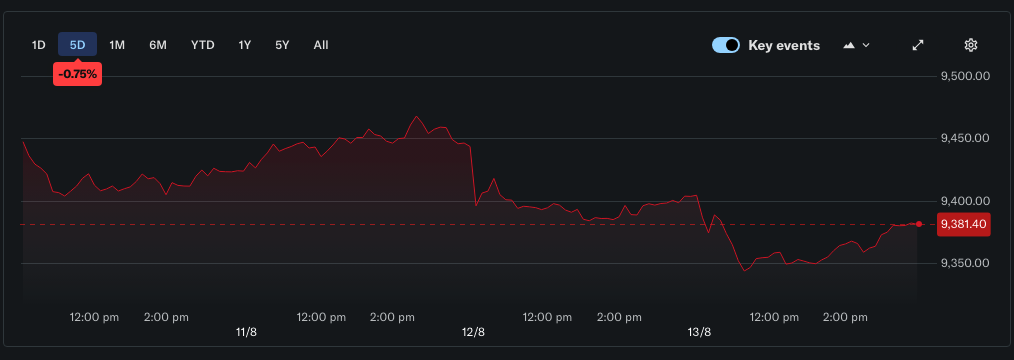
The All Ordinaries dipped roughly 0.75% this week to around 9,381, giving back a small portion of the prior week’s 3.37% surge.
-
The RBA held the cash rate steady at 4.35% at its 11 August meeting, its second consecutive on-hold decision, and the ASX 200 consolidated near record highs in the immediate aftermath.
-
RBA Governor Michele Bullock said financial conditions remained restrictive and stressed that slower economic growth and less labour-market tightness were still needed to bring inflation down.
-
Australian shares retreated from near all-time highs after Commonwealth Bank reported an $11 billion full-year profit but joined its big four rivals in flagging falling mortgage applications, rattling confidence in the broader economy.
-
Earnings season stepped up a gear on Thursday with Telstra, Origin Energy, and the ASX itself among the large number of companies releasing results.
US MARKET UPDATE
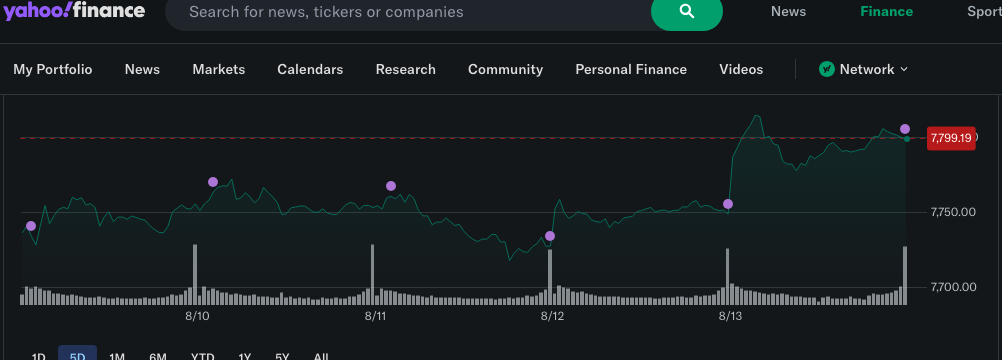
The S&P 500 pushed to a fresh all-time high above 7,800 this week, capping back-to-back gains into Wednesday and Thursday:
-
Stocks were driven higher mid-week as more evidence of moderating inflation reinforced bets the Fed will refrain from raising interest rates next month, with back-to-back gains pushing the S&P 500 toward fresh all-time highs.
-
July’s headline CPI rose just 0.1% monthly and core CPI climbed 0.2%, both in line with consensus, and major indexes extended gains after the data freed markets from near-term rate hike worries. Money markets, which had priced in roughly a 50% chance of a September Fed hike earlier in the week, dropped that estimate to about 35% by Thursday.
-
The July nonfarm payrolls report, released August 7, showed the US economy shed 23,000 jobs, reversing a revised 20,000-job gain in June and coming in well below the 34,000 average monthly gain over the prior 12 months. The BLS also revised May’s gain down by 66,000 to 63,000 and June’s down by 37,000 to 20,000, leaving the two months combined 103,000 lower than previously reported.
-
Stocks slipped Monday and Tuesday as the standoff between the US and Iran intensified, raising doubts about progress toward a deal to reopen the Strait of Hormuz. Communication services was the leading S&P 500 laggard on Tuesday, falling more than 2%, with Alphabet and AppLovin shares dropping 3.8% and nearly 6%, respectively.
-
Intel completed a $20 billion equity raise this week, which analysts said may dilute the stock but signals conviction that demand for its products is in good shape. Wendy’s surged more than 13% intraday Wednesday after the Financial Times reported that investor Nelson Peltz’s Trian Fund Management is preparing a bid, with co-investors Flynn Group and BlueFive Capital, to take the company private.
So, let’s get into my weekly updates and see where we are at.
All the Best,
Cam
QAV MYTH KILLERS
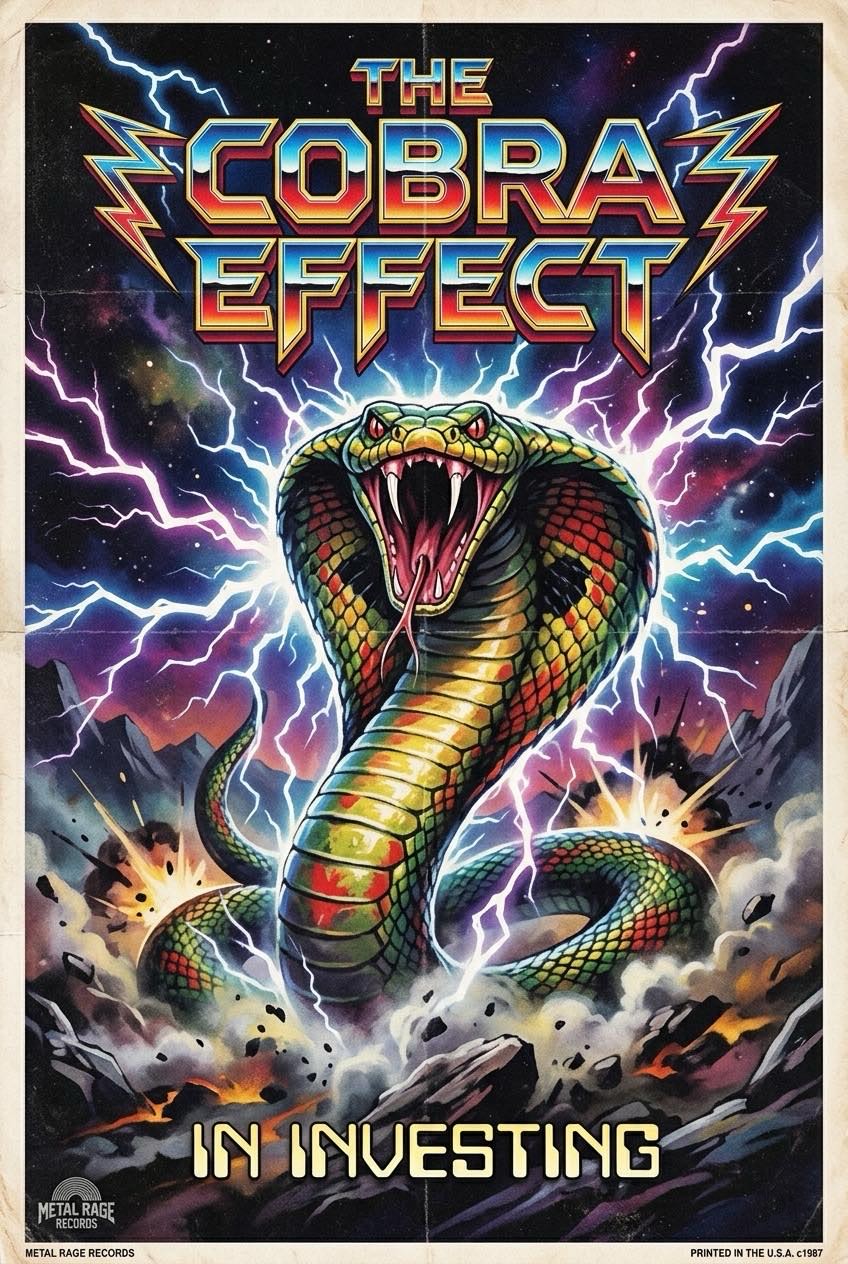
Have you ever heard of The Cobra Effect? No, not the 80s metal band I just made up in my imagination.
The name was coined by economist Horst Siebert in 2001, based on an historically dubious anecdote taken from the British Raj.
According to the story, the British government, who were apparently more concerned about the number of venomous cobras in Delhi than the great famine of 1876, offered a bounty for every dead cobra.
At first, this strategy seemed to work. Large numbers of snakes were killed for the reward. Quite quickly, however, the Indian people being cunning business geniuses, they began to breed cobras for the income.
When the government became aware of this, the reward program was scrapped… and I’m sure you can guess what happened next.
The cobra breeders set their snakes free, leading to an overall increase in the wild cobra population.
This is what is known in economics as a ‘perverse incentive’.
An incentive structure with undesirable, unexpected, and unintended results that can often be contrary to the intentions of its designers.
Unfortunately, an investigation in 2025 by the Friends of Snakes Society cast doubt on the historicity of Siebert’s anecdote.
Their investigation found no contemporary records of cobra breeding operations or prosecutions in British India, and traced the story to an 1873 newspaper article that used speculative language, it was alleged, rather than confirmed evidence.
But there are lots of other examples of this from history that have more evidence to support them. One is the Great Hanoi Rat Massacre, which should have been the name of a hair metal album in the late 1980s, but in fact occurred in 1902 in Hanoi, Vietnam, then known as French Indochina.
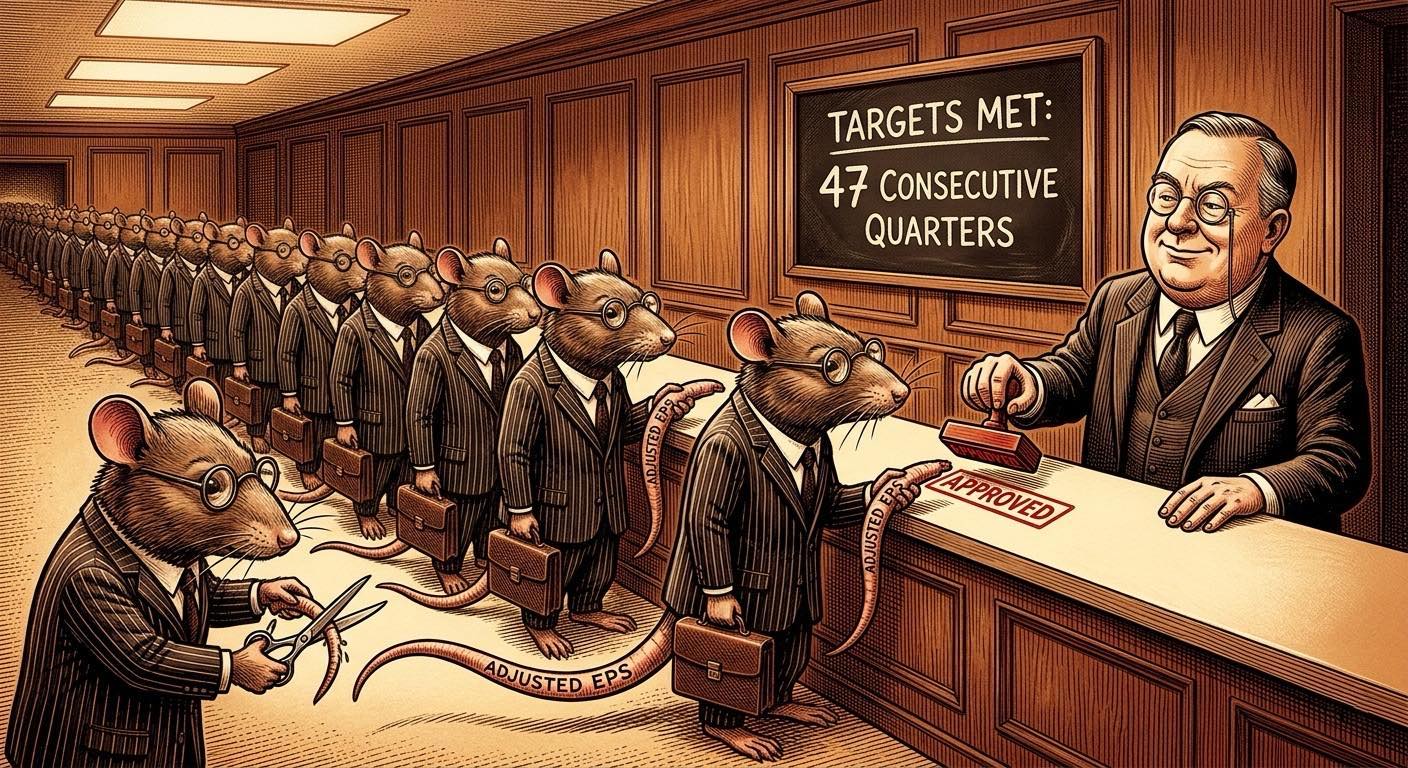
When the French colonial government created a bounty program that paid a reward of one cent for each rat killed, to collect the bounty, people would need to provide the severed tail of a rat.
However, the colonial officials began noticing rats in Hanoi with no tails.
The Vietnamese rat catchers would capture the rats, sever the tails, then release them back into the sewers so they could produce more rats and therefore more tails.
Not learning anything from this, in 2007 the US Army Post Fort Benning in Georgia offered hunters a $40 bounty for every tail of a feral pig they turned in.
During the course of the program, the feral pig population in the area increased.
It turned out that the pigs’ fertility rate and offspring survival rates increased during the scheme, mostly due to the improved nutrition made available by the feed bait used to attract the animals to hunting sites.
On top of that, hunters were found to be more likely to preferentially target large males as trophy quality game while ignoring females and juveniles as targets.
Removing mature males from the population had a negligible impact on population growth because the remaining mature males can each stud many breeding sows.
This effect is similar to Goodhart’s Law, named after Charles Goodhart, the British economist who spent many years at the London School of Economics focusing on central bank governance practices and monetary frameworks.
Goodhart’s Law came from something he said at a conference in Sydney in 1975 that he later admitted was intended as a humorous throwaway line, but it was also perceptive and is cited regularly today in fields ranging from banking to medicine to artificial intelligence because it says something important about how the modern world functions.
What he said was this, any observed statistical regularity will tend to collapse once pressure is placed upon it for control purposes.
In other words, as a British anthropologist later boiled it down, when a measure becomes a target, it ceases to be a good measure.
What does this have to do with QAV?
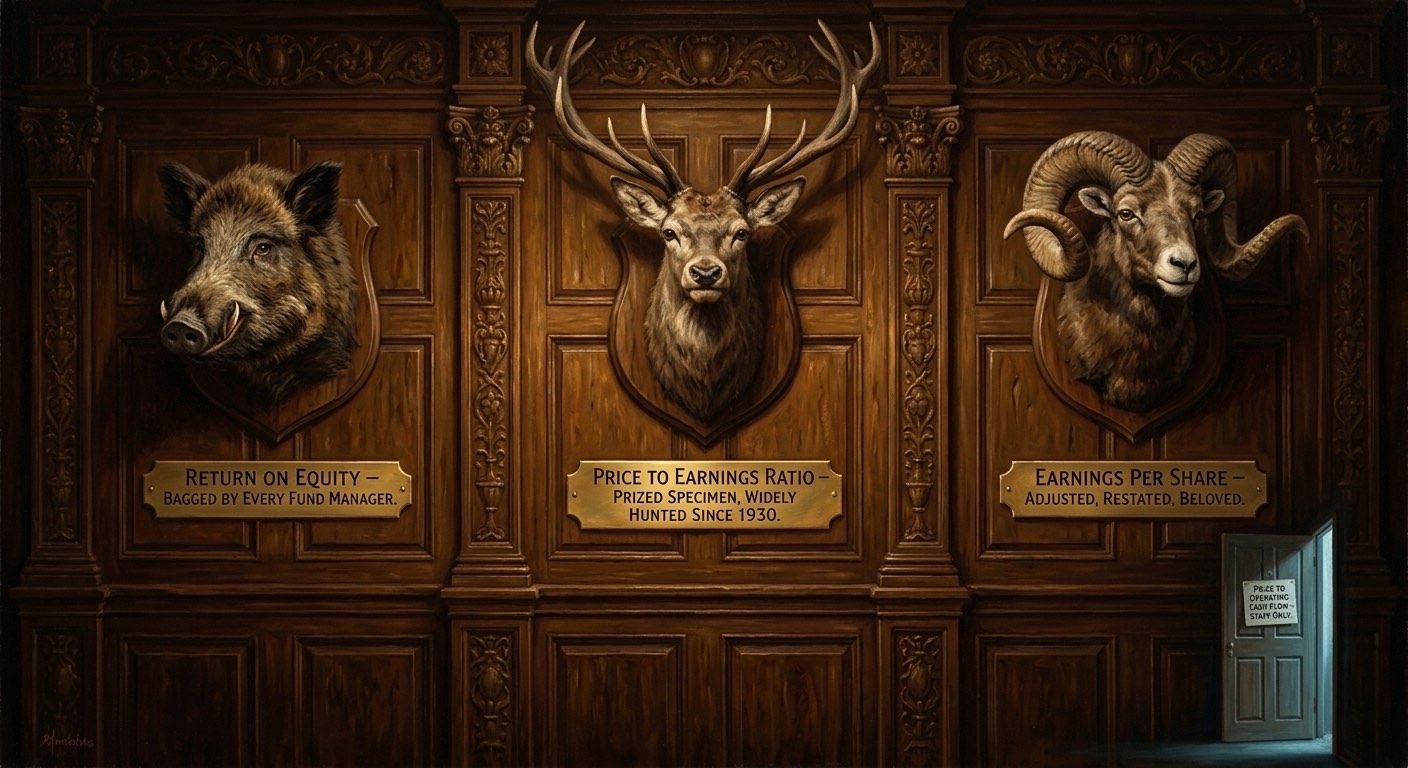
Well, over the years I’ve heard Tony talk many times about why we don’t use PRICE TO EARNINGS ratio or RETURN ON EQUITY as strong indicators in our system.
The reason being they are two very common metrics used in investing and have been for many decades.
And as a result, companies can often game them and manipulate them to make the share price look more attractive.
One of the main reasons we use price to operating cash flow instead of price to earnings, is because it gets less focus from the investing community and is also harder to manipulate.
STOCK ANALYSIS OF THE WEEK
Tony did a pulled pork on New Murchison Gold (NMG) this week, the only stock to make the buy list, with a QAV score of 0.28 on a PE of roughly 4x. Check the podcast link below for the full breakdown.
On the American podcast this week, I did a pulled pork on Republic Airways (RJET). The podcast link is down below if you want the full analysis.
BUY LIST

Each week, we produce a buy list based on our value investing system that we share with our QAV Club members. The intended primary purpose of this buy list is for club members to use as a reference for comparing their own buy list. In theory, all of our buy lists should look pretty similar each week.
AUSTRALIAN BUY LIST
QAV Value Investing Buy List (AU) 2026-08-09
U.S. BUY LIST
QAV Value Investing Buy List 2026-08-11
PORTFOLIO PERFORMANCE
We compare our performance to what we think is the most relevant benchmark (SPDR 200 in Australia, S&P500 in the USA), but if you’re new to investing, these comparisons might not mean much. Instead, you can compare our performance to the top-performing Super Funds in Australia and see why an amateur active investor (who has a system to follow) can out-perform most of the “professionals”.
We publish a fresh performance snapshot once a month. Weekly noise doesn’t tell you much in a value-investing system — what matters is the trend.
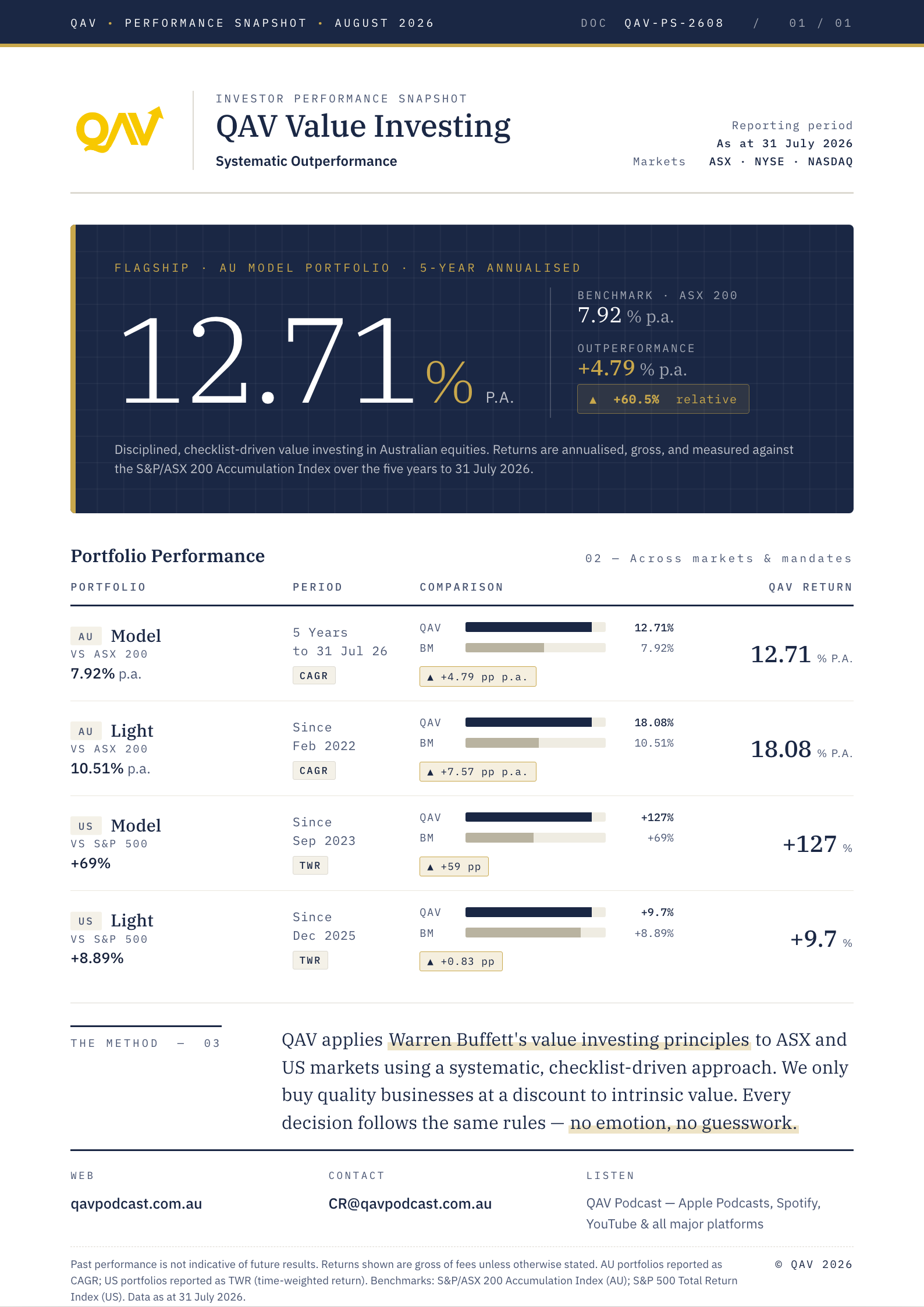
August 2026 performance snapshot.
Australian Model Portfolio: No trades this week.
American Model Portfolio: No trades this week.
Become a QAV Light Member today and start your investing on the right track
If you want to find out what we’re trading in QAV Light each week, sign up to become a member. You’ll get an email from me every Monday letting you know what we’re buying and selling in that portfolio. You can choose to copy our trades or not. It’s the easiest way to start your rules-based investing career… and you don’t even need to know the rules. I’ll follow the rules for you. It’s a good first step to eventually becoming a QAV Club member and learning how to run the system by yourself.
QAV LIGHT: You don’t need to build it to tell the time.

(Note: Americans interested in joining QAV Light or Club please go here instead.)
Add QAV America — US stocks, the same QAV method
Already a QAV member? You can add QAV America as your second membership at 50% off — US-listed stocks, the same QAV approach, billed in AUD through this site (just one payment to keep an eye on). Add QAV America →
Not a QAV member yet? Join QAV first, then you can add QAV America at the 50% member rate.
THIS WEEK’S EPISODES
Flying Under the Radar: Alex Passmore, CEO, NMG — QAV AU #932

Republic Airways (RJET): QAV America #65
STOCK NEWS AND UPDATES
COMMODITIES
This week the big changes to commodities were the following:
| Commodity | Status |
|---|---|
| Coal (thermal) | JOSEPHINE |
| Crude Oil | JOSEPHINE |
| Platinum | BUY |
| Tin | BUY |
| Magnesium | JOSEPHINE |
| Wheat | JOSEPHINE |
| WTI Crude | JOSEPHINE |
DISCLOSURE
Please review our trading and disclosure policy.
SIGNING OFF
SSDD!
- Cam
That’s it for the week!
QAV A GOOD SHAREMARKET!
Got a question? info@qavamerica.com