This week we dig into the colourful history of Banco Bradesco, the second-biggest private bank in Brazil and the top pick on our US buy list. Tony and Cameron run through the QAV numbers on BBDO, cover portfolio updates including a painful 23% drop in RM and a GASS scare that turned out to be nothing, and check in on UBS’s $125 million anti-money laundering fine and CVGI’s latest earnings miss. The model portfolio is up 130% since inception versus 71% for the S&P, so the system is doing its job.
This week’s full episode is for QAV Club members only. The free episode is available below. Also check out our podcast archives link and our pages on Apple Podcasts or Spotify or watch clips on TikTok. Or visit our homepage to learn more about QAV and how it works as a value investing system that you can learn and apply to beat the market.
Transcription
QAV AMERICA 64 BBDO
[00:00:00]
Cameron: Welcome back to QAV America, Tony, episode 64. It’s the 4th of August, 2026. Nothing going on in the news in America, Tony. Uh, all smooth sailing. Um, Trump has negotiated his, uh, 15th straight peace deal with Iran in the last couple of months,
Tony Kynaston: Probably get a Nobel Prize pretty soon
Cameron: Oh, well, I saw some- I think it was John Mearsheimer said he should get a Nobel Prize ’cause he’s signed more peace deals with Iran in the last couple of months than anyone has in history.
That’s, that’s a real achievement. Uh, portfolios. Our US portfolio is, uh, doing well, Tony. The model portfolio since inception is up 130% today versus 71% for the S&P 500. Not quite double market, but quite a good level of outperformance there. Our QAV America Light portfolio is [00:01:00] come back a bit vis-a-vis perfo- Well, no, that’s actually up.
What am I talking about? It’s up 11%. This is since inception, which is December last year. It’s up 11% versus the S&P 500 up 10 and a half percent over the same period of time. So we’re slightly beating the S&P in that one over the last eight months. Nothing to write home about, but at least we’re matching the market. But I did have to sell, uh, one of our holdings of RM this week, not the one that’s actually in the portfolio, but one I added, uh, s- to the light portfolio last week. I had to sell it within a week. It fell 23% in a week. I do hold a po– uh, parcel in it that we bought in the model portfolio quite a while ago, um, which is still up 30, 40%. Not exactly sure why it fell. They did [00:02:00] report their Q2 earnings on the 29th of July. On paper it looked fine. EPS came in at 85 cents, which beat the 79 cent estimate, but they had a weaker quarter than last year, EPS was actually down 17 and a half percent year on year. So there are, you know, they’re a subprime consumer lender that’s doing it tough. So, um, that probably has something to do with it. Um, might be some fluctuations in, uh, Fed rate expectations in the US that are playing a role in that as well. Anyway, 23% down in a week. I’d no- If I buy a stock and it struggles a week later, I’d normally give it a bit of grace, but not that much grace.
Tony Kynaston: No.
Cameron: Grace.
Tony Kynaston: That’s rule one, isn’t it?
Cameron: Bad timing on that.
Tony Kynaston: Mm.
Cameron: Yeah, if it was 5% I’d be like, “Ah, we’ll see how it goes.” But yeah. Um, another stock that I thought about selling this week [00:03:00] was Gas, Stealth Gas, G-A-S-S, which we hold in our portfolio because LPG is a sell. Turns out they’re, um. No, LNG is a sell. They’re LPG, not LNG. S- so I looked at the LPG, uh, commodity chart, and there was no real correlation between the LPG chart and Gas’ chart over the last five years. Did some digging in. I think this is one of these situations where they have long-term charters. They’re locked in. They’re, they’re a shipping company, ships LPG, so
Tony Kynaston: Okay.
Cameron: and, um, they’re able to trade through ups and downs of the LPG market, so that was interesting. But we don’t normally track LPG in our commodity tracking each week.
I might need to do that just in case it comes up again. Couple of quick news stories. Um, [00:04:00] couple of other stocks that we hold or have talked about. We hold, in this case, UBS. UBS, uh, AG, Switzerland based holding company for a big bank. They’ve just been fined $125 million for anti-money laundering violations in the United States. Three US regulators announced separate financial penalties Monday against UBS financial services for anti-money laundering violations involving foreign currency wire monitoring and customer due diligence failures that persisted from January 19 through June 2023. I think it’s, uh, one of the biggest penalties that have ever been thrown at somebody for this kind of, uh, anti-money laundering charge. And reading through the headline or reading through the story, apparently they’ve been doing business with Russia, I [00:05:00] think is what it is. Uh,
Tony Kynaston: Okay.
Cameron: and, uh, the US government doesn’t like that, so they, uh, they’ve been hit. If I look at their chart, see what’s happened to their chart, still, still looking good. They’ve come back a little bit, but it hasn’t had much of an impact on their share price at all. So, you know, there you go. Also, Commercial Vehicle Group, CVGI. Uh, we’ve done a pulled pork on them. I think we hold them in a portfolio maybe too.
Do we hold them, CV? Yes, we do. They’re up 28, 29% in our light portfolio. Come back a little bit in the last couple of months. Released their Q2 earnings snapshot, said it had a loss of 29 cents per share. Losses adjusted for non-recurring costs into account for discontinued [00:06:00] operations came to 13 cents per share.
The results did not meet Wall Street’s expectations, and, uh, three analysts sort of downgraded them a little bit. But, uh, these are guys that supply products for heavy duty trucks. I think they, I said they were the sausage in the sausage bun,
Tony Kynaston: Yeah.
Cameron: the ha- hot dog bun from memory. So we’ll see if that plays through to their, uh, performance, but so far doesn’t seem to have had a huge impact. One of our portfolio companies that I wanted to talk about is Danaos, DAC. We hold them in the light portfolio as well. They’re up about 20% since we added them. They reported their second quarter and half year results. Uh, let me see. Um, good. Results are, um, oh, gee, this is a really bad table. Um- [00:07:00] I can’t even make sense of this. Uh, finviz.com needs to do more work on their presentation. That’s a real mess of a table. All right, let’s forget that. I can’t even read that. It’s hurting my head. All right, moving right along. Pulled pork this week, Tony. Um, BBDO. So I’m gonna talk about this week, not the advertising agency, which was what I
Tony Kynaston: BBD Needham
Cameron: Yeah. Uh, this is Banco Bradesco. They’re a very, very large bank listed on the New York Stock Exchange, the second biggest private bank in Brazil.
Tony Kynaston: We’re going to actually own the whole of Brazil fairly soon?
Cameron: And half
Tony Kynaston: Yeah.
Cameron: the
Tony Kynaston: Okay.
Cameron: Hey, is what the– this was at the top of my American buy list this week. [00:08:00] Uh, market cap of about 36 billion US dollars. And for the same reason this is on as Petrobras was a couple of weeks ago,
Tony Kynaston: Mm-hmm.
Yep
Cameron: also a bit of a softening of inflation there. But an interesting story, a bit of a Brazilian soap opera, this story, Tony. Um, I had fun researching this. Founded by Amador Aguiar, born in 1904, the 12th child of a poor family.
Left school at 13 to work in the fields. Left home at 16 basically nothing. Apparently, he got tired of his father’s alcoholism and abuse. Um, was homeless
Tony Kynaston: Founded the bank. You founded the podcast that he got tired of his father’s alcohol and abuse and founded the bank.
Cameron: Yeah, I founded a podcast [00:09:00] network. Yeah, yeah. He ended up homeless and hungry in a town called Bebedouro, got work as a typographer, setting type by hand, had an accident that chopped off his fingers, or part of his fingers, so that career was over pretty quickly. Um, then got a job as an office boy at a place called Banco Noroeste.
Tony Kynaston: If you’re gonna say get a job as a, um, a thief, no fingerprints.
Cameron: In 1943, maybe that’s the real story about how he got his fingers chopped off in the first place. Maybe he was, uh, you know, bad thief. Um, 1943 they sent him to a little country town in the interior of São Paulo to try and rescue a bank that was going under. Been in his late 30s. While he was there, the president of the bank died unexpectedly, and he ended up taking it over and running it.
Tony Kynaston: Coincidence or not, you be the judge. [00:10:00]
Cameron: Wow.
Tony Kynaston: The man with no fingerprints.
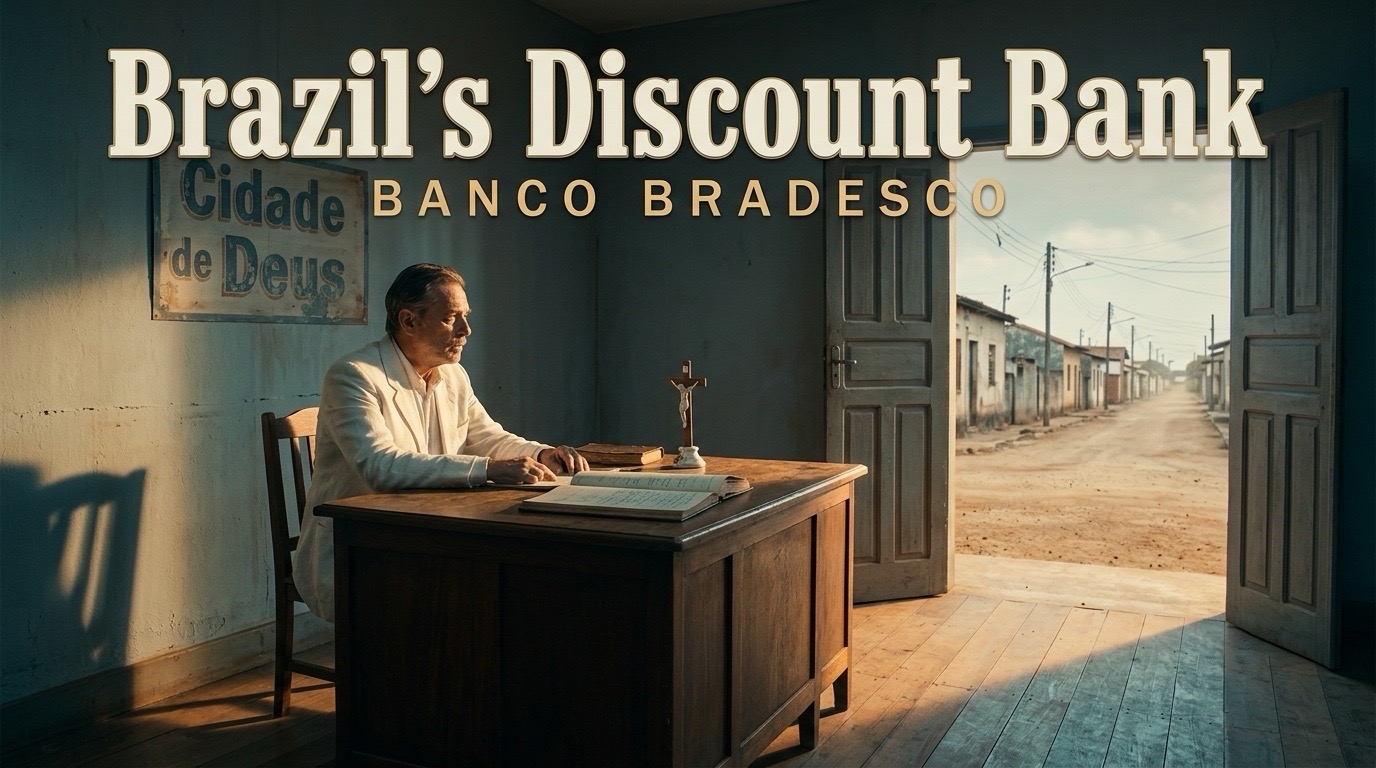
Cameron: Yeah. This is a darker version of the story than I’d anticipated. He takes it over and renames it Banco Brasileiro de Descontos, which is the Brazilian Discount Bank, and if you squash that down it becomes BBDO. So that’s where the name comes from, the Discount Brazilian Bank. Um, ends up with, uh, six branches, um, over 1,000 by 1978.
At one point it was the third largest banking organization in Latin America, and the largest bank employer on Earth. And what he did differently, he did a number of things, but whilst the other banks in Brazil were chasing rich clients in the cities, he was doing the small town farm worker. I think we did a bank in Alaska not long [00:11:00] ago which, uh, with a similar story.
Um, can’t remember. Was that Northrim Bancorp, N-R-I-M, I think?
Tony Kynaston: Yep. Supporting local businesses. Yep.
Cameron: Similar sort of deal. So, um, he’s going after the farm workers, people who’d never had a bank account. I, I love this one story where he had the managers in his branches put their desks right next to the front door. So you would walk in, manager would greet you in person, welcome you to the bank branch. Um, you know, give real. A sort of old school, very, very high customer service, treating people well, teaching people how to save money. Um, you know, there was a story how people were doing check endorsement wrong. Other banks would bounce their checks. He would ring up the client and teach them how to do it properly over the phone. Uh, and, you know, really old school kind of guy. [00:12:00] He also ran the place like a church. There were Bible verses printed on the corporate letterhead. “We trust in God” was on the stationery. New employees had to sign a declaration of principles about punctuality, simplicity, availability. Promoted from within based on what he called superior moral behavior, um, which will come into play later on when, you know, we’ll talk about all the stories of fraud that they’ve been accused with over the last 10 or 12 years. Uh, maybe they’ve. He died, so they’ve loosened it. Um, but, uh, got themselves. Well, actually, I’ll get, I’ll get into the, some of the soap opera stories in a second. In 1953, he moves the head office out to the edge of São Paulo. Doesn’t build an office, he builds a compound. So built a village, basically.
Housing, sports facilities, hospitals, schools to house [00:13:00] 9,000 employees, like a whole company town. Called it the Cidade de Deus, the City of God. After St. Augustine’s book, I assume, written around 420 AD after the Goths sacked Rome. Uh, one, one of my favorite books where he says that, um, the, the virgins who were getting raped by the Goths because they were too holy and God wanted, thought that they needed to be pulled down a few notches. Um, the, uh, he ends up moving the company, uh, headquarters to this compound as well. There’s housing for all of the board members in this place. So it’s like this full on deal.
Tony Kynaston: Old campus.
Cameron: Yeah,
Tony Kynaston: Yeah.
Cameron: Before Microsoft and Silicon Valley had campuses, he was doing it in Brazil. So there you go. Um, in, but here’s, uh, my favorite part of this.
In [00:14:00] 1956, he set up a foundation to run free schools. First one opened in 1962 in the City of God, 289 kids, seven teachers. The foundation now, uh, it’s called the Bradesco Foundation, still around, runs 40 schools across every state in Brazil, has around 105,000 students. It’s free, means tested to poor families.
About a billion reais. Is how we decided it was pronounced, reais?
Tony Kynaston: Reais.
Cameron: Reais. Reais. I said a couple of episodes ago is, uh, a real is, uh, real,
Tony Kynaston: Real, yeah.
Cameron: real, and the plural is i- ia.
Tony Kynaston: Okay. Yep.
Cameron: Let’s
Tony Kynaston: Reais, yeah, reais.
Cameron: Going into, it’s about 200 million US dollars. But here’s the big thing, is the foundation is actually one of the controlling shareholders of the bank.
Tony Kynaston: Mm-hmm.
Cameron: Uh, [00:15:00] I, I couldn’t actually. This, this is complicated shareholding structure, so I, I don’t wanna quote it ’cause I’ll probably get it wrong. But, uh, by one count they own about 48% of the shares of the bank. I don’t think they’re all, um, pref- preferential. Some are voting, some are not. But it, the foundation owns a big chunk of the bank, um, which is interesting.
He died in 1991, there’s a great story. This is part of the rest of the soap opera story. So, uh, when his first wife died, he had three adopted daughters. Well, they had three adopted daughters, twin daughters, and then a third one. And for some reason, when his first wife died, he got his daughters to sign over their share of the inheritance to him in order for them to get it all when he died. But four months before he died, in his 80s, he married his secretary, who [00:16:00] was 40 years younger than him, and then wrote his daughters out of the will.
Tony Kynaston: One of those didn’t, one of those didn’t follow the morals clause, did they? Either the secretary or him or both.
Cameron: Yeah. He dies, the daughters and the grandkids, uh, sue. And this was very, very public, as you can imagine, in Brazil, it went on for decades. In the end, the daughters or the, the twin daughters won, became billionaires. Still are. I think they’re 88 now, still in the ownership structure. I think the third daughter, adopted daughter, got less, but still did okay. The widow appealed, and it went on and on and on. She ended up winning the rights to his personal estate. I think she got, like, 75 million US dollars or something like that. So she did, did all right, but didn’t become a [00:17:00] billionaire out of it. But, uh, yeah, apparently they fought this for decades. So all very, very, very tawdry and messy.
But, um,
Tony Kynaston: What did you expect? What, what did you expect from a city called the City of God? I mean,
Cameron: City of God. Yeah, yeah.
Tony Kynaston: That, that’s always worked out well.
Cameron: Yeah, yeah. But, uh, the whole thing about the foundation I really admired, so
Tony Kynaston: Yeah, it’s a great story, isn’t it? I thought that was brilliant. But can you imagine if it happened in Australia? Like, if the Commonwealth Bank set up a foundation, gave it shares in the company, and then the dividends founded a whole network of schools. The keyboard warriors would just be going off their, off their brains, wouldn’t they?
The corporatization of our school system.
Cameron: Yeah,
Tony Kynaston: Have banks sponsoring schools. Now, well, you know,
Cameron: Well, it depends on how
Tony Kynaston: What do you think the Catholic Church does?
Cameron: Well, he set up a f- he set up a foundation. It’s, it’s not [00:18:00] the banks running the schools, it’s the foundation. Foundation runs the bank, if anything,
Tony Kynaston: Yeah.
Cameron: They have. I thought you were gonna say it’d be like Gina Rinehart setting up schools all over the country. Um,
Tony Kynaston: Maybe.
Cameron: Who knows? Maybe she will. Anyway, let’s talk about the business. Um, so more, more of a supermarket than a bank. They’re kind of what banks in Australia were, you know, before they got slapped on the wrist and cut up after the investigations a few years ago, but even bigger. So not just a savings account.
You get your home loan, your car loan, your life insurance, your pension, your dental cover. Own one of the biggest dental care businesses. I think they’ve, they’ve spun it off and they’re continually moving shares, more and more of their ownership into this, uh, dental business. But they basically own a whole bunch of different financial services and products in Brazil.
They’re absolutely massive. [00:19:00] Loan book is about 1.09 trillion reais, a over 200 billion US dollars, up 8.4% on last year. The loan book is about five and a half times the whole market cap of the company, which I guess is kind of normal for a bank. That’s basically the business. Their, their
Tony Kynaston: Do.
Cameron: loans, mm-
Tony Kynaston: Sorry to interrupt, but they also have a big insurance business, which is important, I think. Because, um, when you get to the currency situation, it’s driven by 14% interest rates in Brazil at the moment, and that’s a huge benefit to an insurance business which invests the float in, um, government bonds primarily
Cameron: Yeah. Indeed. Yes, I think I’ve got something on that a bit later on. Um, but still in the banking business, their ba- bad loans situation isn’t great. Um, the loans more than 90 days overdue are running about 4.2%, [00:20:00] basically flat on last year. But I compared that to some of the other banks. Um, there’s a bank in Brazil called Itaú, which its bad loans are 1.9%.
Santander’s Brazilian arm is running at 3.3%. It’s getting worse, up a half a percent since last year. And, uh, Banco do Brazil is also doing quite badly, but Bradesco’s is 4.2%, so
Tony Kynaston: Yeah, but there’s a reason for that, Doc
Cameron: Oh yeah, what’s that?
Tony Kynaston: Well, I looked into it as well. So yeah, so c– uh, banks like the Australian banks, which are basically building societies full of retail mortgages running at about 1%. But this bank in Brazil has a lot of unsecured loans, so it’s not just lending for mortgages, it’s also lending to businesses, a lot of personal loans, a lot of car loans, that kind of thing.
So that’s why it’s running at 4%. And if you look at unsecured credit, it typically runs around 4%, 2% to [00:21:00] 4%.
Cameron: Right. Okay,
Tony Kynaston: Might be a little bit higher, but it’s not like four times higher than you’d expect.
Cameron: Hmm.
Tony Kynaston: Hmm
Cameron: Obviously, the economy in Brazil is struggling as well, so that’s gonna be driving a lot of difficulties for borrowers, I imagine. The Selic’s running at whatever it is, 15%, 14, 15%
Tony Kynaston: Yeah. But the other thing too is, like I compared the net interest margin for this, uh, bank to the Australian banks and yeah, okay, it’s got more bad debt, but the, the net interest margin’s huge. Um, I’ll just try and find the, find the numbers. Um
Can’t find it now, but it was much bigger
Cameron: Well, I’ve– I found out that they’ve got 161% coverage. So they’ve put aside more than one and a half times the value of the bad loans to absorb them, [00:22:00] and they’re prov- they’re provisioning a lot of stuff for this as well. So it’s. Like it’s bad, but they’ve, they’ve got it well and truly covered from what I can tell.
Tony Kynaston: Yeah
I found the NIM. So, uh, in Australia, the net interest margin for the banks is I think about an average of one point seven eight percent. Uh, this particular bank has five percent, so it’s nearly triple of, uh. Even though it’s got more bad debts, it’s, it’s doing a lot more in terms of the margin on the income side.
Mm-hmm.
Cameron: Yeah, so it’s got it covered. The insurance arm that you mentioned, Bradesco Seguros, one of the biggest insurers in Brazil, um, it’s returning 21.6% return on equity. So doing quite well. And they also own, as I said before, OdontoPrev, the biggest dental insurance business in Brazil, is separately listed.
Um, and I think they’re sort of, [00:23:00] selling out of that, moving more of it into the public market as they go. Some of the history of the business, it’s interesting for a guy who started with no education and half his fingers missing. First bank in Brazil to run computers in 1962. IBM was very early on for computers in banks in Brazil. The first national credit card in Brazil in 1968. They were very early into phone banking and home banking. So they’ve been pretty bullish with technology for a very long time. And, uh, what else? In 2015, they bought HSBC’s Brazilian business for 5.2 billion US dollars. Anyway, it’s a big bank, big growth story, still very big. Back to the superior moral behavior bit. So quite a few scandals that they’ve been [00:24:00] involved in, um, including Operation Car Wash that we mentioned back in the Petrobras story. But they had this other one that was called Operation Zelotes. So Brazil’s tax appeals council is called CARF, C-A-R-F. It’s the body that decides whether a company actually owes a disputed tax bill. Prosecutors allege that companies were bribing the judges who sat on it. In 2014, CARF ruled against Bradesco on a federal tax bill. Prosecutors alleged Bradesco then paid to get that decision overturned. The man that they charged in 2016 was the chief executive of the bank at the time, Luis Carlos Trabuco. No longer the CEO of the bank. He’s now the chairman of the bank. So, uh, he was cleared in the trial, I should point out. Federal appeals court threw the case out [00:25:00] in 2017, for lack of just cause, which means they decided there wasn’t enough there to run a trial on. In 2020, nine more defendants in the case were acquitted, then the government shelved the case entirely. Now, I think Mr. Bolsonaro was running Brazil at the time, um, casting any aspersions there about, uh, federal court cases and Bolsonaro and the bank and the judges. But we did mention last time that, uh, I think I mentioned the who was the judge that sent Lula to jail ended up becoming the chief of justice for Bolsonaro, and then when Lula got out of jail, I think he ended up g- the judge went to jail for corruption. So yes. Lots of stories of corrupt judges and corrupt legal systems, uh, come out of Brazil. Anyway, the [00:26:00] chairman is legally in the clear. I want to be upfront about that. But the bank whose founder printed Bible verses on the letterhead and promoted men for moral behavior had its chief executive charged with bribing tax judges, so there
Tony Kynaston: And marry the secretary.
And cut his kids out of the will.
Cameron: it was true love, Tony. Love is love
Tony Kynaston: well, it could happen for sure
Cameron: Then Operation Car Wash, y- y- Lava Jato, um, which we talked about in the Petrobras episode. Um, they, they got involved in this, but, um, it was somewhat different. The allegation involving Bradesco came out of a plea deal from, um, the former finance minister of Brazil, Antonio Palocci. Said that money stolen from Petrobras had been laundered through accounts at the five biggest Brazilian banks, one of those [00:27:00] was Bradesco, as you would imagine. So allegations against them weren’t that they were part of the actual corruption, just they weren’t doing enough to stop the money laundering from happening, a bit like UBS that I mentioned earlier on. Anyway, uh, they denied it, and as far as I can tell, no charges or fines were ever landed on them. But they got accused of the biggest corruption scandal in the Southern Hemisphere at the time, but nobody could ever prove that they knew that it was going on. So, um, they had to th- th- they didn’t get, uh, found guilty of the disputed tax bill, but they paid it anyway, or bribing the judges for the tax bill, but they paid it anyway. They were found to not have paid a tax bill, then it was overturned, then they were accused of bribing the judges. They got off of that, but then they paid the tax bill anyway earlier this year.
Tony Kynaston: No harm, no foul[00:28:00]
Cameron: ah, well, listen, yeah, let’s just, let’s
Tony Kynaston: Yeah
Cameron: anyway, just ’cause superior moral behavior is, is what it is.
Just a coincidence,
Tony Kynaston: Yep
Cameron: um, that we’re paying it anyway. Then something happened three days ago. On the 30th of July, Bradesco announced they’re raising up to 10 billion reals of new equity, about 1.9 billion US dollars, new shares at a 6% discount, existing shareholders are getting diluted. Uh, the foundation and the family holding companies have committed to taking up about 80% of this themselves, s- but it is gonna dilute existing shareholders.
Um, the reporting says that they’re doing it because they think the bank is cheap, not because there’s a hole in the balance sheet. I couldn’t quite get my head around that. If you think the bank is [00:29:00] cheap, you’d go and buy shares
Tony Kynaston: Myers shares back. Yeah
Cameron: Why would you raise new equity and buy shares in that?
I go– But, uh, it was beyond my pay grade to try and
Tony Kynaston: Yeah.
Cameron: that out
Tony Kynaston: Did they have a, did they report on what they were going to use the funds for?
Cameron: No, they said
Tony Kynaston: Huh.
Cameron: nothing, didn’t need it. But, uh, analyst reaction was kind of mixed, not exactly hostile. Um, Brazil’s biggest investment bank, BTG Pactual, called it a necessary step. JPMorgan said that it strengthens the balance sheet. So yeah, I don’t know. Anyway, they did it. They announced it. Whether or not it’s a good thing or a bad thing is beyond my pay grade. Um, what else have I got for you? Nothing really, just the, the cash rate story that we’ve already hinted at. So the Selic’s around about 15%. A couple of weeks ago, inflation came in softer than had [00:30:00] been predicted. Apparently the odds of a rate cut went from about 68% to 90%.
They’re expecting that to come through this month and bank, bank stocks took off. Now, my intuition would be the opposite of that, that you would think interest rates coming down would be bad for banks. But, um, apparently that’s not right when you’ve got, uh, bad debts. So interest rates coming down, um, means that the bad debts are hopefully gonna lessen, I think is one of the rationales.
Cut rates and fewer people default maybe
Tony Kynaston: Yeah, that’s, that’s part of it. I mean, rising interest rates, high interest rates are good for banks, definitely good for insurance companies, as I said before. Um, but it’s– I guess the, the, the saying or the rule is it’s good to a point. If interest rates rise [00:31:00] so high that people can’t afford loans, then the business gets turned down.
So I think that’s the case in Brazil with fourteen plus percent interest rates. Um, that’s the central bank’s interest rates. The bank would charge more than that for, um, for loaning– for loans to people. So yeah, I think dropping interest rates is gonna promote revenue to the bank, I would’ve thought.
Obviously, the big opportunity with these guys, one of the reasons a lot of money is flowing into Brazil is the carry rate that we’ve talked about in other episodes. If you can borrow money at 3 or 4% in the United States and then invest it in Brazil and get 15%, why, why wouldn’t you do that? So it comes with certain risks, exchange rate risks, the, and the, the interest rates can go up and down, but that’s a, that’s a pretty good spread.
So a lot of people are doing that. A lot of money is sinking into the Brazilian economy as a result of that, some of that ending up with Bradesco. But you’ve also got the election coming up in October, where I think [00:32:00] Bolsonaro’s son is running against Lula, and what happens as a result of that, how that affects the economy is anyone’s guess.
But we don’t predict the future, we look at the numbers, and that is w- you know, where I land on this kind of stuff. The tariff stuff, uh, which I think I briefly mentioned before, but Trump put a 50% tariff on Brazil last year openly tied to the prosecution of Bolsonaro. Supreme Court struck that down.
Administration came back with a different mechanism and applied a 25% tariff instead. Sounds enormous, but a lot of things are exempt, and it doesn’t really have any direct impact on Bradesco, but it does impact some of the businesses that they do business with, and it does affect the economy in general.
But it’s, uh, as we know, you know, the, the tariffs affect the company that’s buying– the country that’s buying the stuff, not the country that’s selling it [00:33:00] directly, although it can make it more difficult for them to sell stuff to the United States. Brazil, by the way, says it’s taking this to the World Trade Organization, so we’ll see how that goes.
Let’s just cut straight into the numbers for Bradesco, though. So when I did my analysis, it was trading at $3.44. Market cap was about thirty-six billion dollars. It scored below both of our intrinsic value scores, IV1 and IV2, so I could score it for both of those. The price to book was one point zero six, so I couldn’t score it for that, but I could score it for price to book plus thirty.
It was comfortably underneath that. The big one for us is price to operating cash flow. That came in at one point seven, so that’s, uh, very low. Basically, if we were buying a coffee shop and we had a price to operating cash flow of one point seven, we would expect to get paid back in under two years, which is a pretty respectable timeframe to get your initial investment back.
Earnings per [00:34:00] share was two point two seven reals. Uh, yield was six point nine percent. Piotroski score of five, so we could score it for that. Stock rank on Stockopedia was a sixty-four. We only score it if it’s ninety or better, so no score for that. Quality rank was thirty-seven, needs to be a sixty. No score for that.
Growth over PE didn’t score, but it did have positive book value growth, up three point seven percent a year on average, so I could score it for that. The forecast intrinsic value was twice the price, above twice the price, so I could score it for that. Of course, it has a three-point uptrend and a new three-point upturn, so I could score it for those as well.
All in all, pretty strong card from us. Uh, quality score, QAV quality score of ninety-two percent and a QAV score of zero point five four. Obviously, lot of unknowns, a lot of risks with the Brazilian economy, with the Brazilian [00:35:00] elections, with tariffs and versus the Trump administration. Uh, but leaving all of that aside and just looking at the numbers, it’s a bank that’s been around a very long time.
It’s very large, generates a lot of money, and for a whole bunch of reasons, we seem to be, be able to buy it pretty cheaply at the moment, so worth taking a look at.
Tony Kynaston: All right. Well, thanks Cam
Cameron: thanks.
Tony Kynaston: ya.
Cameron: talk to you next week.
Tony Kynaston: All right. Fun as usual. Bye
Cameron: Bye
Previous Pulled Porks
Here’s the performance of the “pulled porks” (eg deep dives) we’ve done on the show in the past.
| Ticker | Company | Covered | Price then | Price now | Return | Ep. |
|---|---|---|---|---|---|---|
| SLDE | Slide Insurance | 18 Aug 2026 | $21.60 | $24.95 | +15.5% | 66 |
| RJET | Republic Airways | 10 Aug 2026 | $21.39 | $17.68 | -17.3% | 65 |
| BBDO | Banco Bradesco SA | 3 Aug 2026 | $3.44 | $3.15 | -8.4% | 64 |
| RM | Regional Management | 27 Jul 2026 | $41.65 | $31.39 | -24.6% | — |
| PBR | Petrobras | 20 Jul 2026 | $17.97 | $20.80 | +15.7% | 62 |
| TEO | Telecom Argentina | 14 Jul 2026 | $13.47 | $13.70 | +1.7% | 61 |
| FG | F&G | 7 Jul 2026 | $28.55 | $23.10 | -19.1% | 60 |
| KSS | Kohl's | 1 Jul 2026 | $17.34 | $16.55 | -4.6% | 59 |
| CARE | Carter Bankshare | 23 Jun 2026 | $31.00 | $30.79 | -0.7% | 58 |
| AERO | Aeromexico | 18 Jun 2026 | $17.34 | $15.42 | -11.1% | 57 |
| NRIM | Northrim Bancorp | 1 Jun 2026 | $24.71 | $25.44 | +3.0% | 55 |
| MGA | Magna International | 27 May 2026 | $65.20 | $63.15 | -3.1% | 54 |
| BWLP | BW LPG Limited | 18 May 2026 | $21.06 | $25.66 | +21.8% | 53 |
| KNOP | Knot Offshore Partners Com Unt | 14 May 2026 | $10.78 | $11.30 | +4.8% | — |
| GSL | Global Ship Lease | 13 May 2026 | $41.79 | $45.84 | +9.7% | — |
| DB | Deutsche Bank | 4 May 2026 | $31.11 | $37.98 | +22.1% | 51 |
| UEIC | Universal Electronics | 29 Apr 2026 | $4.25 | $5.19 | +22.1% | — |
| OPRT | Oportun Financial Corp. | 20 Apr 2026 | $5.88 | $8.16 | +38.8% | 49 |
| PAGS | PagSeguro Digital | 13 Apr 2026 | $10.67 | $9.26 | -13.2% | 48 |
| CVGI | Commerical Vehicle Group | 6 Apr 2026 | $3.56 | $2.93 | -17.7% | 47 |
| PBI | Pitney Bowes | 30 Mar 2026 | $10.86 | $16.85 | +55.2% | 46 |
| KODK | Eastman Kodak | 23 Mar 2026 | $7.83 | $9.55 | +22.0% | 45 |
| GPRK | GeoPark | 17 Mar 2026 | $8.77 | $11.04 | +25.9% | 44 |
| MUR | Murphy Oil | 9 Mar 2026 | $34.55 | $37.39 | +8.2% | 43 |
| NBR | Nabor Industries | 3 Mar 2026 | $77.80 | $85.28 | +9.6% | 42 |
| BFH | Bread Financial | 28 Feb 2026 | $70.86 | $108.53 | +53.2% | 41 |
| SHG | Shinhan FInancial Group | 17 Feb 2026 | $69.83 | $80.14 | +14.8% | 40 |
| EC | Ecopetrol | 3 Feb 2026 | $12.57 | $17.58 | +39.9% | 38 |
| CHRD | Chord Energy Corporation | 24 Jan 2026 | $95.53 | $144.49 | +51.3% | 37 |
| AMTD | AMTD IDEA Group | 20 Jan 2026 | $1.02 | $1.02 | -0.4% | 36 |
| VLRS | Controladora Vuela Compania de Aviacion SAB de CV | 13 Jan 2026 | $9.45 | $6.52 | -31.0% | 35 |
| TUSK | Mammoth Energy Services, Inc. | 10 Jan 2026 | $2.45 | $3.18 | +29.8% | 39 |
| XIFR | Xplr Infrastructure | 6 Jan 2026 | $10.17 | $10.94 | +7.6% | 34 |
| AMCX | Amc Networks | 1 Jan 2026 | $9.52 | $11.52 | +21.0% | 33 |
| ZD | Ziff Davis, Inc. | 16 Dec 2025 | $36.48 | $57.49 | +57.6% | 32 |
| VALE | Vale SA | 11 Dec 2025 | $12.90 | $14.21 | +10.2% | 31 |
| AER | AerCap Holdings NV | 29 Nov 2025 | $131.82 | $141.64 | +7.4% | 30 |
| KEP | Korea Electric Power Corporation | 29 Nov 2025 | $16.74 | $11.01 | -34.2% | 29 |
| PCG | PG&E Corporation | 24 Nov 2025 | $15.67 | $13.20 | -15.8% | 28 |
| CALY | Topgolf Callaway Brands Corp. | 12 Nov 2025 | $10.60 | $14.69 | +38.6% | 27 |
| CALM | Cal-maine Foods, Inc. | 23 Oct 2025 | $94.56 | $72.89 | -22.9% | 25 |
| AAL | American Airlines Group Inc. | 20 Oct 2025 | $13.78 | $12.96 | -6.0% | 26 |
| DCH | Dauch | 9 Oct 2025 | $6.16 | $5.89 | -4.4% | 24 |
| CYH | Community Health Systems, Inc. | 3 Oct 2025 | $3.01 | $2.87 | -4.7% | 23 |
| MEOH | Methanex Corporation | 15 Sep 2025 | $39.81 | $60.97 | +53.2% | 21 |
| SUZ | Suzano Inc. | 1 Sep 2025 | $9.73 | $9.29 | -4.5% | 20 |
| KE | Kimball Electronics, Inc. | 26 Aug 2025 | $28.65 | $24.65 | -14.0% | 19 |
| TITN | Titan Machinery Inc. | 14 Aug 2025 | $18.98 | $23.72 | +25.0% | 18 |
| GTN | Gray Media, Inc | 7 Aug 2025 | $4.42 | $4.44 | +0.5% | 17 |
| SENEA | Seneca Foods Corporation | 30 Jul 2025 | $102.12 | $184.35 | +80.5% | 16 |
| BHC | Bausch Health Companies Inc. | 22 Jul 2025 | $6.32 | $5.67 | -10.3% | 15 |
| SSL | Sasol Limited | 17 Jul 2025 | $4.99 | $13.72 | +174.9% | 14 |
| ZEPP | Zepp Health Corporation | 11 Jul 2025 | $2.98 | $4.32 | +45.0% | 13 |
| PKX | POSCO Holdings Inc. | 1 Jul 2025 | $48.49 | $58.21 | +20.0% | 12 |
| PDS | Precision Drilling Corporation | 27 Jun 2025 | $47.78 | $87.65 | +83.4% | 11 |
| IX | Orix Corporation | 19 Jun 2025 | $21.00 | $39.30 | +87.1% | 10 |
| JXN | Jackson Financial Inc. | 11 Jun 2025 | $83.00 | $132.67 | +59.8% | 9 |
| IHS | IHS Holding Limited | 30 May 2025 | $5.38 | $8.42 | +56.5% | 7 |
| F | Ford Motor Company | 21 May 2025 | $10.80 | $13.21 | +22.3% | 6 |
| ENIC | Enel Chile SA | 14 May 2025 | $3.97 | $4.19 | +5.5% | 5 |
| CM | Canadian Imperial Bank Of Commerce | 8 May 2025 | $63.76 | $114.87 | +80.2% | 4 |
| DAC | Danaos Corporation | 2 May 2025 | $82.47 | $161.19 | +95.5% | 3 |
| CX | Cemex Publicly Traded Stock Corporation With Variable Capital | 28 Mar 2025 | $5.66 | $10.06 | +77.7% | 2 |
| ZIM | Zim Integrated Shipping Services Ltd | 13 Mar 2025 | $17.97 | $30.10 | +67.5% | 1 |
3 more recent picks from the last 30 days are available to QAV America members — members hear every deep dive a month before it appears here. Become a member
Returns exclude dividends and are measured from the price on the day each stock was covered on the show. Prices as of Sun 20 Sep 2026, 7:37 am ET. Updated automatically. Not financial advice.
0 Comments