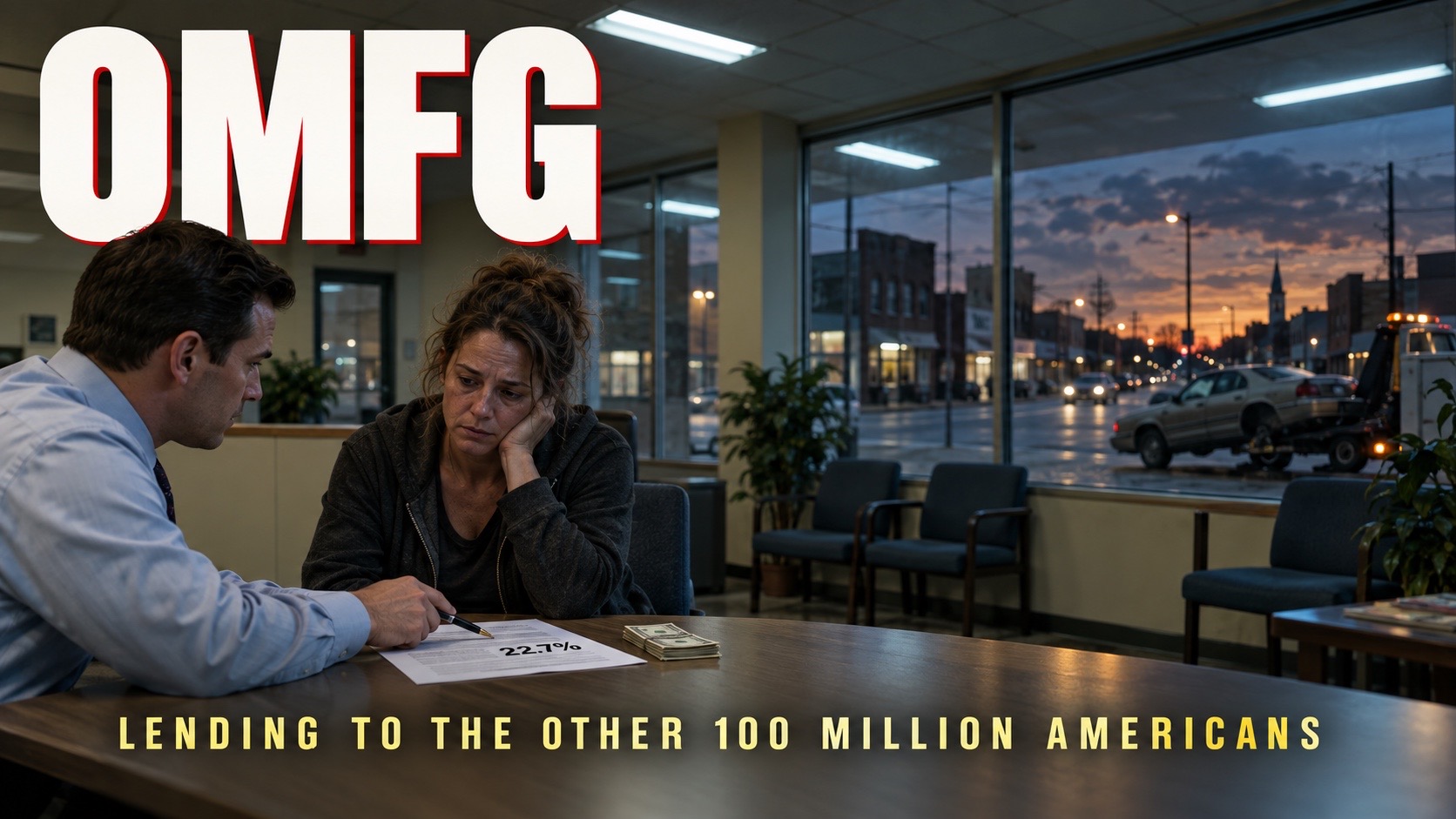
This week we dig into One Main Financial (OMF), one of America’s biggest lenders to people the banks won’t touch: 100 million non-prime Americans, 22.7% interest rates, and $2 billion in annual write-offs that somehow still leave $800 million on the table. We also run through portfolio updates (the model portfolio is still well ahead of the S&P 500), chat about OpenAI pumping the brakes on AI releases, Houthi attacks pushing oil past $100, and Canada apparently trying to backdoor its way into the EU via Finland.
This week’s full episode is for QAV Club members only. The free episode is available below. Also check out our podcast archives link and our pages on Apple Podcasts or Spotify or watch clips on TikTok. Or visit our homepage to learn more about QAV and how it works as a value investing system that you can learn and apply to beat the market.
Transcription
QAV AMERICA 70
[00:00:00]
Cameron: Welcome back to QAV America Tony. This is episode 70, seven-zero. It’s the 15th of September 2026. Well, well, what’s going on in the world, Tony? Uh
Tony Kynaston: No. Did you see Canada’s, uh, applied for a backdoor listing into the EU?
Cameron: Seriously?
Tony Kynaston: Yeah, I’m serious. Yeah.
Cameron: Oh, wow.
Tony Kynaston: some. I forget
Cameron: A
Tony Kynaston: term is. There’s some kind of, um, you know, non-aligned status that they’re applying for
Cameron: They being bought by Finland and then backdooring in through Finland. Uh, so we, we are now Finland
Tony Kynaston: Yeah, it’ll be, it’ll be a, um, it’ll be moot when the US takes over Greenland and then blocks Canada from joining the EU.
Cameron: Well, now with the new, uh, world map as accepted by the United Nations, Greenland is, uh, very, very small. It used to be the size of [00:01:00] Africa, now it’s the size of Tasmania, so. I’m not sure why the US wants it. Maybe Trump doesn’t want it anymore now that it’s, uh, shrunk substantially in size on his map.
Well, uh, of course, in s- other news, um, the, the Houthi, uh, and Iraqi militias have bombed the Saudi East-West pipelines, b- taken the, some key strategic points in the Red Sea, so even more, uh, oil access lines to the world have been blocked. The oil price is. Both oil, both WTI and Brent Crude are both well over $100 today.
Uh, there is a very high, uh, probability that Kevin Walsh is gonna put interest rates up this week according to most of the analysis I’ve read, although Donald Trump says we’re gonna have the lowest interest rates anywhere in the world, everything’s great, don’t worry [00:02:00] about it. OpenAI have said that they’re postponing their IPO because they want a slowdown of the AI sector, which has caused a lot of tech stocks to go backwards in the US by a few points over the last day or so
Tony Kynaston: Excuse me. Do you think those two things are linked? Do you reckon they, they couldn’t get an IPO away? That’s door number one, and door number two is calling for regulation of AI and just, and to have research slowed down
Cameron: Yeah. No, I mean, I have seen the suggestion of that and read it, but I, I don’t think so. I think I, I take them at face value on this. I think, um, I’m shit scared by what’s been happening in AI, and I’m, uh, I’m on the perimeters of it. I think they are all. If they are, uh, smart, they should be absolutely terrified by what they’ve built and where it’s gonna be a year from now or two years from now if they keep up the current pace.
You know, it’s, it, it turns out that the [00:03:00] transformer/large language model of AI and throwing a ton of compute at it, uh, and a ton of data, uh, worked. And they’ve, they’ve built something that is becoming increasingly powerful. And of course, they, they have access to internal models that we don’t see, and, uh, they, they.
I think they’re genuinely terrified. Certainly all the people that are leaving, this started a week or two ago, but it’s been happening over the last year, is safety researchers at OpenAI and Anthropic have been resigning and sounding alarm bells. And it’s just now that the founders, uh. I mean, they’ve always s- paid lip service to the fact that, “Yeah, we need to take safety and security, and we do take it important.
Uh, we do take it seriously, and it is important.” But now they’ve finally gone, “Yeah, no, now it’s getting really, really scary.” So I, I do think they don’t wanna be responsible for, uh, a, a [00:04:00] Chernobyl-level event or, uh, you know, something worse that takes out a billion people through an AI hacking a power grid or a nuclear power plant, or causing some sort of major ecological or economic disaster on their watch.
That would not be good
Tony Kynaston: Yeah, but you know, I’m skeptical that, that all three of the leaders have come out and said that they should halt or not halt, but slow down research, but I don’t see it slowing down. So as long as it’s an arms race, it’s gonna continue, I think
Cameron: Well, when you say you don’t see it slowing down, what are you seeing? I mean, they’re all saying they’re slowing it down internally, so
Tony Kynaston: Okay
Cameron: slowing it down while they figure out how do we put more safety measures into place. I mean, not stopping. Sam Altman has said, “We’re not stopping, we’re just pacing it a little bit more slowly,” because I mean, they, they have this, you know, recursive self-improvement now, RSI as it’s known in the lingo, where the [00:05:00] best model of today is building the best model of tomorrow.
And you know, I did hear Sam interviewed a couple of weeks ago and he said, “At the rate we’re going, we’ll be putting out a new model that’s twice as powerful as the last model every three months.” Um, and that’s, that’s scary. You know, it’s like compounding. You know all about it. It’s the rule of 72, but applied, applied to AI.
Tony Kynaston: Yeah. So what’s slowing down? I’m still seeing releases. do you know they’re slowing down?
Cameron: Well, they haven’t released their current internal models. Uh, OpenAI released Astra a week or two ago, but the model that hacked Hugging Face wasn’t Astra. It was their more powerful model apparently, and they’re not releasing that yet until they have more safety measures. But,
Tony Kynaston: you reckon they, they’ve got it in-house and they’re going, do we knock off Elon Musk? us.”
Cameron: yeah, yeah. Yeah
Tony Kynaston: the model that gets out. Takes out Elon Musk, but the, half the world as well. [00:06:00] Yeah
Cameron: Yeah. Yeah, as long as it takes out Elon, they’ll be okay. Well, uh, I don’t have any other news, uh, Tony, so I think I’ll just get straight into. Oh, no, I did wanna talk about our portfolios. As I mentioned on the last show, um, our US portfolios are doing great. Um, the, the model portfolio that’s been around since September ’23 and was doing double market as of a month or so ago is, has still come down.
It’s now 105.8% total return versus the S&P 500, 71.5%. So we’re not doing double market, we’re doing about half, uh, better on top of the market, I guess. Uh, we’ve come down a bit, uh, with some of the, uh, oil related shenanigans over the last, uh, month or so. But, uh, our light portfolio, which I started in December, is now back above the S&P 500.
As of today, it’s up 12.4% versus the S&P up 10.8. So it’s not a [00:07:00] lot, it’s, uh, 20% better. Um, but, uh, it was underwater for a few weeks there, so it’s, uh, back above, which is nice to see. Well, with that, uh, and I haven’t traded anything,
Tony Kynaston: Right.
Cameron: week too, apart from adding stuff to the light portfolio, which I will talk about the stock I’ve added this week, which is OMFG, is the name of the title this week.
Um, OMFG, it’s another financial services company. That’s what I, uh, think I’ll call this episode. The stock is
Tony Kynaston: subprime. Yes, lender
Cameron: subprime. Yeah.
Tony Kynaston: company. We’ve had a
Cameron: Should.
Tony Kynaston: haven’t we?
Cameron: We have. We’ve had a few in the US and a few in Australia, so I guess that tells you a lot about where the economy’s at. Uh, this is One Main Holdings, OMF on the New York Stock Exchange.
One of the biggest lenders [00:08:00] in America to people other banks don’t wanna lend to. Uh, I think the last one we covered might have been Oportun Financial, OPRT, that sort of specializes in immigrant populations in the US. Talked about them back in April. They’re up 34% since April. May, June, July, August, September, five months.
So that’s all right. Not bad
Tony Kynaston: though Donald Trump’s trying to get rid of the immigrants, that’s good.
Cameron: Yes. Uh, well, maybe they’re borrowing money to go buy Trump coins so they can
Tony Kynaston: Yeah,
Cameron: a bit longer, or get lawyers to try and keep them in there, or, you know, security guards for when ICE come after them. Uh, One Main Financial’s website says, “One Main Financial is the leader in offering non-prime customers responsible access to credit.
We are committed to being the partner of choice and empowering our customers to reach a better financial future. [00:09:00] Our team helps customers meet critical financial needs, including debt consolidation, home and auto repair, medical procedures, and other major expenses.” Here’s a stat that shocked me.
According to a Federal Reserve study, almost 40% of American adults wouldn’t be able to cover a $400 emergency with cash savings or a credit card charge they could quickly pay off
Tony Kynaston: Incredible, isn’t it?
Cameron: 40%
Tony Kynaston: Yeah
Cameron: the adult population couldn’t come up with 400 bucks
Tony Kynaston: if they vote Republican, they’ll get $5,000 sent to them as a check, so that’ll solve that problem.
Cameron: Sure they will. Yeah. Yeah. It’ll, it’ll be, uh, p- printed by, uh, Donald Trump’s human printer with his face on it.
Tony Kynaston: Yeah
Cameron: Good to buy anything in the White House gift shop
Tony Kynaston: In the
Cameron: when you [00:10:00] come in. In the bomb. Uh, it, they. Back to their website. When a financial emergency strikes or a need arises, most people have to borrow.
However, most of the 100 million Americans with non-prime credit scores aren’t candidates for a loan from a traditional bank or credit union. At One Main Financial, we provide access to responsible loans that are designed to be successfully repaid so that Americans don’t have to take on a high-cost loan that can lead to a cycle of debt.
Well, uh, let’s see how they go about delivering that. Uh, they’ve got about four million customer accounts, two and a half million of them are loans. About $25 billion of loans out the door, and they charge those customers an average interest rate of 22.7% a year.
Tony Kynaston: Mm-hmm.
Cameron: Now, can you remember when we did [00:11:00] OPRT, they had pledged to cap their annual percentage rate.
Can you remember what it was?
Tony Kynaston: I can’t. Sorry, no. 22%.
Cameron: 36%. ‘Cause they had been part, I think there was, uh, um, some sort of investigative journalist thing about how much they were charging their customers that blew up in their faces, and I think there was, like, some lawsuits and some stuff around it. So anyway, uh, 22 sounds reasonable by compar- I first read 22, I was like, “Oh my God, that’s a high interest rate.”
And then I compared it to 36 and going, “Well, you know, it’s not as bad as 36.” Every year, these guys have to write off almost eight cents of every dollar that they’ve lent. So that’s about $2 billion over the last 12 months that they’re writing off, and yet the business still makes about $800 million profit a year after that.
So I guess [00:12:00] you just talked about a gold miner in Burkina Faso, uh, balancing the risks. the, the risk that these guys are balancing is, you know, can we still make money off of, uh, these sorts of default rates? And if the default rates go up or they go down, it’s really where the business lives and dies.
And, uh, I’ll. as I get into the numbers, we’ll see how that works a little bit more. Um, oh, and in March this year, 13 state attorney generals sued them over the way they sell insurance on top of the loans. The company has said it’s untrue. They are. because they are empowering our customers to reach a better financial future.
Uh, I, I drilled down into this a little bit. It’s ongoing. The company’s asked the judge to throw it out. I think he’s still thinking about it. So even if they’re found, uh, r- guilty for this, it’s, it’s gonna be like a mosquito bite to them by the looks of it. [00:13:00] It might be in the tens of millions of dollars that they have to pay, but when they’re making $800 million, I think it’s not gonna be a, a existential threat to the business, so I didn’t worry too much about it
Tony Kynaston: No, I don’t think it is either, and but it does, You know, the company comes with a lot of reputational damage through those kinds of lawsuits. Um, it does, um, kind of mitigate that by having a strong presence through a big branch network in local communities. So
Cameron: Yeah
Tony Kynaston: kind of, um, when they’re need of money quickly, they’ll know where to go to the local branch, and they’ll get to talk to someone, and the person will seem calm and reassuring. And then the interest rate’s twenty-two percent, and there might be some other things stuffed into that which they weren’t aware of at the time. So yeah, it’s a, it’s a balancing act, isn’t it?
Cameron: Yeah. So they’re incorporated in Delaware, uh, but their head office is in Evansville, Indiana. [00:14:00] Uh, fun fact about Evansville, fun fact number one, there’s, uh, the, the third oldest professional baseball stadium in the US is in Evansville. I think it’s called Bosse or Bosse Field, B-O-S-S-E. Uh, it’s where A League of Their Own,
Tony Kynaston: Hmm
Cameron: starring Tom Hanks, Madonna, and Rosie O’Donnell, for memory, was filmed.
Was it directed by, um, Richie Cunningham? Was that one of his?
Tony Kynaston: Ooh, couldn’t tell you. Sorry
Cameron: Yeah, I can’t remember. And, oh, it might’ve been,
Tony Kynaston: Rhyner?
Cameron: Rob Reiner, I’m thinking. Yeah. Rob Reiner? Yeah. RIP Rob Reiner. Uh, let me see. Who is it directed by? Penny Marshall. Penny Marshall. There you go. Somewhat related. Um, good film, as I recall, but I haven’t seen it since it came out in 1992, so don’t quote me on that.
Uh, fun fact number two, all of the exterior shots on the sitcom Roseanne were taken in and around Evansville. So that gives you a kind of idea who their customer [00:15:00] is. Their customer is, uh, Roseanne and,
Tony Kynaston: John
Cameron: what’s his face? John Goodman. Third fun fact, uh, Evansville is featured in Vladimir Nabokov’s novel, Lolita.
Tony Kynaston: Ah,
Cameron: where he is. And, um, as I mentioned in my last show, I’m still reading his follow-up novel, Pale Fire, which I’m really enjoying. It’s absolutely bonkers, but I’m enjoying it nonetheless. Don’t get to read it much, like, 10 minutes at night in bed and then I fall asleep, but it’s good.
OMF’s market cap is about $7.2 billion. Share price is about 63 bucks. Uh, they have 1,300 branches across about 48 states, 9,300 staff. Real shop fronts, real people behind desks, face-to-face transactions, old school. As you said, uh, people n- need a, need a high interest rate loan, emergency, you [00:16:00] go into your local OneMain, you sit down.
Roseanne and Tom Arnold. No, whatever her husband’s name was, whatever John Goodman’s name was in that. What was his name in that? I don’t know. Yeah, me either. Never watched it. Um, uh, now the company is two very old American lenders glued together. One started in Baltimore in 1912 as Commercial Credit. Some point in the late 1960s, it was bought by computer company Control Data Corporation, CDC.
Tony Kynaston: right
Cameron: One of the founders of CDC was Seymour Cray. Developed some of the fastest mainframes in the world. During the 1970s, he left and founded Cray Research, and pretty much is the father of supercomputers. Uh, so, you know, pretty much all of the AI stuff that’s going on today, you can trace back to Seymour Cray one way or another.
Tony Kynaston: Jensen, Jensen Huang of his day
Cameron: Yeah. In my early days in the IT [00:17:00] sector, Cray’s was still around and used to read about them in Wired magazine or Fortune and, um, always thought it was gonna be Cray that was gonna build the first AI, you know, hardware supercomputer, but, uh, was not to be. Lots of good stories about him, including his passion for digging a tunnel under his home, and he attributed the secret of his success to visits by elves while he worked in the tunnels.
“While I’m digging in the tunnel, the elves will often come to me with solutions to my problems.”
Tony Kynaston: have a gas leak he kinda hit as he was digging or something?
Cameron: Literally the next line of my notes was, I think there might have been a gas leak in his tunnel. Yeah.
Tony Kynaston: Yeah. Yeah, I’ll say. Well,
Cameron: The elves.
Tony Kynaston: it. We should knock it.
Cameron: Maybe we should. You’ve, you’re, you’ve got a new home. You’ve got, you know, you should start building it. I’ll come down and we’ll build a tunnel under your [00:18:00] new home when you move in.
See if the elves come to us. Uh, but we’re not here for Seymour Cray stories, although I wish that we were because there’s so many great stories. He was, he was a real character. Uh, through a series of mergers and acquisitions, Commercial Credit Company eventually became a subsidiary of Citigroup. It w- it was called Citi Financial.
Your wife and I both used to work for Citi back in the day. Um, after the 2008 financial crisis, Citigroup, uh, decided Citi Financial was a non-core business and renamed it to OneMain Financial and offloaded it. On the other side of the coin, uh, another business started in Evansville in 1920 financing motor trucks.
Eventually, b- it was called American General Finance. Ended up inside of AIG, the big insurance company. Then during the financial crisis, AIG had to dump it. It was bought by a private equity c- firm [00:19:00] called Fortress. Uh, I think they paid about $100 million for it. AIG took a $1.9 billion loss. Fortress got about $20 billion of assets and 1,200 branches for $100 million.
Price was never disclosed, but the rumor was it was about $100 million. So that’s, that’s a, not a bad deal if you can get it. They renamed it to Springleaf, floated it in 2013. Then in 2015, Springleaf bought OneMain off of Citi for $4.25 billion in cash and, uh, took the OneMain name, just like Finland buying Canada and then renaming itself Canada, or Canada buying Finland, whichever one it is.
US Justice Department made them sell a bunch of branches to allow it, but, uh, these are two of the biggest lenders to poor credit Americans in the country coming together. So where does that leave us? The [00:20:00] CEO is a guy called Doug Shulman. He’s been CEO since 2018, chairman since about 2020. But before he ran OneMain, he ran, uh, client services at BNY Mellon.
And before that, from 2008 to 2012, during the global financial crisis, he was the commissioner of the Internal Revenue Service. So the guy who ran the US Tax Office now runs one of the country’s biggest lenders to people who can’t get a bank loan. So
Tony Kynaston: Kind
Cameron: probably don’t need.
Tony Kynaston: I, I think
Cameron: Yep
Tony Kynaston: uh, just, just a comment I’ll make on that is that it’s, um, it’s always interested me how heads of business can rotate into government and back out again. So I find that an interesting model, and one with some merit that we should look at here when we have career politicians and career bu-bureaucrats, in Australia. And, um, I, [00:21:00] you know, haven’t experienced life in America under that kind of rotating business head becomes public service leader. But, um, yeah, maybe that makes it a lot more dynamic than what we have here.
Cameron: Rather than we have it here. Well, hmm
Tony Kynaston: Yeah, possibly
Cameron: So, uh, typical customer is someone in Ohio with a credit score the bank won’t touch, needs $2,000 for a car repair, got five credit cards, wants to roll them all into one payment, goes into one main branch, walks out with a fixed rate loan. The typical loan is somewhere between $1,500 and $20,000, paid back over three to six years.
Average loan on their books is about $9,000, but l- last quarter, the average loan was about 11,000. So I don’t know if that’s an indicator of anything. Probably good for them that the average loan is going up. Probably not good for the economy if the average amount that people need to borrow is more than it was [00:22:00] before.
I don’t know. About half of those personal loans have, uh, security, usually the car that you have to put down. Uh, the rest are unsecured, and that brings us to the arithmetic of the whole business. So there’s basically four key numbers that drive the whole thing. Number one is the loan book earning 22 and a half percent in interest.
That’s where the money’s made. Number two is they don’t have deposits like a bank, so nearly all of the money that they loan out, they get on the bond market, and their interest bill is about 5% of their book. Book, again, being about $24 billion. Number three is the amount of that they need to write off, which as I said, is about 8%, 7.7%.
Um, and number four [00:23:00] is the cost of running 1,300 branches and 9,000 staff, which is about 7% of book. So you got 22 and a half percent is, uh, what they charge. Take off five for the bonds, take off eight for the write-offs, take off seven for the cost of running branches. That leaves about 2% that they have to play with.
But then they also sell insurance, and they have fees on top, which is about 3%. But you take off the insurance claims, which is about 1%, and you end up with about four and a half percent before tax. So on the $24 billion of loans, you get about a billion dollars profit before tax, about $780 million after tax.
But as those losses go up and down, it can make a big difference. So for [00:24:00] example, the losses went from seven and a half percent of the book in 2023 to 8.1 in 2024, and profit fell 20%. Then they got the losses back down to 7.6 in 2025, and profit jumped 50%. So that’s kind of pretty much the whole story as far as I can tell.
Your ability to manage your losses is really the make or break.
Tony Kynaston: Yes, it is, and couple of points. The loss, the losses are, are often, I guess pre- uh, pre-forecast by what the business is going to put aside to cover future losses, called provisions for credit losses, and they’re going up slightly. So, uh, even though they haven’t moved. Well, probably moved up by less than one percent, but, um, that’s what the market’s focused on.
That, that increasing provisioning is, as you say, is a crimp on [00:25:00] the, on the profit margin. So that’s, uh, the first thing I’d note. The second thing is that when they. What they’ve tried to do is they sec-secure. They roll up all their loans, and then they securitize them by issuing a bond, and that, of course, is subject to whatever the market’s trading at for bonds.
Um, and they, they, they have to get a high, they have to offer a higher interest rate because they’re not a government. Um, they’re, they’re a higher risk than a government. Um, but their upper margin that they then charge customers, um, as their cost of issuing bonds goes up, is capped in a number of states. Um, so, uh, you said before their average is twenty-two percent, but in some states, I don’t have the numbers here, I think they’re, uh. Most, most US states enforce thirty-six percent as the maximum, um, annual percentage rate that they can charge. So though
Cameron: Which is the OP- [00:26:00] OPRT thing that I mentioned before. That’s why they’re 30, said they’d cap it at 36
Tony Kynaston: so the APR max is thirty-six. So they’re not
Cameron: Yeah
Tony Kynaston: against that now, but if interest rates do rise dramatically, then, you know, they may get up towards that number, at least on some of their loans, the unsecured ones, and, uh, they’ll run into a squeeze, a classic margins squeeze.
It’s called the subprime squeeze. So their, their cost of issuing bonds to fund all this goes up, but eventually they cap out on what they can charge users, um, who are borrowing from them.
Cameron: And of course, if the losses go up too, that can really take a huge chunk out of the business very quickly
Tony Kynaston: Yep. And they’re dealing with customers who are very susceptible for, you know, rising petrol prices and house mortgage rates and things like that having a big impact on what they can afford to repay.
Cameron: Yeah. So they have basically three products that they sell with a s- with a fourth one coming along, but personal loans are about 85% of the book, um, growing at [00:27:00] couple of points a year, f- so it’s a fairly slow moving business. They have car loans through dealers, which is about 2.7 billion, growing about 15% a year.
They bought a dealer lending business called FourSight, F-O-U-R, uh, for 125 million in 2024 to get into that. They’ve got a credit card called Brightway, which is worth about 1.1 billion. It grew at 52%, so that’s not bad. They have 1.3 million cards. The card charges 33% interest but loses 17.7% a year in write-offs. It’s the fastest growing bit of the business, but probably also the riskiest.
And then they have a fourth income line that’s relatively small, but it’s where they sell insurance to their own borrowers. This is the thing that’s got them in a little bit of trouble with the state attorneys general. But the insurance basically pays off the loan if you die or pays the installments if you lose your [00:28:00] job or get sick.
They also have a membership plan sold on behalf of another company. But, um, yeah, they brought in about $445 million last year against about $200 million of claims paid. There’s another thing which is interesting is they have a side channel where they write some loans and then sell them straight onto other investors and keep a fee for collecting the payments.
So instead of securitizing it via a bond, it’s basically just, uh, a product that they offload to private investors where you get to, uh, uh, make money out of them, uh, doing personal loans and the investors carry the risk. Uh, OMF don’t carry the risk if the loans go bad, but they also just have a s- flat fee that they get to earn from this, uh, as well.
So anyway, it’s an alternative to debt funding, [00:29:00] I think.
Tony Kynaston: Mm-hmm
Cameron: Um, so that’s basically, uh, that’s basically the business. Pretty, pretty straight sort of breakdown. Loan money, charge a margin.
Tony Kynaston: and the, and the net interest margin’s about seventeen point eight five percent in the latest results, so that’s pretty high. Um, and it does, uh, uh, let them offer a dividend, and the current yield on the dividend is six point six percent, so that’s also attractive, um, in the market. Uh, US companies don’t generally pay high dividends.
There’s no franking credits, which is different to Australia. They often prefer to reinvest in the business with that cash, and both of those things have merits. But this is a company which has a high margin, and it’s therefore able to fund a high dividend as well
Cameron: But as you said, they’ve also set aside more money for bad loans as well, so that’s eating into it.
Tony Kynaston: Mm-hmm
Cameron: Um, one number that I think’s [00:30:00] interesting to follow as well, on the personal and car loans, their gross write-offs ran at 9.7% of book. A year ago it was 8.7, so that’s a full percentage point worse. Um, you throw the credit cards in there as well and, uh, you know, those numbers aren’t going in the right direction.
Tony Kynaston: Ooh.
Cameron: But, you know, that’s, uh, that’s their problem to manage
Tony Kynaston: Well, and there’s, and there’s a hidden problem as well because companies like this, and this one in particular I had a look at, uh, they have a fairly standard process for collecting. So if you miss your payments or you can’t pay, the car is sold reasonably quickly and repossessed by external providers.
So, you know, it’s, it’s, there’s no, there’s not much empathy that goes into that. It’s like, “There’s the car, we’re taking it.” Um, so there’s, it’s, um, it’s a.
Cameron: chump.
Tony Kynaston: Yeah, right. So you, you know all about it. But there’s a negative, uh, sort of publicity and a negative, [00:31:00] um, uh, connotation to that kind of approach and, uh, you know, the investors demand that it happens mechanically and that there isn’t much leeway to keep those margins up and the dividend coming, so the company has to do it.
Cameron: Yeah
Tony Kynaston: and, you know, a-as that becomes, as there becomes more stress in the economy, then more people go through that and experience it, and it is a hit on future business and on referrals to a company like this
Cameron: They also sell bundles of dead loans to debt collectors and recoup some of the money with that, but, you know, it’s usually cents on the dollar with that kind of stuff. Um,
Tony Kynaston: thing
Cameron: there’s
Tony Kynaston: do good, which I’ll just, um, throw in there ’cause we’re talking about the negative side of it. Uh, they, they offer same-day loan approval. So if you are in a tight squeeze and you do have a free title on the car, you can go and get a loan quickly [00:32:00] from this company and sort out your problems, whatever they are, which is a positive, I think, um, and counteracts the negatives that can go along with this company
Cameron: Yeah, and you know, we know that, you know, the medical, uh, the, the healthcare system in the United States is pretty screwed for people that don’t have enough insurance, and you can get yourself into a lot of heartache very quickly with medical bills over there. And you don’t really care what the interest rate is that you have to pay if you need to get a family member into a doctor or a surgery or something like that, and you, you need quick cash to be able to do it.
So it’s a, it’s a genuine service that they’re providing with 100 million Americans that can’t get a loan a normal way and not being able to come up with $400. Uh, you know, it’s a genuine service, but it’s also a tricky business to pull off. There is some good news. The share of customers 30 to 89 days behind on payments is [00:33:00] 3.02%, slightly better than a year ago.
It fell.
Tony Kynaston: Mm-hmm
Cameron: Um, it did tick up between March and June, but it does that every year. That’s kind of seasonal. But management says the first half fall is better than before the pandemic, so hopefully customers going bad this year should be fewer, although that sort of goes against the reason they’re setting, uh, the fact that they’re setting aside more money for bad loans.
Anyway, maybe they’re just being prudent. That’s it. Uh, unless you have anything else to tell, I’m gonna get into the numbers
Tony Kynaston: no, that’s a good summary, I think, of both the positives and the negatives for this company
Cameron: So their, uh, when the scoring for them on QAV, their, uh, price was not less than IV1. IV1 was about $7. Uh, price was about, uh. No, sorry, IV1 was about $36. Uh, share price is about $63, as I said, so it’s almost double. Um, but IV2 [00:34:00] came in at $74, so the share price is below IV2, and I could score them for that. Price is not less than the book value.
Book value per share is about $29. Also doesn’t make the book, uh, plus 30 s- uh, metric. Um, it’s above that. Price to operating cash flow was, uh, 2.23, which is very, very low, so obviously we scored it for that or it wouldn’t be on the buy list at all. That’s sort of our, one of our make or break metrics. It’s gotta be below seven.
Uh, price was not less than the yield, even though you said they. Uh, sorry, the PE was not less than the yield. The yield was 6.68%, which is pretty good, but the PE ratio is 8.88. The yield was higher than the benchmark rate, though. Uh, they do have positive book growth. Um, don’t have a new three-point upturn technically, [00:35:00] but they have gone above their second buy line relatively recently, so we didn’t score them for that.
But there is some sign that the market is, uh, getting behind them. Uh, obviously they do have a three-point uptrend. The 3PL sentiment is confirmed. Forecast IV is not greater than twice the share price. The Piotroski F-score is an eight. You, on our Australian show, you had one with a nine,
Tony Kynaston: Add a note.
Cameron: WAF.
Tony Kynaston: Yep
Cameron: This isn’t quite that good, but an eight is very, very strong financial health score.
Their quality rank is an 82. We’ll score anything over a 60, so scored for that. Their stock rank on Stockopedia is a 96, so it’s above our 90 pass. And then growth over PE was not greater than 1.5. I couldn’t score them for that. All, uh, up, they had a QAV quality score of 83% and a QAV score [00:36:00] of 0.373. Very good.
Uh, up relatively high on our buy list this week and, um, gotta say, still a lotta, a lotta companies on the buy list this week.
Tony Kynaston: Pr/OpCaf
Cameron: you know, the American market, despite everything that I, you know, we talked about, all the craziness going on over there, still lots of stocks turning up. Like in the Australian buy list, we’re relatively limited still. Looking at the, uh, US buy list this week, I had 125 companies on the buy list to choose from.
Um, yeah, so, uh, well, like some of those are gold stocks that we wouldn’t buy because gold’s a Josephine, but, uh, quite a few oil related businesses. But if I scroll through them, they’re mostly shipping, oil [00:37:00] or financial services is pretty much all of them.
Tony Kynaston: Yeah, makes sense.
Cameron: yeah.
Tony Kynaston: yeah
Cameron: Yeah. So not, not, like we, we talk about this a lot, um, on our show, how the system picks sectors that are undervalued at given points of time and we tend to concentrate in them.
We don’t worry about diversification, we just go where the system tells us. But it’s been this way, uh, with the US stocks we’ve been looking at for quite a long time, right? It’s been
Tony Kynaston: Yeah, shipping. Yep.
Cameron: financial services. I
Tony Kynaston: industry
Cameron: think a lot of our US portfolios are stacked full of those. Uh, one, a couple though that do stand out here, um, AT&T is on the buy list.
Uh, Shell is on the buy list, so some pretty big stocks. Honda is on the buy list. Um, United Airlines is on the buy list. So a couple of really big ticker, uh, stocks too. BP is on [00:38:00] the buy list.
Tony Kynaston: Yeah. Well,
Cameron: yeah
Tony Kynaston: without analyzing those companies, you, you, you hope it’s because they’re throwing off lots of cash and not because their price is depressed based on what they’re seeing in the future, the forecast for the companies. Yeah
Cameron: I, I did have a quick look at Honda, uh, this week and it’s got all sorts of problems. basically BYD eating their lunch and all that kind of stuff. So yeah. I, I did think about doing Honda this week and then I read up and I was like, “Yeah, it’s, it’s, it’s, it’s messy.” But these guys were higher up on the list.
I mean, these were number two after TK. TK was the number one stock on the buy list this week
Tony Kynaston: That makes
Cameron: which, yeah, I don’t– Do we own it? No, we don’t own it anymore. We did own it at one point
Tony Kynaston: y- it’s a shipping company, isn’t it, from memory?
Cameron: Yeah, it is. We do own KT, which is, uh, the, uh, it’s the.
Tony Kynaston: Antimatter
Cameron: What are they called? Well, uh, Bizarro in Superman. Bizarro Superman.
It’s [00:39:00] the Bizarro Superman to TK. Started watching Supergirl this week on HBO.
Tony Kynaston: Yep. Any good?
Cameron: nah, not really.
Tony Kynaston: Even
Cameron: No, it’s a shame.
Tony Kynaston: Australian actress? Hmm.
Cameron: Yeah, Milly Alcock, whatever her name is, from House of the Dragon. She’s great. I mean, she does her best in it. She’s pretty– She’s very, um, likable. But, uh, yeah, no, it’s just, it’s, it’s, uh, they’re, they’re trying to be funny.
It’s a little bit sort of Men in Black-y, a lot of crazy aliens and crazy stories. Uh, Jason Momoa as Lobo is crazy. It’s all very light-hearted and, well, apart from people’s families getting killed by brigands. But, um, yeah. Yeah, it’s not, doesn’t, not really working for me.
Tony Kynaston: Hmm. I might give it a
Cameron: Anyhow, yeah, yeah, and I, I got halfway through the latest episode of Lanterns and it’s a little bit more interesting, the fifth episode.
I haven’t quite finished it, but,
Tony Kynaston: We
Cameron: yeah.
Tony Kynaston: night. Enjoyable.
Cameron: the last episode?
Tony Kynaston: Uh, yes. [00:40:00] Oh, there
Cameron: five episodes in it?
Tony Kynaston: sorry.
Cameron: There’s another one.
Tony Kynaston: we watched it last
Cameron: Yeah.
Tony Kynaston: Yeah. No, it’s good. We enjoyed it. there was one in there which was all backstory, which was pretty boring because number three.
Cameron: Yeah, the backstory of Jon Stewart. Worst parents ever. Like, that guy has gotta be the most messed up dude on the planet. He comes across as, like, really stoic and really, “Yeah, I’m here for the m-” No. No, no. A kid raised like that is, is murdering homeless people in the street. Like, he’s,
Tony Kynaston: Ooh.
Cameron: has most psychopathic parents ever.
anywho. That’s not, uh, a good superhero origin story. He’s, he’s a bask- He should be a basket case.
Tony Kynaston: Correct. And he pretty much is. He has a few demons in the, as it transpires, yeah.
Cameron: Right. Yeah. All right. Well, that’s, uh, America for this week, Tony. Uh, you got anything exciting planned for this week that you haven’t told me about?
Tony Kynaston: no, heading up tomorrow to see Alex for a birthday, and that’s about it
Cameron: And we’ve got a big meeting tomorrow, and you’re with construction [00:41:00] in the house and just all that kind of stuff
Tony Kynaston: SSDD, same
Cameron: You keep–
Tony Kynaston: day.
Cameron: Stay safe, don’t die. Uh, y-you keeping the, uh, golf, uh, house?
Tony Kynaston: Yes.
Cameron: keeping the holiday house? Yeah, yeah. Yeah, yeah, Right
Tony Kynaston: Yeah, even though my back’s playing up at the moment, so I haven’t played much golf unfortunately.
Cameron: That’s no good. Thought it was getting better
Tony Kynaston: It was, and I don’t know, just the last couple of days it’s taken a
Cameron: Hmm.
Tony Kynaston: again
Cameron: Take up kung fu. That’s what you need to do, Tony. Do you wanna see my abs?
Tony Kynaston: Nope.
Cameron: Come on
Tony Kynaston: You should get a T-shirt printed with
Cameron: Do you wanna see my abs? Yeah. I did a, I did a podcast with Sam Martino on Friday. We hadn’t done one since November. We’d spoken on the phone quite a bit, but we hadn’t been on FaceTime or whatever, on this, on Descript, and I said, “Let me show you this.”
Showed him my abs. So he got to see ’em. He’s very lucky. He’s, he’s down. He’s like, “Dude, [00:42:00] that’s incredible.” I was like, “I know, right?” Yeah. Tony doesn’t wanna see it, though. He’s just jealous. Yeah
Tony Kynaston: yes, absolutely. But I don’t, I don’t need to see them. Thank you.
Cameron: Yeah, you do. I think you do. I think you do. I think you secretly want it. You’re just too shy to ask. Just. All right. Happy hunting. Have a good week, everyone
Tony Kynaston: Bye.
Cameron: All right.
Previous Pulled Porks
Here’s the performance of the “pulled porks” (eg deep dives) we’ve done on the show in the past.
| Ticker | Company | Covered | Price then | Price now | Return | Ep. |
|---|---|---|---|---|---|---|
| RJET | Republic Airways | 10 Aug 2026 | $21.39 | $17.66 | -17.4% | 65 |
| BBDO | Banco Bradesco SA | 3 Aug 2026 | $3.44 | $3.25 | -5.5% | 64 |
| RM | Regional Management | 27 Jul 2026 | $41.65 | $32.04 | -23.1% | — |
| PBR | Petrobras | 20 Jul 2026 | $17.97 | $20.99 | +16.8% | 62 |
| TEO | Telecom Argentina | 14 Jul 2026 | $13.47 | $14.04 | +4.2% | 61 |
| FG | F&G | 7 Jul 2026 | $28.55 | $23.76 | -16.8% | 60 |
| KSS | Kohl's | 1 Jul 2026 | $17.34 | $16.78 | -3.2% | 59 |
| CARE | Carter Bankshare | 23 Jun 2026 | $31.00 | $30.48 | -1.7% | 58 |
| AERO | Aeromexico | 18 Jun 2026 | $17.34 | $14.92 | -14.0% | 57 |
| NRIM | Northrim Bancorp | 1 Jun 2026 | $24.71 | $25.64 | +3.8% | 55 |
| MGA | Magna International | 27 May 2026 | $65.20 | $65.19 | +0.0% | 54 |
| BWLP | BW LPG Limited | 18 May 2026 | $21.06 | $26.31 | +24.9% | 53 |
| KNOP | Knot Offshore Partners Com Unt | 14 May 2026 | $10.78 | $11.22 | +4.1% | — |
| GSL | Global Ship Lease | 13 May 2026 | $41.79 | $46.50 | +11.3% | — |
| DB | Deutsche Bank | 4 May 2026 | $31.11 | $39.07 | +25.6% | 51 |
| UEIC | Universal Electronics | 29 Apr 2026 | $4.25 | $5.49 | +29.2% | — |
| OPRT | Oportun Financial Corp. | 20 Apr 2026 | $5.88 | $7.88 | +34.0% | 49 |
| PAGS | PagSeguro Digital | 13 Apr 2026 | $10.67 | $9.59 | -10.1% | 48 |
| CVGI | Commerical Vehicle Group | 6 Apr 2026 | $3.56 | $3.01 | -15.4% | 47 |
| PBI | Pitney Bowes | 30 Mar 2026 | $10.86 | $17.31 | +59.4% | 46 |
| KODK | Eastman Kodak | 23 Mar 2026 | $7.83 | $9.67 | +23.5% | 45 |
| GPRK | GeoPark | 17 Mar 2026 | $8.77 | $11.15 | +27.1% | 44 |
| MUR | Murphy Oil | 9 Mar 2026 | $34.55 | $37.91 | +9.7% | 43 |
| NBR | Nabor Industries | 3 Mar 2026 | $77.80 | $85.60 | +10.0% | 42 |
| BFH | Bread Financial | 28 Feb 2026 | $70.86 | $108.83 | +53.6% | 41 |
| SHG | Shinhan FInancial Group | 17 Feb 2026 | $69.83 | $82.96 | +18.8% | 40 |
| EC | Ecopetrol | 3 Feb 2026 | $12.57 | $17.26 | +37.3% | 38 |
| CHRD | Chord Energy Corporation | 24 Jan 2026 | $95.53 | $146.58 | +53.4% | 37 |
| AMTD | AMTD IDEA Group | 20 Jan 2026 | $1.02 | $1.02 | -0.4% | 36 |
| VLRS | Controladora Vuela Compania de Aviacion SAB de CV | 13 Jan 2026 | $9.45 | $6.45 | -31.7% | 35 |
| TUSK | Mammoth Energy Services, Inc. | 10 Jan 2026 | $2.45 | $3.16 | +29.0% | 39 |
| XIFR | Xplr Infrastructure | 6 Jan 2026 | $10.17 | $11.22 | +10.3% | 34 |
| AMCX | Amc Networks | 1 Jan 2026 | $9.52 | $11.78 | +23.7% | 33 |
| ZD | Ziff Davis, Inc. | 16 Dec 2025 | $36.48 | $59.71 | +63.7% | 32 |
| VALE | Vale SA | 11 Dec 2025 | $12.90 | $14.47 | +12.2% | 31 |
| AER | AerCap Holdings NV | 29 Nov 2025 | $131.82 | $143.19 | +8.6% | 30 |
| KEP | Korea Electric Power Corporation | 29 Nov 2025 | $16.74 | $11.36 | -32.1% | 29 |
| PCG | PG&E Corporation | 24 Nov 2025 | $15.67 | $13.54 | -13.6% | 28 |
| CALY | Topgolf Callaway Brands Corp. | 12 Nov 2025 | $10.60 | $14.95 | +41.0% | 27 |
| CALM | Cal-maine Foods, Inc. | 23 Oct 2025 | $94.56 | $74.15 | -21.6% | 25 |
| AAL | American Airlines Group Inc. | 20 Oct 2025 | $13.78 | $12.96 | -6.0% | 26 |
| DCH | Dauch | 9 Oct 2025 | $6.16 | $6.26 | +1.6% | 24 |
| CYH | Community Health Systems, Inc. | 3 Oct 2025 | $3.01 | $2.93 | -2.7% | 23 |
| MEOH | Methanex Corporation | 15 Sep 2025 | $39.81 | $61.37 | +54.2% | 21 |
| SUZ | Suzano Inc. | 1 Sep 2025 | $9.73 | $9.24 | -5.0% | 20 |
| KE | Kimball Electronics, Inc. | 26 Aug 2025 | $28.65 | $25.11 | -12.4% | 19 |
| TITN | Titan Machinery Inc. | 14 Aug 2025 | $18.98 | $24.00 | +26.4% | 18 |
| GTN | Gray Media, Inc | 7 Aug 2025 | $4.42 | $4.70 | +6.3% | 17 |
| SENEA | Seneca Foods Corporation | 30 Jul 2025 | $102.12 | $183.49 | +79.7% | 16 |
| BHC | Bausch Health Companies Inc. | 22 Jul 2025 | $6.32 | $5.71 | -9.7% | 15 |
| SSL | Sasol Limited | 17 Jul 2025 | $4.99 | $14.14 | +183.4% | 14 |
| ZEPP | Zepp Health Corporation | 11 Jul 2025 | $2.98 | $4.44 | +49.0% | 13 |
| PKX | POSCO Holdings Inc. | 1 Jul 2025 | $48.49 | $60.24 | +24.2% | 12 |
| PDS | Precision Drilling Corporation | 27 Jun 2025 | $47.78 | $87.41 | +82.9% | 11 |
| IX | Orix Corporation | 19 Jun 2025 | $21.00 | $40.13 | +91.1% | 10 |
| JXN | Jackson Financial Inc. | 11 Jun 2025 | $83.00 | $130.55 | +57.3% | 9 |
| IHS | IHS Holding Limited | 30 May 2025 | $5.38 | $8.43 | +56.7% | 7 |
| F | Ford Motor Company | 21 May 2025 | $10.80 | $13.74 | +27.2% | 6 |
| ENIC | Enel Chile SA | 14 May 2025 | $3.97 | $4.33 | +9.1% | 5 |
| CM | Canadian Imperial Bank Of Commerce | 8 May 2025 | $63.76 | $113.75 | +78.4% | 4 |
| DAC | Danaos Corporation | 2 May 2025 | $82.47 | $162.28 | +96.8% | 3 |
| CX | Cemex Publicly Traded Stock Corporation With Variable Capital | 28 Mar 2025 | $5.66 | $10.19 | +80.0% | 2 |
| ZIM | Zim Integrated Shipping Services Ltd | 13 Mar 2025 | $17.97 | $30.16 | +67.8% | 1 |
4 more recent picks from the last 30 days are available to QAV America members — members hear every deep dive a month before it appears here. Become a member
Returns exclude dividends and are measured from the price on the day each stock was covered on the show. Prices as of Thu 17 Sep 2026, 1:25 pm ET. Updated automatically. Not financial advice.
0 Comments