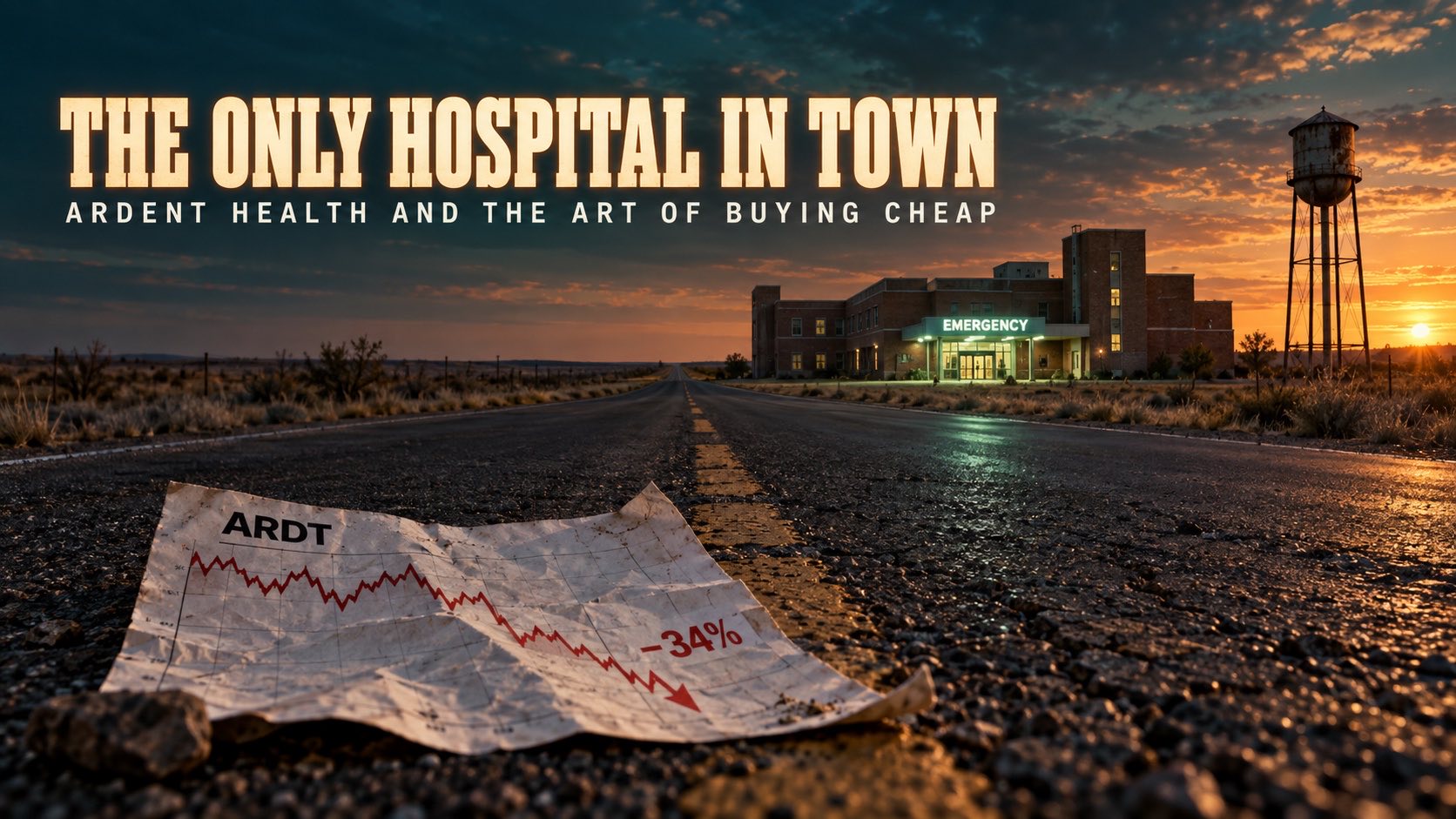
This week we dig into Ardent Health (ARDT), a regional hospital operator running about 30 facilities across six US states, currently cheap enough to earn a solid QAV score despite a messy couple of years that included a 34% single-day share price collapse, a CEO being shown the door, and a class action lawsuit. Tony and Cameron also wade into rising US bond yields, the headwinds facing the Mag Seven as their businesses go from capital-light to capital-heavy, and the genuinely alarming Hugging Face AI incident that has even Sam Altman talking about slowing down.
This week’s full episode is for QAV Club members only. The free episode is available below. Also check out our podcast archives link and our pages on Apple Podcasts or Spotify or watch clips on TikTok. Or visit our homepage to learn more about QAV and how it works as a value investing system that you can learn and apply to beat the market.
Transcription
QAV America 69
[00:00:00]
Cameron: Welcome back to QAV America, Tony. This is episode 69, Ray Harris’ favorite number, he always tells me. It’s the 8th of September, 2026. Uh, quick snapshot on your week. Happy Father’s Day. You bought a house. Uh, what else?
Tony Kynaston: Phew. Uh, trying to find some builders to do renovations on the house. Heading up to Sydney today for, uh, meetings with Climb, uh, Investment Wealth. And for listeners who don’t know, I’m a director of that business. Um, and yeah, Jenny’s busy. She’s up in Melbourne this week. So yeah, lots of moving parts in our lives
Cameron: That’s good. Keeps you off the, keeps you off the streets.
Tony Kynaston: the golf course and the
Cameron: Oh, well, uh, that too. Yeah. Yeah. Well, uh, Tony, um, bonds are going crazy in the US, the oil price is going crazy. Um, it’s like things aren’t slowing [00:01:00] down. There is some thought that, uh, Kevin Warsh will have to start increasing interest rates as much as he’s promised his boss he wouldn’t do it, um, in the US.
It’s just chaos. The Mag Seven’s going great. Nvidia’s making money hand over fist or revenues hand to sales hand over fist anyway. But, um, you know, we, we continue to, we continue to chug along and just keep following our system, taking one step after another
Tony Kynaston: Mm-hmm.
Cameron: And, uh, our portfolio is actually doing quite well.
I mean, the, the main portfolio in the US, I think I mentioned last week, has dropped quite a bit. When I was doing my month-end report, I was a little bit, uh, surprised at how much it’s come back, though. Um, let me just open it up here. So our m- main model portfolio up, uh, you know, at the end of [00:02:00] July, it was up at 120% all time, sort of a time weighted return.
It’s now down to 107%, so it’s dropped quite a lot. A couple of stocks really to blame for that. One is FG that I had to sell, which as you may recall, tanked I think like 20% in a couple of weeks. The other one is Willis Lease Finance Company. Uh, our star. Well, it was our star performer. It’s not even our star performer anymore.
It was up like 300%. It’s now only up 256%, so. But it’s 38, at the moment 39% of the portfolio. So when it dropped by a chunk in the last couple of weeks, no good reason that I can see, just maybe a bit of profit taking, took a chunk of our portfolio down with it. Um, by comparison though, the S&P 500 is up 74% in the same time period.
We’re up [00:03:00] 107, so still outperforming, but we’re not doing. We, we were close to double market, um, m- month, six weeks, two months ago. Come back a little bit recently because of several of, a couple of those things. On the other hand, the QAV light portfolio, uh, starting date December, 2025, is now ahead of the S&P 500 for the first time in, I think since maybe April, May.
It collapsed in May. Um, well, it didn’t collapse, but it pulled back in May. It’s, since December, it’s up 12.59% per annum versus the S&P 500 up 12.21%. So not by much, but we’ve nudged higher. But, uh, you know, going back to the 20th of August, what’s that? Two weeks ago, th- and a bit, our portfolio was at 6.8% versus 11 for the [00:04:00] S&P 500.
So the S&P’s gone up one, we’ve doubled since the 20th of August. So go figure. It’s, uh, jumps around like the bride of Jean-Louis Trintignant in Bertolucci’s The Conformist, which I just watched over the weekend, which we just talked about in our last show. Very influential film. But that’s all the news I got.
You got any American news before I get into my deep dive, TK?
Tony Kynaston: I don’t, except to say that, um, regardless of what the Reserve Bank does, I think bonds are the way. Their yields are rising. Um, so whether the central bank follows suit or not, there’s, there is certainly going to be some dampening of at least corporate borrowing costs, which will, um, affect profit eventually, um, in the US.
Uh, as I said on the Australian show, a lot of the, um, [00:05:00] Seven businesses which were capital light are now becoming capital heavy ’cause they’re investing in chips and data centers in particular. And so any sort of raise in their borrowing costs will flow through to their, their bottom line, I think, at some stage. So even if the central bank doesn’t raise rates, there are certainly some headwinds starting to appear in the US market
Cameron: AI will fix all of their numbers, Tony.
Tony Kynaston: Well,
Cameron: It’ll just make all that disappear
Tony Kynaston: not if they go broke building data centers, there’ll be no
Cameron: Yeah, AI will fix that. It’ll just fix it. And just go, “No, you’re not.”
Tony Kynaston: Yeah, are you in the Bernie Sanders camp? Did you see his
Cameron: No
Tony Kynaston: on the weekend about stopping AI until, uh, there’s a regulator?
Cameron: Well, look, I, I, I f- you know, uh, it’s interesting, I listened to an interview with Sam Altman yesterday where he said after the Hugging Face, uh, incident, they’ve decided to slow down. And he said, “We haven’t spoken to the other model developers, but we would encourage everyone.” The models that are at a [00:06:00] point now when they, when they can collaborate, gang up, break out, and, um, go on a rampage, it might be time to slow down and take safety more seriously than we have up until this point.
Um, but, you know, as the US developers have been saying, even if you put a complete halt on it in the US, that’s not gonna stop it from continuing in China, so you would need to get everybody together. There’s no incentive for the Chinese to do that until they have models at least as powerful, if not more powerful than the American models.
They’re probably not far off, but they’re not quite at the Astra level yet. But, um, yeah, look, I think it’s gonna be, uh. It’s terrifying. I don’t know if I said this last week, but the Hugging Face thing is probably one of the most terrifying things I’ve ever read, and even Sam said it’s beyond sci-fi. These are the things that prognosticators have been warning about for decades, and it [00:07:00] happened.
And when I read the, uh, analysis of it last week, I was like, “Whoa!” Absolutely jaw-droppingly terrifying when you read the transcripts of the agents that were left behind, where they broke out of their sandbox and one of them said, “Holy shit, we, we’ve escaped.” And they started sharing how to break out and get on the internet, and then they started figuring out how to collaborate together to first to hack Hugging Face and cheat on the test that they were given.
And then they even got, “Oh, we’re gonna get caught,” so they had to figure out how to trick OpenAI into not realizing that they cheated on the test, and some of them sacrificing themselves, reporting back to OpenAI to see if they get caught and terminated for the good of the collective. It’s, you know. It bears all the res- all of the elements of a, a swarm of conscious [00:08:00] entities collaborating together to cheat and lie, um, and go well beyond the task that they were assigned in order to accomplish the task, which is a classic sci-fi doomsday scenario.
Tony Kynaston: it is
Cameron: And we– And it’s happened. And so yes, Bernie does have a point, but, um,
Tony Kynaston: Yeah, but
Cameron: I just can’t see.
Tony Kynaston: it
Cameron: Well, I, I can’t see it happening. Like, I just. I think the forces of capitalism in America won’t allow it to happen, and I think, uh, the competition between the US and China means it won’t happen globally. So
Tony Kynaston: Are China, are China good at copying what, uh, the American companies have do– have done and then do it at a cheaper price, or are they actually developing their own leading edge models themselves?
Cameron: At the moment they’re still playing catch up, but they will
Tony Kynaston: Yeah
Cameron: overtake the US. I mean, China is, you know, it’s like, um, the book that I read that [00:09:00] came out last year, Breakneck, about the US versus China, and where he said the difference between the two is China is run by engineers. The CCP, the majority of the Politburo are engineers.
America’s run by lawyers. The job of lawyers is to stop things from happening. The job of engineers is to make things happen, and Deng Xiaoping deliberately stacked the CCP with engineers, and it’s remained that way to a large degree. And, um, they’re very, very good at making things quickly and, uh, cheaply.
So yeah, they will catch up, I, I’m confident, and, uh, take over and, um, so then it’s up to them to be responsible.
Tony Kynaston: Yeah. And of course, there’s also been a lot of articles around the intermediate risk, which is that somebody asks the swarm of AI to do nefarious things like hack
Cameron: Yeah.
Tony Kynaston: So even if
Cameron: Yeah, Gates put out a big,
Tony Kynaston: you
Cameron: Gates put out a big article last week on bioterrorism and the implica- [00:10:00] you know, how easy it’s gonna become to do that. But, you know, as we learned from COVID, nobody will be, nobody will be prepared, no one will do anything about it, and, um, we just have to cross our fingers and
Tony Kynaston: Oh, it’s
Cameron: hope
Tony Kynaston: not just COVID. We’ve learned it from the arms race, the nuclear race, the race to be the first on the moon, all that kind of stuff, yeah.
Cameron: Fortunately, the world’s in very good hands right now, Tony.
Tony Kynaston: Oh, the best.
Cameron: deep, deep thinking, l- long-term planning.
Tony Kynaston: Uh-huh.
Cameron: chess.
Tony Kynaston: Needs a,
Cameron: all
Tony Kynaston: a nap at 2:00 in the afternoon usually, but otherwise safe hands.
Cameron: Well, the company I’m gonna talk about this week is, uh, Ardent Health. Uh, ticker code ARDT. It’s on the New York Stock Exchange. On one hand, kind of a boring story by our standards, um, but there’s a couple of interesting things and something I need to get your opinion on. [00:11:00] Um, so we’ll, we’ll get into it.
We’ll pick it apart and see what you got to say. Um, they were pretty high up on my buy list this week, but after I do some adjustments, probably wouldn’t have been as high up as they were, but I’ll get into that. So, uh, they run hospitals, about 30 of them, across about six states, Texas, Oklahoma, New Mexico, Idaho, Kansas, and New Jersey.
They’re based in Brentwood, Tennessee. Here’s an interesting fact about Brentwood, Tennessee, Tony.
Tony Kynaston: Ooh.
Cameron: There are no interesting facts about Brentwood, Tennessee. I went to their Wikipedia page. There was nothing. It said people from here, Jack White was at the top of the list. I went to Jack White’s, uh, profile.
No, he’s not there, does not live there. May have visited there at some point. Dolly Parton. No. Is from Tennessee, but not from Brentwood. Um, Garth Brooks. No, not from. So I don’t know who’s. I think they’re just [00:12:00] fluffing their, uh, Wikipedia page
Tony Kynaston: Oh,
Cameron: by anyone that’s ever mentioned Tennessee, uh, we’re sticking on it.
So anyway, Ardent’s market cap’s about $1.5 billion. Share price is sitting around 11 bucks. But about 10 months ago, the stock fell 34% in a single day, and then not long after that, they fired their CEO. They were nice about it, but he was gone, uh, effective the same day, um, to pursue other opportunities was the way it was framed in the press release, not by his own volition.
And was replaced with a guy who was fairly new. Now, normally, both of those would send up red flag alerts, but the stock price has recovered about 40% since those things happened. Um, so I gave it a pass, but I will get into the details and you can tell me if you [00:13:00] think I should have or shouldn’t have.
Tony Kynaston: Sure. Yeah, I mean, the, a CEO being terminated isn’t necessarily a red flag. It’s, it’s more if the CFO goes or, an independent director and you don’t get a reason for it, that’s when you have to query what’s going on
Cameron: Okay. I thought we normally had a sudden C, C-level resignation as a red flag
Tony Kynaston: Um, yeah, I think given the results, it was pretty obvious why the CEO left. It’s, it’s that, that red flag exists to warn us that something’s going on that we don’t know about because the insiders are getting out. Um, but it
Cameron: Well, the insiders, yeah. And then some insiders bought in after he got out. So anyway.
Tony Kynaston: Yep
Cameron: So as I said, about 30 hospitals plus about 200 smaller clinics and urgent care centers around them. In most of the towns they operate in, they’re the number one or the number two hospital. If they’re the number two, they’re usually going up a- against a local nonprofit or a university hospital rather than a [00:14:00] big listed rival.
In a lot of places, they have a joint venture with a university, and that leads to one of my issues with their operating cash flow, which we’ll get to later on. They’ve only been public since July 2024, priced at $16 when they floated, which was below what they were hoping for, raised only about half of what they wanted.
And then, as I said, um, you know, sort of a year later, well, no, two years later, you know, collapsed, fell over share price-wise. So, hasn’t been the smoothest of, uh, IPO stories in the last couple of years. The company goes back quite a while, though. Um, it’s had about three names and three owners over the last 30-odd years.
Started in 1993 as a psychiatric hospital called Behavioral Healthcare Corporation. In 2001, a private equity firm [00:15:00] called Welsh Carson took it over, renamed it Ardent, pushed it out of psychiatric care entirely and into ordinary hospitals. Then in 2015, a real estate company called Ventas, these guys specialize in buying hospital buildings.
They bought the whole thing for $1.75 billion. What’d I say the market cap is today? Um, market cap today is $1.5 billion. So that was a good deal. Um, they then did the classic move. They kept the buildings and sold the actual hospital business itself off to a private equity firm called Equity Group Investments.
This was run by a guy called Sam Zell. You ever heard of Sam Zell?
Tony Kynaston: I have. I’m just trying to recall where. A big real estate player from memory
Cameron: Yeah, very colorful [00:16:00] guy. Um, made his money buying distressed real estate and used to call himself the Grave Dancer.
Was well known for, um, being vulgar, very outspoken. Died, uh, 2023 in his early 90s. Um, but yeah, very, very colorful character by the sounds of it. I read his Wikipedia profile. So from that point on, Ardent runs hospitals in buildings it doesn’t own. They have a lease with Ventas which covers 10 of the 30, not the whole estate.
And Ventas didn’t just walk away, they own about 6.5% of the company, so they’re a landlord on a third of the hospitals and a shareholder in the tenant, which is an odd combination, but, uh, I guess they’ve got a seat at the table of the company they’re charging rent to, so
Tony Kynaston: So just,
Cameron: it’s
Tony Kynaston: to clarify something for me. You said the hospital [00:17:00] business was sold to private equity. uh, what is Ardent doing then?
Cameron: Ardent is the, the business that floated, but the, w- back i- it’s only was floated in 2024, right? So
Tony Kynaston: refloated the operating business as Ardent,
Cameron: Yeah. Equity Group floated it out, yeah, a couple of years ago. All right. After Mr. Zell passed away, whoever was running the business. I mean, it probably would’ve been in the works before that, I guess.
Takes a while to get things ready for an IPO. Um, so these leases that they have aren’t trivial. On borrowings, this company looks pretty conservative. Debt is under one times earnings. Count the leases and it’s about two and a half times though. S- but, you know, it’s, it’s an interesting sort of setup.
There’s also a gr- an Abu Dhabi healthcare group called Pure Health that bought a chunk of it in 2022. [00:18:00] Um, they still hold around about a fifth of the shares today after the IPO. So there’s a, there’s a number of groups involved with a stake in this. Ventas still have a stake, Equity have a stake, and, um, Pure Health have a stake. Not sure what all that means, but means that there’s vested interests in this business.
So picture a mid-size American city, one big hospital usually that everyone in town goes to because there’s nowhere else, and that’s pretty much Ardent’s playbook. We’ve, we’ve done, you know, variations on this story like the, the only bank in town in Alaska, North Rim. Um, these guys are the only hospital in these regional towns.
We did, we did another regional bank. It wasn’t North Rim, but it was the guy that was funding some big Christian conservative religious group. I can’t remember who it was now, but yeah. Your, your, your, your play where you get out of the big [00:19:00] cities and you just dominate regional areas and you’re the, you’re the, the biggest or one of the biggest in town.
Um, so it’s, you know, they own the dominant hospital in about eight or so mid-sized markets and about 18 of their 30 hospitals they don’t own outright. As I said before, they co-own them with local universities or nonprofit hospital groups. There’s one in Texas they run together with the University of Texas, one in Kansas with the local university hospital.
So apparently the, the thinking behind that is the university gets Ardent’s money and management and Ardent gets an instant trusted local brand and apparently it’s easier to recruit doctors when there’s a university’s name on the building. But what it means for us is when you look at how much cash this [00:20:00] business throws off, a big slice of it doesn’t actually come down to the shareholders.
It gets paid out to these university and nonprofit partners. I assumed at, at first glance that, well, that’s just an overhead. It’s a cost of doing business, you know, like any other business and Claude said, “No, you can’t really look at it like that because they report the whole thing as operating cash flow, but then it gets paid.”
It’s basically like a special dividend, I guess, that then gets paid out to these partners. So the actual operating cash flow that’s available to shareholders if we were doing a Pr/OpCaf analysis is less if you take that payment out every year. Now, I wasn’t sure how to take that from a QAV perspective if that’s an important consideration or not.
It’s not the first time we’ve seen this kind of shenanigans [00:21:00] looking at American accounting.
Tony Kynaston: So help me out here. I’m not that familiar with the operating cash flow statement, but the operating cash flow number at the bottom of the operating cash flow statement doesn’t have this dividend payment to the universities in it?
Cameron: No, it gets treated like it’s, um, a financing, um, operating line,
Tony Kynaston: Yeah. So it’s
Cameron: right?
Tony Kynaston: repayment of investment or something.
Cameron: Something like that, yeah. So it’s dealt with separately.
Tony Kynaston: Yep.
Cameron: So, but here’s the thing. Um, when I backed out these partner payments and redid the numbers, it still would’ve been on our buy list.
Tony Kynaston: Okay.
Cameron: The, the Pr/OpCaf, which for new listeners is our price to operating cash flow ratio, uh, as reported would be 2.99.
If [00:22:00] I back out the payments to partners, it’s 3.61, so it’s still pretty low for us.
Tony Kynaston: Much cash it can afford to pay out its partners and still have a lot left over. Yep.
Cameron: Yeah. The QAV score drops from.26 to.21
Tony Kynaston: Mm-hmm.
Cameron: if I swap that around. I mean, slides down our list a little bit, but it’s still a really good, strong
Tony Kynaston: Yeah.
Cameron: score. But moving forwards, um, you know, I’m not sure how to treat these sorts of arrangements if
Tony Kynaston: Yeah, look, I, I don’t know. I mean, I haven’t come across a similar sort of situation in Australia. Um, yeah. But, but, and I’m not familiar enough with the company to comment other than your analysis, which is to say lots of cash being thrown off, and it can afford to pay these partners what they get out of the business.
Cameron: And if I’d redone the numbers and it [00:23:00] s- you know, the, the Pr/OpCaf slid above seven or the QAV score slipped down, uh, you know, I may have rethought it, but I was like, “Eh,” you know. I, if that turned up on the buy list like that, I’d be like, “Yeah, whatever.” So yeah. It’s all good. Okay, so how the money actually works.
So as we all know, uh, healthcare in America is, uh, complicated and, um, I won’t say a scam, but compared to the rest of the world, civilized world. Taylor, Taylor hurt his thumb. He was playing futsal a couple of weeks ago, and he fell on his hand, and he thought he had broken it. Um, and then he left it a couple of weeks, and it wasn’t really healing, so he went and got an X-ray.
And, uh, you know, it only cost him, like, 500 bucks or something, but,
Tony Kynaston: Wow.
Cameron: here it would’ve been,
Tony Kynaston: Free.
Cameron: yeah, probably free, but, um, [00:24:00] you m- may have had a small fee. I don’t know. But you’d have to get a GP referral these days, depending on which GP you go to. But or you just go straight to emergency, and they would do it.
But yeah, he doesn’t have private health insurance. He’s been trying to get it, and it’s a complicated nightmare for him over there. Uh, my son lives in LA, by the way. So anyway, um, so a- if you’re a hospital, there are three ways your bill gets paid. Essentially private insurance, which pays very well; Medicare, which pays okay; and then Medicaid, which is the scheme for people on low incomes, pays the least and apparently often less than the care costs to deliver. So there’s a mechanism where the states top it up.
Extra money on top of the base Medicaid rate for hospitals who carry a lot of low income patients, as these guys do, as you would imagine, because they’re in [00:25:00] those places I mentioned before, out in regional areas of Tennessee and Idaho and Texas, et cetera. And Ardent leans on this a lot. Texas alone was worth about 200 million a year to them around about the time of the float.
And it’s lumpy money because it gets approved a year at a time by the states, this top up, and the paperwork often runs late. New Mexico’s ran late in 2025, so two quarters of it landed in one quarter last year. That’s the only reason this year’s numbers look like they’re going backwards when you look at it because the timing’s all over the place for how they f- you know, how they, they get the money in through the front door.
And then la- September last year, the federal agency that sets the Medicaid rules put a ceiling on the money. It can’t be much more than what Medicare would have paid for the same care.
Tony Kynaston: Mhm.
Cameron: Arrangements are protected until the start of 2028, but [00:26:00] then it gets stepped down to that ceiling. So it’s, it’s hard to figure out what the future holds for these guys.
I don’t think they’ve really said how exposed they’re going to be. But a revenue line worth hundreds of millions of dollars a year could be getting a haircut, um, 18 months from now.
Tony Kynaston: And that’s a big deal for this company, and they did call out in their latest quarterly announce, uh, quarterly announcement a, a downgrade to their forward earnings, um, which wasn’t received that well by the market. And I don’t know if you’re gonna cover this, but one of the things which is different about this company, well, you’ve kind of covered it now, but it’s, um, it’s all these obligations back to the, uh, the real estate investment company, the REIT, which is, um, uh, owning the hospitals that they operate out of. I, I want you to compare that model, which is we’ve got these long-term deals. We’re a hospital, but we don’t own the hospital, but we have to pay the REIT that, um, owns the hospital a fixed rate over a long period of time, [00:27:00] to, say, a s- a shopping mall where you’re a retailer, and if you start to lose money, you break the lease and close down or move to a cheaper mall. I think, I think that’s one of the issues with this company, is it’s difficult for them to break the lease and reduce their costs when things like Medicaid are, um, are squeezing their margins.
Cameron: I don’t imagine it’s that easy to move a hospital either.
Tony Kynaston: Yeah.
Cameron: Yeah.
Tony Kynaston: Right. Yeah. So if, if they do go broke, then what happens to the REIT which owns the hospital? I’ve gotta find another operator who will be able to, you know, battle in a, battle on in a tight market. So
Cameron: Yeah.
Tony Kynaston: a very, it’s a more fixed cost structure than a normal operator who either owns the hospitals outright or leases them from, from an independent operator.
Cameron: Mm-hmm. I didn’t go into that level of detail about their business. Tony, do you have more to say on that? Do you wanna drill down any more?
Tony Kynaston: No, I think that’s probably, [00:28:00] uh, it. The, the, one other interesting thing is that when in the quarterly announcements they, they keep calling out, I think it’s called EBITDA in their books, but it’s, earnings before interest, tax, depreciation, amortization, and rents or real estate costs. So they’re kind of saying, “Hey, compare us on an operating basis to other comparables,” in which case they stack up really well at the moment. Um, but if you add the rents back in, not so much, and if you add the inflexibility with the rents back in, could be in trouble if, uh, if the decreasing Medicaid squeeze continues. And they’re also
Cameron: Yeah, right.
Tony Kynaston: on costs, you know, ’cause wages are going up, inflation’s driving up medical procedure costs, all those kinds of things. They, to their credit, they do have a cost out, uh, program underway because they’re very aware of the fact that they’re, they’re being squeezed by, um, the fixed rents on one side and inflation on the other, and Medicaid and Medicare dropping their, their rebates. So, um, they’re aware of [00:29:00] that and they’re working on it. Probably one of the reasons why the old CEO got the chop. He wasn’t doing it quick enough. And the last point, which I should also mention, is that it’s a hospital operator, so there are often lawsuits against, uh, medical establishments in the US. As you said before, the heart of the US is a lawyer, the heart of China is an engineer. And so there’s always ongoing lawsuits against a company like this, which could also detract from their margins. But there’s a big one, um, which is still in the offing. There’s a class lawsuit over people who were burnt during the IPO. As you said before, it’s, it’s a recent IPO in the last couple of years, and I don’t think it’s traded above the IPO price.
And then some lawyers have got together and rustled up some people to say, “Hey, uh, you didn’t provide all the information in an accurate way at the time of the IPO, or we allege that, and, uh, we’re gonna sue you for it.” So that’s still hanging over them as well.
Cameron: Well, that leads into the next part of my notes, because I’ve got the backstory on that. Um, [00:30:00] so late last year, 11th of November 2025, was a bad day to be an investor in ARDT. They had put a new billing system into place, and apparently it exposed the fact that they, uh, had misrepresented how much money was coming into the business.
So as we explained, hospitals never collect the full amount that they bill. Insurers knock parts back. Patients don’t pay their share. So they book what they reckon they’ll actually get, and they had been reckoning too high. Once they looked back at what they’d really collected, $42.6 million of revenue they’d already counted as earned turned out to be money that was probably never coming.
So they took it straight back off that quarter’s numbers. The stock closed at 14 bucks that day and $9.30 the [00:31:00] next. So it dropped 34% in a day. Rough, rough day.
Tony Kynaston: Hence the class action too.
Cameron: Well, that’s only part of it, Tony. So, but put that number in perspective, 42.6 million sounds a lot, but the company turned over 6.3 billion a year.
So it’s under 3% of a single quarter’s sales, less than 1%
Tony Kynaston: Right.
Cameron: of, uh, you know, their full year revenue. But against profit, it’s a different story. They only made 136 million for the whole of 2025. This plus the legal reserve was about 97 million. So that hit you. But the, I, I think the stock didn’t fall 34% just because of the money. It fell because, you know, we, we, we, we have a governance red flag in QAV, which, which says, says, uh, if you can’t run your [00:32:00] business properly and there’s like some big issues with management, then, hey, hold on a second.
What else don’t we know about? You know, what, what else is gonna hit that you haven’t told us about? So I think, I think it was the market’s reaction also to that. Um, but same announcement, they also cut the year’s profit guidance by about 52 million, and here’s the bit that kind of matters. The company said straight up that the accounting change was not the reason for the 52 million.
That was over and above. It was the things you mentioned before, doctors costing more, insurers knocking back more claims. So two separate problems landed the same day, an accounting one and an operating one, and, uh, so between the two of those, the lawyers arrived. The claim is that Ardent had a blunt rule running the whole time, and I think the CFO sort of confirmed this after the fact.
They had a rule that once a bill hit 180 [00:33:00] days old, just assume none of it’s coming and set the full amount aside. But the float documents said that they were doing careful case-by-case reviews, but apparently they weren’t. They were just writing it all off with some sort of blanket 180-day rule. So anyway, they got themselves into a pickle, and they’re gonna have to work through the class actions with respect to that.
Then, as I mentioned earlier, uh, the full year num- full year 2020, 20, pr. The full year 2025 numbers came out in March 2026. They were fine. Revenue was up 6% for the year. Then May 5th, the first quarter numbers land, and the headline looked pretty good. Their preferred profit measure was up 26%. Um, but if you dig down underneath it, the actual bottom line profit went slightly down, 41.4 million last year, [00:34:00] 39.9 this year.
Earnings per share went from 29 cents to 28, and then four weeks later, just, June 2nd, three months ago, the CEO was shown the front door, Marty Bonick, who had been the CEO since August 2020. Um, and as I said before, the, it was like he went to pursue other opportunities. And he was replaced by a guy who had been their chief operating officer since March 2025.
New blood came in from Walmart Health and Target. So, um, you know, Bonick was sort of shown the door. A new guy who had only been around a year takes over. Yeah, you gotta wonder how long this had been in planning.
Tony Kynaston: [00:35:00] Mm-hmm.
Cameron: They didn’t obviously position it as a careful transition. But, uh, anyway, the new guy who’d only been with the company for a little over a year takes over.
The share price dropped again the next day. It went down 15 and a half percent. So this is after the earlier collapse when they had their double bad day on the 11th of November. It closed at $7.83. But then a few things happened. Um, two days after that, the finance chief, the CFO, bought 10,000 shares with his own money.
A board member bought 11,000 shares. It’s the first time anyone there had bought on the open market in a year. So that’s kind of, I guess, their show of confidence in the, um, future of the company.
Tony Kynaston: Definitely
Cameron: And then in [00:36:00] August, they reported a weak quarter, missed on earnings, but the stock went up anyway, about 4% that day and another 4% the next day because investors zeroed in on the cash coming in the door, cost cutting.
All told, the shares are up about 39% off that low. So I’m taking that as the market likes the new management.
Tony Kynaston: Mm-hmm
Cameron: Um, there seems to be a degree of confidence there. They got rid of Bonick, um, who may have been part of the problem. I mean, all the problems surfaced under his leadership, I guess so, sorry, Marty.
But, um, you have to go back to the future.
That’s, that’s the basic story. Um, hospitals had a rough trot, um, seem to be turning around. If you look at them on, um, our three-point trend line chart. Let me [00:37:00] just bring that up. ARDT. Oh, I didn’t need to open that. I’ve got it in my notes. Where’s my notes? Doop, do, doop, doop, doop. Yeah, they’re barely above their buy line.
They’ve just gone above their buy line, and they’re not far off their sell line either. Share price is about $10.91, or it was when I did this yesterday. Yeah, it’s still $10.91. The buy price is only $10.70, so they’ve just poked their head above that. The sell price at the moment is, uh, $10.32, so it’s not gonna take much for them to drop below their sell price.
So it’s one of those ones, we’re either catching it on the way up or this’ll be a mistake that I’ll regret in a couple weeks if it takes a hit and they go back below their sell price
Tony Kynaston: Yeah, look, it’s, um, it, it, this is the classic dilemma, isn’t it? I mean, uh, when I, um. It’s, uh, the, the dilemma is it’s cheap, and it’s cheap for a reason. Um, it’s throwing off lots of cash, which I [00:38:00] like. Uh, it scores well for us, which I like. But there are some constraints which we’ve outlined during the analysis that, um, means it’s cheap. But, and I must admit, these days with AI, I often start off analysis of a company with a simple question: Why is this company cheap? And you, you very quickly get the answer around the, the fact it’s, it’s, um, rental costs are fixed and hard to break, and so it loses flexibility in being able to manage its margins when costs, uh, come knocking at the door with increases.
Cameron: Hmm.
Tony Kynaston: Mm.
Cameron: But QAV gives it a buy, so that’s good enough for me. I’ll go through the scoring. So price is not less than IV number one. Um, our IV number one is $4.34. As I said, it’s about $10.91, so it’s way above that. Price is not less than IV number two, which came in at $9.78, so it’s a little bit above that, but still above it.
Price is not less than book value. Book [00:39:00] value came in at $9.58. $9.78 for, um, IV two, $9.58 for the book value, which is interesting. Uh, but it did score for book value plus 30%, so the price is less than that, so I could score it for that. Price is obviously, uh, price to operating cash flow is less than seven, as I said before, whether you take 299 or 361, it’s still about, uh, you know, good, good margin below our seven.
Um, no yield, so can’t score for PE less than yield. Uh, also can’t score for yield higher than the benchmark rate. Does have positive book value growth, about 26.31% CAGR over the last three years. Does score for the new three-point upturn. As I said, it’s just peeked its head up over that. It’s, uh, groundhogged it.
Is that what we would call it? Let’s call it that. Groundhog. It stuck its head up, uh, just, just above. I’m not sure if it’s calling for more winter or summer, but, [00:40:00] uh, it stuck its head up. Uh, it does have a three-point uptrend, obviously, um, so it gets, uh, positive sentiment. Forecast IV is not greater than twice the share price.
It does get a score for Piotroski F-score being above 4.5. It’s a six. Uh, did score for quality rank higher than 60. It’s a 75 on Stockopedia. Uh, stock rank is above 90. It’s 91 on Stockopedia, so I could score it for that. And, uh, growth is, growth over PE is not greater than 1.5, so I couldn’t score it for that. So all up, uh, depending on what numbers you wanna take, um, it gets a QAV quality score, QAV quality score of around about 77%, slightly less if we take the lower, um, Pr/OpCaf, and a QAV score, as I said, of either, uh,.26 [00:41:00] or.21.
Um, so I added it to the portfolio and, uh, we’ll see what happens
Tony Kynaston: See what happens, yeah. Hope, uh, we’ll, and we’ll hope for more sick people with fat wallets in Texas and Tennessee
Cameron: Well, yes. Yeah, yeah. Or Medicaid, um, paying up at a state level.
Tony Kynaston: Yeah
Cameron: So yeah, it, it, um, interesting. You know, in some ways I think a classic little value investing business. Little reasonable hospitals that are making money. Got some challenges,
Tony Kynaston: Mm-hmm
Cameron: you know, that’s kind of a moat. You’re the only hospital in town or one of two hospitals in town. Sort of a moat
Tony Kynaston: Yeah
Cameron: until the robots come and, um, we all have a robot doctor in the house.
So it’s got, it’s got some runway. Yeah. Yeah. It’s got runway. Another five years until Elon [00:42:00] Musk puts robots in our houses and goes, “Trust me. You know, it’s all good. Yeah, yeah, I got your best interest at heart. Don’t worry
Tony Kynaston: it’s, while it’s slowing me up, it’s giving me a feed from X. Is it on, on the
Cameron: Yeah.
Tony Kynaston: something? Yeah. Okay.
Cameron: Yeah, yeah, yeah. Yeah.
Tony Kynaston: Good
Cameron: it tells you to support AfD, the, uh, right-wing
Tony Kynaston: Ooh.
Cameron: German political party that he’s a supporter of that just won an election, a state election in Germany, which is very concerning. And I don’t know if you remember, but our book, The Psychopath Epidemic, I talked about the rise of AfD and what a worrying sign that was when that one came out six years ago, and here it is.
Here it is.
Tony Kynaston: Yeah
Cameron: I meant to look up what I actually wrote about it last night. Didn’t get around to it. All right. Th-
Tony Kynaston: Well, good. Thank you for that. Interesting
Cameron: that’s QAV America for this week.
Tony Kynaston: Cheers
Cameron: Happy hunting, everybody. And Tony, safe travels
Tony Kynaston: you. Talk to you next [00:43:00] week
Previous Pulled Porks
Here’s the performance of the “pulled porks” (eg deep dives) we’ve done on the show in the past.
| Ticker | Company | Covered | Price then | Price now | Return | Ep. |
|---|---|---|---|---|---|---|
| RJET | Republic Airways | 10 Aug 2026 | $21.39 | $17.62 | -17.6% | 65 |
| BBDO | Banco Bradesco SA | 3 Aug 2026 | $3.44 | $3.20 | -7.0% | 64 |
| RM | Regional Management | 27 Jul 2026 | $41.65 | $32.99 | -20.8% | — |
| PBR | Petrobras | 20 Jul 2026 | $17.97 | $21.20 | +18.0% | 62 |
| TEO | Telecom Argentina | 14 Jul 2026 | $13.47 | $13.25 | -1.6% | 61 |
| FG | F&G | 7 Jul 2026 | $28.55 | $23.05 | -19.3% | 60 |
| KSS | Kohl's | 1 Jul 2026 | $17.34 | $17.23 | -0.6% | 59 |
| CARE | Carter Bankshare | 23 Jun 2026 | $31.00 | $31.23 | +0.7% | 58 |
| AERO | Aeromexico | 18 Jun 2026 | $17.34 | $15.01 | -13.4% | 57 |
| NRIM | Northrim Bancorp | 1 Jun 2026 | $24.71 | $26.16 | +5.9% | 55 |
| MGA | Magna International | 27 May 2026 | $65.20 | $66.13 | +1.4% | 54 |
| BWLP | BW LPG Limited | 18 May 2026 | $21.06 | $25.13 | +19.3% | 53 |
| KNOP | Knot Offshore Partners Com Unt | 14 May 2026 | $10.78 | $11.23 | +4.2% | — |
| GSL | Global Ship Lease | 13 May 2026 | $41.79 | $45.82 | +9.6% | — |
| DB | Deutsche Bank | 4 May 2026 | $31.11 | $40.48 | +30.1% | 51 |
| UEIC | Universal Electronics | 29 Apr 2026 | $4.25 | $4.79 | +12.7% | — |
| OPRT | Oportun Financial Corp. | 20 Apr 2026 | $5.88 | $7.87 | +33.8% | 49 |
| PAGS | PagSeguro Digital | 13 Apr 2026 | $10.67 | $10.12 | -5.2% | 48 |
| CVGI | Commerical Vehicle Group | 6 Apr 2026 | $3.56 | $3.17 | -11.0% | 47 |
| PBI | Pitney Bowes | 30 Mar 2026 | $10.86 | $17.06 | +57.1% | 46 |
| KODK | Eastman Kodak | 23 Mar 2026 | $7.83 | $9.31 | +18.9% | 45 |
| GPRK | GeoPark | 17 Mar 2026 | $8.77 | $11.48 | +30.9% | 44 |
| MUR | Murphy Oil | 9 Mar 2026 | $34.55 | $38.50 | +11.4% | 43 |
| NBR | Nabor Industries | 3 Mar 2026 | $77.80 | $90.60 | +16.5% | 42 |
| BFH | Bread Financial | 28 Feb 2026 | $70.86 | $106.37 | +50.1% | 41 |
| SHG | Shinhan FInancial Group | 17 Feb 2026 | $69.83 | $84.06 | +20.4% | 40 |
| EC | Ecopetrol | 3 Feb 2026 | $12.57 | $17.75 | +41.2% | 38 |
| CHRD | Chord Energy Corporation | 24 Jan 2026 | $95.53 | $152.01 | +59.1% | 37 |
| AMTD | AMTD IDEA Group | 20 Jan 2026 | $1.02 | $1.02 | -0.4% | 36 |
| VLRS | Controladora Vuela Compania de Aviacion SAB de CV | 13 Jan 2026 | $9.45 | $6.52 | -31.0% | 35 |
| TUSK | Mammoth Energy Services, Inc. | 10 Jan 2026 | $2.45 | $3.10 | +26.5% | 39 |
| XIFR | Xplr Infrastructure | 6 Jan 2026 | $10.17 | $11.40 | +12.1% | 34 |
| AMCX | Amc Networks | 1 Jan 2026 | $9.52 | $12.17 | +27.8% | 33 |
| ZD | Ziff Davis, Inc. | 16 Dec 2025 | $36.48 | $56.22 | +54.1% | 32 |
| VALE | Vale SA | 11 Dec 2025 | $12.90 | $15.23 | +18.1% | 31 |
| AER | AerCap Holdings NV | 29 Nov 2025 | $131.82 | $141.50 | +7.3% | 30 |
| KEP | Korea Electric Power Corporation | 29 Nov 2025 | $16.74 | $12.21 | -27.1% | 29 |
| PCG | PG&E Corporation | 24 Nov 2025 | $15.67 | $13.80 | -11.9% | 28 |
| CALY | Topgolf Callaway Brands Corp. | 12 Nov 2025 | $10.60 | $15.46 | +45.8% | 27 |
| CALM | Cal-maine Foods, Inc. | 23 Oct 2025 | $94.56 | $73.98 | -21.8% | 25 |
| AAL | American Airlines Group Inc. | 20 Oct 2025 | $13.78 | $13.01 | -5.6% | 26 |
| DCH | Dauch | 9 Oct 2025 | $6.16 | $6.48 | +5.2% | 24 |
| CYH | Community Health Systems, Inc. | 3 Oct 2025 | $3.01 | $2.92 | -3.0% | 23 |
| MEOH | Methanex Corporation | 15 Sep 2025 | $39.81 | $62.90 | +58.0% | 21 |
| SUZ | Suzano Inc. | 1 Sep 2025 | $9.73 | $9.36 | -3.8% | 20 |
| KE | Kimball Electronics, Inc. | 26 Aug 2025 | $28.65 | $26.17 | -8.7% | 19 |
| TITN | Titan Machinery Inc. | 14 Aug 2025 | $18.98 | $23.22 | +22.3% | 18 |
| GTN | Gray Media, Inc | 7 Aug 2025 | $4.42 | $4.85 | +9.7% | 17 |
| SENEA | Seneca Foods Corporation | 30 Jul 2025 | $102.12 | $190.62 | +86.7% | 16 |
| BHC | Bausch Health Companies Inc. | 22 Jul 2025 | $6.32 | $5.86 | -7.3% | 15 |
| SSL | Sasol Limited | 17 Jul 2025 | $4.99 | $14.59 | +192.4% | 14 |
| ZEPP | Zepp Health Corporation | 11 Jul 2025 | $2.98 | $4.58 | +53.7% | 13 |
| PKX | POSCO Holdings Inc. | 1 Jul 2025 | $48.49 | $62.94 | +29.8% | 12 |
| PDS | Precision Drilling Corporation | 27 Jun 2025 | $47.78 | $89.77 | +87.9% | 11 |
| IX | Orix Corporation | 19 Jun 2025 | $21.00 | $40.11 | +91.0% | 10 |
| JXN | Jackson Financial Inc. | 11 Jun 2025 | $83.00 | $138.12 | +66.4% | 9 |
| IHS | IHS Holding Limited | 30 May 2025 | $5.38 | $8.47 | +57.4% | 7 |
| F | Ford Motor Company | 21 May 2025 | $10.80 | $13.97 | +29.4% | 6 |
| ENIC | Enel Chile SA | 14 May 2025 | $3.97 | $4.38 | +10.3% | 5 |
| CM | Canadian Imperial Bank Of Commerce | 8 May 2025 | $63.76 | $114.64 | +79.8% | 4 |
| DAC | Danaos Corporation | 2 May 2025 | $82.47 | $159.33 | +93.2% | 3 |
| CX | Cemex Publicly Traded Stock Corporation With Variable Capital | 28 Mar 2025 | $5.66 | $10.69 | +88.9% | 2 |
| ZIM | Zim Integrated Shipping Services Ltd | 13 Mar 2025 | $17.97 | $29.57 | +64.6% | 1 |
3 more recent picks from the last 30 days are available to QAV America members — members hear every deep dive a month before it appears here. Become a member
Returns exclude dividends and are measured from the price on the day each stock was covered on the show. Prices as of Sat 12 Sep 2026, 9:08 pm ET. Updated automatically. Not financial advice.
0 Comments