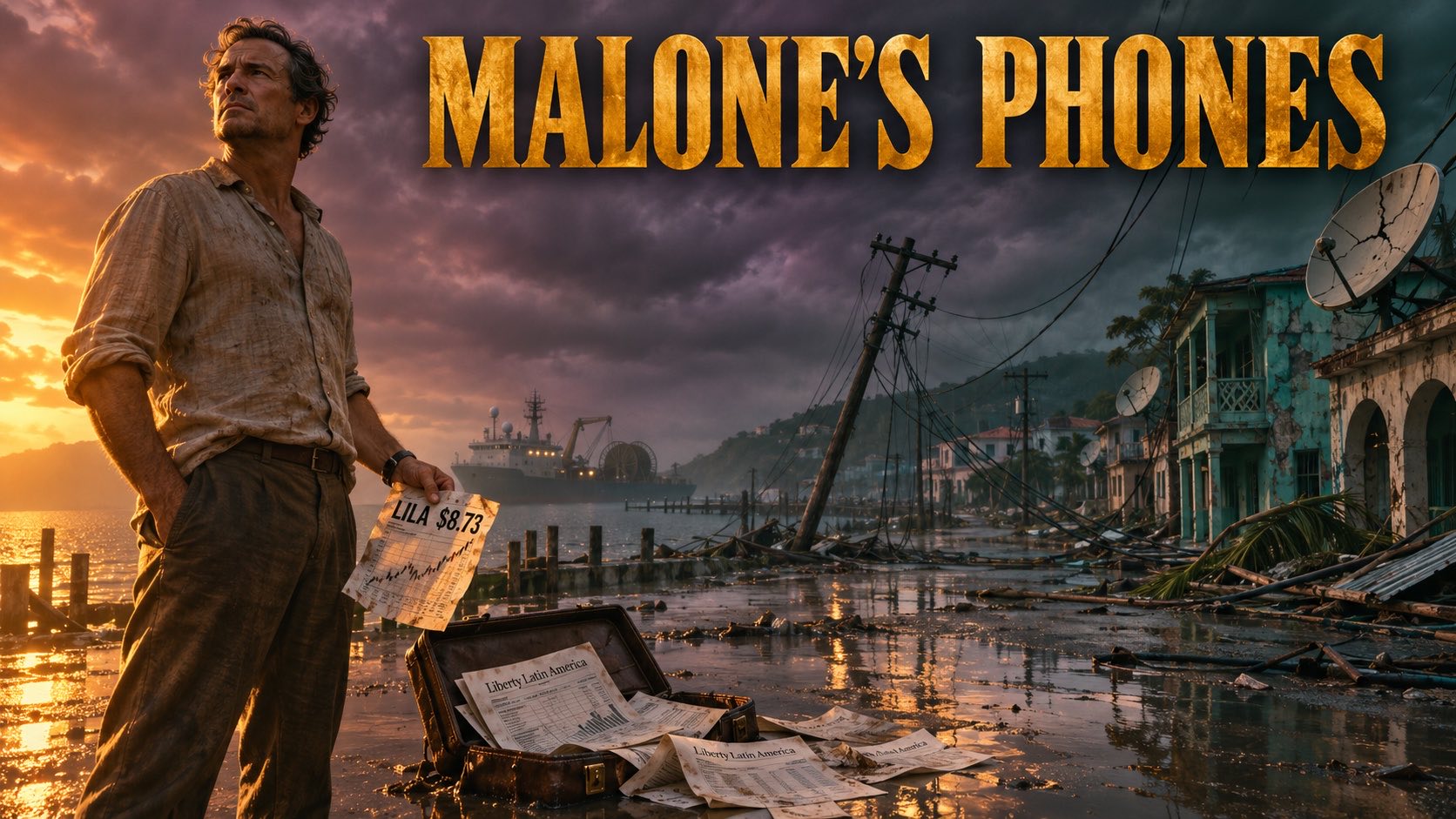
This week Cameron flies solo, checks in on both portfolios, and digs into Liberty Latin America (LILA), a John Malone-backed telco covering the Caribbean and Latin America that’s been hammered by Hurricane Melissa, a botched Puerto Rico acquisition, and a messy debt dispute. Despite a pile of problems, the QAV score comes in at a very attractive 0.36, which is why it landed on the buy list. Plus a quick read on the US midterm elections as the results roll in.
This week’s full episode is for QAV Club members only. The free episode is available below. Also check out our podcast archives link and our pages on Apple Podcasts or Spotify or watch clips on TikTok. Or visit our homepage to learn more about QAV and how it works as a value investing system that you can learn and apply to beat the market.
Transcription
QAV AMERICA 77
[00:00:00] Welcome to QAV America, episode 77. I’m recording this on the 4th of November, 2026, Australian time, which is Tuesday the 3rd of November in the United States. The midterm elections are currently in play and based on the results that I’m seeing come in on Reuters, it looks like the Democrats are picking up seats in the Senate and the House and we’ll see how it plays out.
It should be a fun and interesting week, at least for those of us that are international observers. May not be so much fun for those of you living there. I’m by myself this week as, uh, Tony is busy this week. We had Melbourne Cup Day yesterday and he had friends coming in from out of town. It’s a big day.
The race that stops a nation, as they say. Tony being a horse owner takes a big interest in big race days. So he was not available this week [00:01:00] and so I’m going to do a quick show by myself. Gonna do a bit of a deep dive, a pulled pork into a company. But before we get into that, let me just do a quick review of our portfolios for this week because I’m sure that you, like me, are interested how it’s been going in the last week.
So our model portfolio, our main portfolio, the one that’s been running since September 2023 with US stocks, is currently for all time up about 82.5% versus the S&P 500 up 70%. So it’s picked up a little bit in the last couple of weeks for some reason. Let’s see what’s had. Oh, um, RM, Regional Management’s had a good week.
It’s up 18%. The worst one this week is Sarcos Energy Navigation in that portfolio. Looks like it’s down about 8% in the last week. Willis Lease Finance Company’s turned [00:02:00] around. It’s up 8%. It’s down about, I don’t know, 30 or 40% over the course of the last six months, but still doing quite well for us ’cause it was up about 300% at some stage.
Our light portfolio which has been going since only December last year, so coming up to 12 months,
It’s up about 6.6% versus the S&P, which is up about 10% over that period of time. So it has not had as good a run of late. It was back above the S&P for a while there, but it’s fallen back. Let me see what’s going on with that this week. Uh, biggest loser was Pitney Bowes, which was down 10% in the last week versus, oh, a new, the new entry actually that I’m gonna talk about today.
Liberty Latin America, LILA, which I added on Monday. I’m recording this on Wednesday. It’s up 10% since I added it, so that was good. Uh, what else is down? [00:03:00] Carter Bankshares is down 6%. Interactive Brokers is down 5.8. But there’s hit and miss here. Some are down, some are up. It’s been a bit of a even spread this week by the looks of it.
So anyway, that’s the portfolios. It has not been a good period for our value stocks of late here or in, uh, in the US or in Australia. I mentioned on our Australian show this week that our main portfolio has kind of just been traveling sideways for the last year, but is still doing double market over the long term, and that’s the important thing.
If you’re new to QAV, what we’ve discovered, what Tony’s seen over 30 odd years that he’s been running his method, and the seven or so years we’ve been running it on the podcast, is that we tend to have one really good year where we do three, four times the market. Then we’ll have a number of average years where we go neutral versus the market, or we’re a little bit up or a little bit down, but nothing to write home about.
And then we’ll have a [00:04:00] bad year or two somewhere in the mix as well, where we underperform the market by 10% or something like that. But the good years where we do 20, 30, 40, or 200, 300, 400 times the market, two, three, four times performance really gets us this big buffer and then we coast on that for a few years and, and then we get another big buffer year and that’s just seems to be the way it, the cycles work.
And, uh, we’re happy with that because it’s the long term performance that matters. So without any further ado, let me get into my notes for today. So as I mentioned, I’m doing a company called Liberty Latin America. The ticker code is L-I-L-A, LILA or LILA. Not Layla. That would be Eric Clapton song. So Liberty Latin America are a phone and internet company.
They basically do your basic telco stuff, phone services, internet services for homes and businesses, [00:05:00] but they focus on Latin America and the Caribbean or the Caribbean, depending on how you want to pronounce it. My, uh, son, Fox, who’s got an American mother and an Australian father, is never really sure which way to pronounce words like that and after being with her for nearly 20 years, neither am I.
So, uh, I wanna point out though that we’re looking at LILA, which is the Class A ordinary shares, carries about one vote each. Not about, does carry one vote each. And not LILAK, which is the same company, but they’re non-voting Class C shares, and I’m pointing that out because they’re both on our buy list this week.
But it’s a separate stock. What I have to say for LILA probably applies just as equally to LILAK, but, uh, I’m just talking about LILA today. They also have high vote Class B shares, which John Malone, who’s the majority shareholder in the company, holds about 27% of [00:06:00] as of last count. But we’re not talking about those either.
So LILA has a few brands it trades under. Flow is its brand in the Caribbean. Liberty is the name that it trades under in Puerto Rico and Costa Rica. And then it also has other phone companies that pay it to carry calls and internet data on its international cables. Now, a couple of things I need to flag about this.
Uh, one is if, if you look at the chart for this, it’s, it’s a little bit tricky. I had a look at our normal chart, the breadliner, and it looked all wrong. It had a buy line that had a buy price today well above where the share price is. The buy price came in at about nine forty-five on the chart, and the current price is about eight seventy-three.
But when I ran my code over it on the weekend, it had a buy price of six forty-two, which is a hell of a gap. So I went to see what happens, and the explanation is a little bit confusing. But back in [00:07:00] June, Liberty gave shareholders one preference share for every ten ordinary shares they owned. That preference share was trading at twenty-five dollars just before the handover.
So for every ordinary share you owned, you got about two dollars fifty worth of something you could sell separately. So the code has factored all of that in and drawn its own buy line and sort of repriced the share history accordingly. Um, I’m not sure how valid that is, and if Tony was here, I’d ask him about it.
But, um, for whatever reason, I decided to go for it. If the code thinks it makes sense and, uh, then I’m gonna go with it and see if it works out in my favor or not. Um, the ordinary shares did rally, though, just after this happened. Uh, according to the recalculated share price, they went from four dollars eighty to seven dollars eighty-four by the [00:08:00] end of June.
John Malone apparently bought more than a million shares as the rally was getting underway. I don’t know how much of the uptick is due to him or not, but all of that makes this a little bit complicated. Um, and I’m just gonna go with it and cross my fingers. Now, this group has a bit of an interesting history.
Um, sort of a spinoff of a spinoff as a spinoff, and then a few mergers and acquisitions thrown in along the way. So it goes back to John Malone’s old company, Tele-Communications Inc., or TCI, big cable television business. Liberty Media was a spinoff out of that. He also is, I think, the chairman emeritus or something like that of Liberty Media, big owner of Liberty Media.
The international arm of Liberty Media merged with another company called United GlobalCom, UGC, in 2005 and became Liberty Global. Liberty Latin America [00:09:00] then spun out of Liberty Global in 2018, and then it grew from a series of acquisitions. They added AT&T’s mobile and fixed line operations in Puerto Rico and the US Virgin Islands in 2020, and then Telefonica’s Costa Rican mobile business in 2021, combined it with the home and business internet stuff that they already had.
And that’s the business as it is today. So it’s Latin America and the Caribbean. Um, your basic telco, as I said, each household pays every month for home internet, mobile phone services, that sort of thing. Businesses pay for internet connections and phone connections. And they have other sort of international cable stuff that, that they carry.
International and, and other telcos buy space on those cables. But the first question always when a business this big, this old, this large turns up on our buy list is: [00:10:00] Why is it cheap right now? Why is it so undervalued that it’s turning up on a QAV checklist? Well, they’ve got a range of issues. Um, I’m gonna run through them fairly quickly.
Uh, they have a lot of businesses in Jamaica. They had a lot of customers in Jamaica. And then Jamaica got hit by Hurricane Melissa in late October twenty twenty-five, so over a year ago. Damaged a lot of homes and businesses and communications infrastructure. It’s apparently the strongest as well as the costliest hurricane on record to strike Jamaica.
Estimated damages of one point nine five trillion Jamaican dollars, which is about twelve point two billion USD. Mobile calls and data recovered quickly across the island, but the wired services required rebuilding a lot of damaged parts of the system. And [00:11:00] before all of this, LILA had about two hundred and seventy-four thousand Jamaican broadband subscriptions.
By June of twenty twenty-six, they had still about eighty thousand of those offline, roughly thirty percent. Um, some were gonna be reconnected in the not-too-distant future. Some they thought was gonna take a lot longer. They factored all this into their latest revenue. But they’re losing money from not having these businesses connected, and they also have to pay to, uh, uh, revive the damaged network.
They also got an eighty-one million dollar insurance payout, though, as a result of Hurricane Melissa, which has covered most, but not all of the costs. But I think some of the, uh, valuing of the business right now is based on the, the lost revenue they had and, and the cost to rebuild the infrastructure.
They also have unrelated problems in [00:12:00] Puerto Rico. So back in twenty twenty, as I mentioned, they bought AT&T’s mobile and business telecommunication operations in Puerto Rico and the US Virgin Islands. They paid one point nine five US billion for that. Uh, they were already selling home broadband and television there, and the plan was to merge all of this and cut the costs, offer the customers a bundle.
Uh, ipso facto, make more money for lower cost, reduce margins, et cetera. Looks great. Didn’t go well, bottom line is. Moving AT&T’s customers onto their own mobile network and billing systems went badly. Network problems, billing and collection problems, customers left. Their, uh, annual report says that the recovery took longer than expected.
They wrote down the value of the Puerto Rican business by about five hundred and sixteen million in goodwill in twenty twenty-four, and then another four hundred and ninety-four million on spectrum licenses in [00:13:00] twenty twenty-five. Meanwhile, they still needed to finance this whole thing, so they raised new money against assets that were held in a separate group of subsidiaries.
Problem being that some existing lenders have complained about that. They’ve said that some of the assets that were transferred breached the loan agreements that they already had in place. That they had assets that these lenders believed were the, you know, the security for the loans that they’d already made, now they’re being used as security for different loans to different lenders.
Liberty disputes that version of the story, but in March of twenty twenty-six, a couple of entities affiliated with the investment firms Arini and GoldenTree sued Liberty. Um, so that’s still ongoing. So you’ve got a business that’s trying to recover its customers and earnings. It’s gotta cover all of the costs of a [00:14:00] merger that didn’t go well.
And then it’s got lenders saying, “Hold on a second, you can’t loan money, uh, uh, with existing assets and, and we’re gonna sue you.” And the new money is expensive. Uh, the new Puerto Rico loan term facilities are carrying a twelve percent interest bill. They’re holding talks with existing creditors about restructuring that debt, but, um, as of September, uh, the negotiations had stopped and they, they weren’t going well.
So they’re paying through the nose for this money, and there’s a whole bunch of legal issues surrounding how they raised it in the first place and, as I said, the business isn’t going well on a number of fronts. Another thing I have to flag, uh, in, in warnings is their accounting firm is KPMG.
In the most recent financial statements, they actually, uh, um, gave them, uh, a warning saying that the company’s preparation for their accounts was [00:15:00] badly done. It was ineffective. Now, they didn’t give them a qualified order. They still signed off on the audit, so technically they’re still clean. If you’re new to QAV, you might not know this, but one of the immediate red flags that we have is a qualified audit by the accounts.
This isn’t a qualified audit, but it was a bit of a warning sign from KPMG that their, um, accounting standards weren’t very, um, uh, highly effective, I think is the terminology. Weren’t effective is the terminology that KPMG used. But we’ll, we’ll leave that aside for now, and let’s assume that they’ll fix that up.
So in terms of some of the numbers, in the June twenty twenty-six quarter, Liberty sold about one point one billion dollars USD worth of phone and internet and other services. After taking exchange rate movements out, that’s about the same as a year earlier. They didn’t really grow the business at all.
They [00:16:00] did add some more home internet subscriptions in the previous quarter than, than they had in the previous quarter. People signed up for some more monthly mobile plans, but total monthly mobile subscriptions fell. So some parts of the business are growing, others aren’t, and overall, it’s kind of neutral year on year.
The profit figure does look better. A hundred and eighty-one million dollar operating profit for the June quarter compared with a three hundred and thirty million dollar loss the previous year. But that included the big write-downs on Puerto Rico’s mobile spectrum licenses. So it wasn’t, the, the improvement in profit wasn’t due to them all of a sudden selling a lot more mobile phone plans.
So over the 12 months to June 2026, they brought in about $899 million in cash. That included the $81 million insurance payout. Also cost them a lot of money as well, as I said before. And of course, that $899 million isn’t all available to shareholders. They’re [00:17:00] continuing to invest in cables and towers and equipment, and they’re carrying a ton of debt as well, $8.45 billion in debt and equipment financing leases.
So, um, very, very debt heavy, but they are generating cash and, uh, they are very well priced. So, you know, it’s, uh, it, it’s got some problems, which is why we have an opportunity to buy in, quite frankly. As Tony often says, businesses that have had a bit of a struggle and are being discounted by the market is what we’re looking for.
You know, we’re looking for opportunities where the market may have overreacted, and we may be able to get a relatively healthy business at a relatively attractive price. So let me run through the scoring on this just to wrap it up. I don’t really have anything much more to tell you. There’s no other [00:18:00] real interesting stories behind this one.
They’re not running an Outback Steakhouse. Um, the quality rank was slightly below our cutoff, the Stockopedia quality rank. We look for something that’s a sixty or above. They got a fifty-eight, so we couldn’t score them for that. But they did score for stock rank. They have a ninety, which is our cutoff, so I did score them for stock rank.
And they passed on the F score. The F score was six, and we, we give them a pass for four and a half or above. So that’s good. Basically means that despite all of that debt, they’re still relatively financially healthy.
I couldn’t score them for their share price being lower than our intrinsic value number one because the price was around about $8.44, and their intrinsic value number one was negative 64 cents because they, they lost money on an accounting basis, uh, in the last [00:19:00] reporting period.
Couldn’t score them for an IV2, uh, either, for the same reason. Uh, their price is not less than book and not less than book plus 30 either, so couldn’t score them for either of those. They do have a three-point uptrend. Obviously, or we wouldn’t be talking about them, so I could score them for that, but they don’t have a new uptrend.
It’s a relatively old uptrend. Could not score them for growth over PE being greater than 1.5 either, or book value growth being positive. Couldn’t score them for PE being greater. Uh, being below the yield or the yield being greater than the bank debt. And their forecast IV, again, is not greater than twice the price because their IV is terrible.
So at the end of the day, they ended up with a QAV quality score of 67%. Not bad, not as high as we would like. We like to see them over 70, but [00:20:00] pretty close. But a QAV score of 0.36, which is very high. The price to operating cash flow was pretty low, 1.88, so very, very low by our metrics. So, uh, as I said, a few complicating issues with this one, but, uh, we’ll see how it goes, and we have our sell metrics in place, although it’s gonna be difficult to calculate the three-point sell line because of these charting issues that I mentioned.
And I’ll talk to Tony about it next week, and he might put the buy/sell on it, and we’ll see what happens. But, um, that was my Pulled Pork and my QAV Light stock pick for the week. That’s it. Good luck with the midterms, whichever side you’re on, and, uh, happy hunting. We’ll be back next [00:21:00] week
Previous Pulled Porks
Here’s the performance of the “pulled porks” (eg deep dives) we’ve done on the show in the past.
| Ticker | Company | Covered | Price then | Price now | Return | Ep. |
|---|---|---|---|---|---|---|
| ATLC | Atlanticus Holdings | 6 Oct 2026 | $92.86 | $91.23 | -1.8% | 73 |
| CAL | Caleres | 28 Sep 2026 | $12.52 | $12.69 | +1.4% | 72 |
| VLGEA | Village Super Market | 21 Sep 2026 | $44.74 | $41.22 | -7.9% | 71 |
| OMF | OneMain Financial | 14 Sep 2026 | $62.75 | $56.09 | -10.6% | 70 |
| ARDT | Ardent Health | 7 Sep 2026 | $10.91 | $17.30 | +58.6% | 69 |
| SND | Smart Sand | 1 Sep 2026 | $5.27 | $3.58 | -32.1% | 68 |
| CRGY | Crescent Energy | 25 Aug 2026 | $13.85 | $11.22 | -19.0% | 67 |
| SLDE | Slide Insurance | 18 Aug 2026 | $21.60 | $25.94 | +20.1% | 66 |
| RJET | Republic Airways | 10 Aug 2026 | $21.39 | $20.15 | -5.8% | 65 |
| BBDO | Banco Bradesco SA | 3 Aug 2026 | $3.44 | $2.40 | -30.2% | 64 |
| RM | Regional Management | 27 Jul 2026 | $41.65 | $36.25 | -13.0% | — |
| PBR | Petrobras | 20 Jul 2026 | $17.97 | $18.53 | +3.1% | 62 |
| TEO | Telecom Argentina | 14 Jul 2026 | $13.47 | $9.97 | -26.0% | 61 |
| FG | F&G | 7 Jul 2026 | $28.55 | $23.38 | -18.1% | 60 |
| KSS | Kohl's | 1 Jul 2026 | $17.34 | $23.04 | +32.9% | 59 |
| CARE | Carter Bankshare | 23 Jun 2026 | $31.00 | $28.69 | -7.5% | 58 |
| AERO | Aeromexico | 18 Jun 2026 | $17.34 | $16.44 | -5.2% | 57 |
| NRIM | Northrim Bancorp | 1 Jun 2026 | $24.71 | $23.49 | -4.9% | 55 |
| MGA | Magna International | 27 May 2026 | $65.20 | $61.86 | -5.1% | 54 |
| BWLP | BW LPG Limited | 18 May 2026 | $21.06 | $21.85 | +3.8% | 53 |
| KNOP | Knot Offshore Partners Com Unt | 14 May 2026 | $10.78 | $8.57 | -20.5% | — |
| GSL | Global Ship Lease | 13 May 2026 | $41.79 | $39.03 | -6.6% | — |
| DB | Deutsche Bank | 4 May 2026 | $31.11 | $34.84 | +12.0% | 51 |
| UEIC | Universal Electronics | 29 Apr 2026 | $4.25 | $5.52 | +29.9% | — |
| OPRT | Oportun Financial Corp. | 20 Apr 2026 | $5.88 | $11.31 | +92.3% | 49 |
| PAGS | PagSeguro Digital | 13 Apr 2026 | $10.67 | $7.60 | -28.8% | 48 |
| CVGI | Commerical Vehicle Group | 6 Apr 2026 | $3.56 | $3.15 | -11.5% | 47 |
| PBI | Pitney Bowes | 30 Mar 2026 | $10.86 | $15.55 | +43.2% | 46 |
| KODK | Eastman Kodak | 23 Mar 2026 | $7.83 | $8.01 | +2.3% | 45 |
| GPRK | GeoPark | 17 Mar 2026 | $8.77 | $9.44 | +7.6% | 44 |
| MUR | Murphy Oil | 9 Mar 2026 | $34.55 | $35.96 | +4.1% | 43 |
| NBR | Nabor Industries | 3 Mar 2026 | $77.80 | $73.20 | -5.9% | 42 |
| BFH | Bread Financial | 28 Feb 2026 | $70.86 | $101.83 | +43.7% | 41 |
| SHG | Shinhan FInancial Group | 17 Feb 2026 | $69.83 | $63.52 | -9.0% | 40 |
| EC | Ecopetrol | 3 Feb 2026 | $12.57 | $15.55 | +23.7% | 38 |
| CHRD | Chord Energy Corporation | 24 Jan 2026 | $95.53 | $136.49 | +42.9% | 37 |
| AMTD | AMTD IDEA Group | 20 Jan 2026 | $1.02 | $1.02 | -0.4% | 36 |
| VLRS | Controladora Vuela Compania de Aviacion SAB de CV | 13 Jan 2026 | $9.45 | $7.93 | -16.1% | 35 |
| TUSK | Mammoth Energy Services, Inc. | 10 Jan 2026 | $2.45 | $3.11 | +26.9% | 39 |
| XIFR | Xplr Infrastructure | 6 Jan 2026 | $10.17 | $7.32 | -28.0% | 34 |
| AMCX | Amc Networks | 1 Jan 2026 | $9.52 | $8.39 | -11.9% | 33 |
| ZD | Ziff Davis, Inc. | 16 Dec 2025 | $36.48 | $49.61 | +36.0% | 32 |
| VALE | Vale SA | 11 Dec 2025 | $12.90 | $11.59 | -10.2% | 31 |
| AER | AerCap Holdings NV | 29 Nov 2025 | $131.82 | $169.64 | +28.7% | 30 |
| KEP | Korea Electric Power Corporation | 29 Nov 2025 | $16.74 | $11.20 | -33.1% | 29 |
| PCG | PG&E Corporation | 24 Nov 2025 | $15.67 | $12.97 | -17.2% | 28 |
| CALY | Topgolf Callaway Brands Corp. | 12 Nov 2025 | $10.60 | $16.83 | +58.8% | 27 |
| CALM | Cal-maine Foods, Inc. | 23 Oct 2025 | $94.56 | $64.60 | -31.7% | 25 |
| AAL | American Airlines Group Inc. | 20 Oct 2025 | $13.78 | $13.18 | -4.4% | 26 |
| DCH | Dauch | 9 Oct 2025 | $6.16 | $4.52 | -26.6% | 24 |
| CYH | Community Health Systems, Inc. | 3 Oct 2025 | $3.01 | $2.21 | -26.6% | 23 |
| MEOH | Methanex Corporation | 15 Sep 2025 | $39.81 | $66.33 | +66.6% | 21 |
| SUZ | Suzano Inc. | 1 Sep 2025 | $9.73 | $9.66 | -0.7% | 20 |
| KE | Kimball Electronics, Inc. | 26 Aug 2025 | $28.65 | $19.26 | -32.8% | 19 |
| TITN | Titan Machinery Inc. | 14 Aug 2025 | $18.98 | $22.14 | +16.6% | 18 |
| GTN | Gray Media, Inc | 7 Aug 2025 | $4.42 | $4.92 | +11.3% | 17 |
| SENEA | Seneca Foods Corporation | 30 Jul 2025 | $102.12 | $151.04 | +47.9% | 16 |
| BHC | Bausch Health Companies Inc. | 22 Jul 2025 | $6.32 | $8.18 | +29.4% | 15 |
| SSL | Sasol Limited | 17 Jul 2025 | $4.99 | $14.83 | +197.2% | 14 |
| ZEPP | Zepp Health Corporation | 11 Jul 2025 | $2.98 | $2.25 | -24.5% | 13 |
| PKX | POSCO Holdings Inc. | 1 Jul 2025 | $48.49 | $48.90 | +0.8% | 12 |
| PDS | Precision Drilling Corporation | 27 Jun 2025 | $47.78 | $91.79 | +92.1% | 11 |
| IX | Orix Corporation | 19 Jun 2025 | $21.00 | $34.85 | +66.0% | 10 |
| JXN | Jackson Financial Inc. | 11 Jun 2025 | $83.00 | $131.69 | +58.7% | 9 |
| IHS | IHS Holding Limited | 30 May 2025 | $5.38 | $8.42 | +56.5% | 7 |
| F | Ford Motor Company | 21 May 2025 | $10.80 | $12.44 | +15.2% | 6 |
| ENIC | Enel Chile SA | 14 May 2025 | $3.97 | $4.34 | +9.3% | 5 |
| CM | Canadian Imperial Bank Of Commerce | 8 May 2025 | $63.76 | $115.18 | +80.6% | 4 |
| DAC | Danaos Corporation | 2 May 2025 | $82.47 | $148.11 | +79.6% | 3 |
| CX | Cemex Publicly Traded Stock Corporation With Variable Capital | 28 Mar 2025 | $5.66 | $10.72 | +89.4% | 2 |
| ZIM | Zim Integrated Shipping Services Ltd | 13 Mar 2025 | $17.97 | $27.95 | +55.5% | 1 |
4 more recent picks from the last 30 days are available to QAV America members — members hear every deep dive a month before it appears here. Become a member
Returns exclude dividends and are measured from the price on the day each stock was covered on the show. Prices as of Sun 8 Nov 2026, 5:25 am ET. Updated automatically. Not financial advice.