This week we cover the fallout from the Brazilian election, with Lula’s win hammering our Brazilian holdings hard, including Banco Bradesco and Petrobras dropping sharply in a single day. We also touch on Anthropic’s monster IPO plans and the upcoming US midterms. Then Cameron does a full Pulled Pork on GIII Apparel, the fashion group behind Donna Karan, DKNY, and Karl Lagerfeld, a classic value play going through a rough patch as it loses its Calvin Klein and Tommy Hilfiger licences.
This week’s full episode is for QAV Club members only. The free episode is available below. Also check out our podcast archives link and our pages on Apple Podcasts or Spotify or watch clips on TikTok. Or visit our homepage to learn more about QAV and how it works as a value investing system that you can learn and apply to beat the market.
Transcription
QAV AMERICA 76
[00:00:00]
Cameron: Welcome back to QAV America, Tony, episode 76, the 27th of October, which means, as I said in our last episode, it’s, uh, Vasili Arkhipov Day, the Soviet Navy commander who single-handedly prevented a nuclear war in October 1962 when, uh, they were. During the Cuban Missile Crisis when the US Navy dropped some depth charges on top of the submarine to force them to surface.
But, uh, the submarine commanders thought, uh, a, a nuclear war had started, and they decided to launch a nuclear missile at the US Navy, and they needed three commanders to approve it, and two did, including the captain of the submarine. And Vasili Arkhipov refused to agree and said we should surface the submarine instead, which they [00:01:00] did, and turned out there was no nuclear war.
But if it hadn’t have been for Vasili Arkhipov By the time I was born in 1970 and you were like, what, 64 or 66? What are you? 63. Oof. Could’ve, could’ve, we all could have, uh, not made it. Who knows?
Tony Kynaston: Or we could be in a Mad Max hellscape
Cameron: Yeah, yeah, with three eyes and 12 legs or something. Anyway, good on. Then he went on to become rear admiral. He got promoted. He had a long career, died at 72 in the late ’90s. Didn’t get stood up against a wall and shot, as you thought. Uh, so it’s, it’s big news, um, that’s affecting our US markets today, Tony.
Uh, not as big as the one that’ll be about a week from now when they have the midterms. But the, uh, Brazilian election happened and despite all of the predictions of a Bolsonaro junior win, Lula won again. [00:02:00] Bolsonaro, young Bolsonaro is disputing it. No surprise there. Uh, I am wondering if he’s gonna take it another step.
We’ll see. Or if Trump will take it another step. I kind of expected to wake up this morning to hear that Trump had launched a war on Brazil, but that hasn’t happened yet. Might wait till after the midterms and see how they go. One war at a time. Also saw in the news today that Netanyahu’s been.
Tony Kynaston: at a time at the moment?
Cameron: yeah, lots of wars, but yeah.
I saw that, uh, it’s in the New York Times this morning that, um, Netanyahu’s been trying to get the Israeli military to launch strikes on Iran to, uh, affect the Israeli election that’s going on at the moment or, or suspend the election because the- there’ll be counterattacks by Iran and then they’ll have to pr- stop the election from happening.
But the chief of staff of the Israeli military has refused to do it.
Tony Kynaston: Oh, what’s his name? We should celebrate him
Cameron: Yeah. Well, yeah, I did, uh, make a note of it [00:03:00] earlier, but I forget. Um, but yeah, so Lula won the election and it’s had a pretty dramatic impact on our portfolio, uh, in the one day since it happened. Um, a lot of stocks dropped, our Brazilian stocks.
Um, Banco Bradesco, BBDO, dropped 25% in one day and is now a three-point sell, I just noticed. So I’m gonna have to do something about that when I get off the air today or tomorrow, tonight, something
Tony Kynaston: stock’s got a Brazilian.
Cameron: there’s, there’s the title for this week’s show. Um, PagSeguro Digital also dropped 25%. So, um, they’re the two financial services, uh, companies that we have, and they both took a hit. Petrobras dropped 14%. It’s still up 25% since we bought it. It was up 40% a [00:04:00] week ago. So it took a hit, but not as bad as the financial services stocks.
Vale SA, uh, is down 3.2 and Suzano is up 2%. So it wasn’t across the board Brazilian stocks getting punished, but, um, some big punishments for their, for some of them. So
Tony Kynaston: largely currency related? Has the currency moved with the elections?
Cameron: A little bit, but I, I sort of got GPT to do some analysis on it, and it says, look, basically investors have been hoping for a Bolsonaro win, spending gets cut, debt becomes more manageable, and interest rates can come down. Lula’s win has undermined that bet. The reversal explains part of the sell-off. The worry runs like this.
One, Lula’s expected to protect social programs and public investment rather than make the spending cuts investors wanted. Two, that could mean government debt keeps growing. Investors demand higher interest payments to lend to Brazil because they see more risk. [00:05:00] Three, a weaker real makes imported goods more expensive.
That adds inflation pressure and makes it harder for the central bank to cut interest rates. Four, expensive borrowing then squeezes households and businesses. Fewer purchases, less investment, and potentially more unpaid loans. That’s particularly relevant to Bradesco and PagSeguro. So, uh, I guess we’ll wait and see if that was an overreaction, if it, if they recover
Tony Kynaston: Lula, of course, may actually have his eye on those kinds of things and reform the economy in a less dramatic way.
Cameron: We’ll see what happens. But, uh, there you go. With the, our Brazilian stocks were all doing great guns, and then it did a sudden reversal and that’s, that’s, that’s the risk. Um, but we’ll see what happens. Um, of course the midterms are gonna happen on the 3rd of November, so that’s a week from today. [00:06:00] Um, interest-
Tony Kynaston: in The Wall Street Journal saying that a lot of investors were taking going to cash, waiting to see what the results of the midterms were
Cameron: Hmm. Your thoughts on that?
Tony Kynaston: No, let them. We don’t, we don’t do that. I can’t. Like if I, if I could predict the outcome of the midterms, I’d jump onto Polymarket and invest that way, but, um, I’m not an expert.
Cameron: So like only three things can. Well, four things maybe can happen, I guess. N-number one, it’s a landslide for the Democrats, um, and you know what that means, um, for the markets remains to be seen. Number two, it isn’t a landslide for the Democrats, um, and, uh, Trump actually has a victory, um, in one way, shape, or form.
Loses less seats than he thought, maintains control.
Tony Kynaston: There’s one thing certain, he will have a victory.
Cameron: Three, it’s, [00:07:00] uh, a little bit both ways. Um, win some, lose some, um, a-and it’s too close to call or, or there’s no clear verdict. And four, of course, is that it is a big victory for the Democrats and Trump just says, “No, don’t accept it.
It’s fra- it’s a fraud, it’s a fake,” and we go to fascism stage two over there. Um-
Tony Kynaston: I guess my take on it all is that if the Democrats do win both houses, um, which is a possibility, gonna have two years of impeachments and, um, focusing on Trump’s negatives and, uh. We’ve seen that before. It doesn’t do a whole lot for the government in the US because, you know, you can impeach a president and kinda so what?
They can pardon themselves. So it, it might just generate headlines. And
Cameron: pardon themselves
Tony Kynaston: I guess the other thought, I guess my other thought is that Trump really hasn’t relied on Congress, has he? He’s just been doing his own thing.
Cameron: Yeah
Tony Kynaston: Yeah. So there’ll [00:08:00] be cases where he does have to rely on them, like to pass debt ceilings and that kind of thing, which will be tricky, but, I, I, I. It’s probably more if this is an indicator to what’s gonna happen in two years’ time, that is the interesting thing, I think.
Cameron: Yeah
Tony Kynaston: And what will Trump’s re-reaction to that be?
Cameron: Yeah. So we’ll see what happens next week
Tony Kynaston: Iran can’t hold the election.
Cameron: Yeah
Tony Kynaston: Yeah
Cameron: So the other big news, uh, in the US markets this week, Tony, is Anthropic’s IPO is ramping up. Um, read an interesting article actually in Australia’s ABC about that this morning. They’re looking to raise a h-
Tony Kynaston: the ABC?
Cameron: no, I read it, um, on the ABC. Didn’t watch it, I read it.
Um, the first time I’ve been to the ABC in, uh, weeks. Um, they’re looking to raise $100 billion, uh, US, bigger than the SpaceX IPO. So it will be the biggest IPO of all time. I think SpaceX raised about 85, [00:09:00] 86 billion. Analysts valued Anthropic earlier this year at 2 trillion US dollars, but recent financial results updates meant that it was revalued downwards to only one and a half trillion.
So
Tony Kynaston: Hmm.
Cameron: we’ll see what happens with that
Tony Kynaston: it’s a different, it’s a different kettle of fish compared to the failed Firmus float in Australia and the CoreWeave debt blowing out to 15% ’cause they’re more data center focused. But, um, yeah, I
Cameron: Next DCs?
Tony Kynaston: And XDZ dropped as well. All Australian stocks I know. But,
Cameron: Hmm.
Tony Kynaston: for data center operators in the States.
Um, yeah, it’ll be interesting to see what happens. Uh, there’s a, know it’s, uh, it’s nowhere near profitable at the moment, and I don’t think the market has a big appetite to keep punting on profitability in five years or 10 years’ time. So yeah, I’m not, I’m not convinced it’s gonna get away at the price they hope it will
Cameron: Hmm. Well, [00:10:00] we’ll see what happens. Uh, portfolio wise, our light portfolio has actually surprisingly had a good week or so. It, um, oh, it’s dropped a bit more today. It was catching up when I looked earlier this morning. It was, uh, only about one point behind the S&P, but it’s dropped a bit more since. It must have dropped a bit more during the day.
So it’s, um, now 8.73% versus 11.61% for the S&P. And our model portfolio is still barely ahead, 76.92% versus 72.75%. So, uh, you know, we’ve still had a lot of retraction, uh, in that portfolio. Um, let me see what happened [00:11:00] with the light portfolio today
let’s see. In the last week, eh, the low portfolio’s had a couple of stocks go backwards. Shinhan Financial’s down 6% in the last week. Atlanticus Holdings is down 3.5. Telecom Argentina, TEO, is down two. Big one is Petrobras, of course, dropped 12. So it was Petrobras that really dropped us today, I think.
Um, on the other hand, Coles is having a great run. The, um, retailer, it’s up another 10% this week. I think it was up 10% last week. So, um, yeah, it’s booming. In the last month it’s gone from $18 up to $24. So yeah, something’s going right there. I look at our
Tony Kynaston: the transition from growth stocks to defensive stocks, but who knows?
Cameron: Isn’t that what you said on the Australian show too?
Tony Kynaston: [00:12:00] yeah.
Cameron: Funny that
Tony Kynaston: Hmm. I try and be consistent, but I hardly ever am. One of my, uh, one of my, um, failings, many failings in life
Cameron: Oh, really? Don’t, don’t be so humble, Tony. Failings.
Tony Kynaston: I don’t know if being completely consistent is a, is a strength anyway, ’cause times change, right?
Cameron: That’s, well, yeah. Okay. Well, maybe your consistency is in being inconsistent. Yeah
Tony Kynaston: Yeah, that’s like when you go to an interview and they say, “List your strengths.” “Oh, I work too hard.”
Cameron: Yeah. Yeah, yeah, yeah. Too humble. Way too humble. Way too easy to get along with. Yeah, yeah.
Tony Kynaston: Yeah
Cameron: yeah, so having a quick look at through some of the companies we’ve talked about in the last few months, um, Bloomer Brands is down 8% since we talked about it last week. So the
Tony Kynaston: it a good tick, did we? So maybe that was the reason
Cameron: Uh, actually I did. I said it was worth a buy, but, [00:13:00] um, the, you know, hopefully they could turn
They were still making money even though customers hate them. Um-
Tony Kynaston: Australian customers anyway.
Cameron: And American customers. When I did the, the Trustpilot reviews, they were terrible.
Tony Kynaston: Yeah
Cameron: Um, but they’re trying to turn it around. APA, we talked about, uh, the week before that. It’s up nearly 13%, so that’s doing okay. Uh, what else? Ardent Health’s up 11%.
OneMain Financial is down 10. Slide Insurance is up 35% since we talked about them. Republic Airways, Arjet, Roger Ramjet’s down 19. Banco Bradesco is down nearly 20. Regional Management is down 22. Petrobras is up 25, as I said, but down from where it was. F&G is down 28. So there’s been a couple of big, uh, declines in some of those stocks that we’ve talked about since sort of July, last few months.
Um, over the last, [00:14:00] uh, so the history of doing these, uh, Pulled Pork’s though, um, on American companies, the biggest winner at the moment is Sasol, which is, uh, I think a South African company from memory. Although the headquarters is United States. Um, they’re up 250%. Precision Drilling Corporation’s up 106% since we talked about them in June last year.
Danaos Corporation is up 92. Canadian Imperial Bank is up 81%. Chemex, you know, a concrete company, uh, are up 80%. Oryx is up 74. Zim Shipping is up 64. Cord Energy is up 63. Methanex is up 61. Jackson Financial is up 60. Opportune Financial is up 60. We only talked about them back in April. They’ve had a good year.
Pitney Bowes is up 60 since we talked about them in March. [00:15:00] So a lot of winners, uh, and a few recent losers. But, um, all in all, out of the 74 stocks that we’ve talked about, at the moment, 40 are up, 34 are down, so that’s a 54% win ratio. Little bit worse than it was. I think we were running at 60% last week, but Brazil’s had a bit of an impact on that.
Well, with that, I’m going to talk about my pick of the week. The Pulled Pork of the week, which is a pretty interesting business that I’d never heard of before, although I was familiar with some of the brands that they’re involved with. This company is called GIII Apparel. G-I-I-I is the ticker code, which I believe is the Roman numeral for three.
I should know that, seeing as I do a show on Roman history.
Tony Kynaston: belief is well-founded
Cameron: GIII is what they call themselves. Another business that’s going through hard times, [00:16:00] but is making money and has been seriously discounted by the market. So people probably haven’t heard of them before, but they’re involved in fashion, clothing and accessories, handbags, those sorts of things.
And, uh, they are associated with a lot of very, very famous brands. Um, so they own some labels and then they license some other brands. So they own, for example, Donna Karan, DKNY, Donna Karan New York and Karl Lagerfeld, as well as a few others which I’ll get into later on. They have license to manufacture other brands, manufacture and sell, wholesale and retail Calvin Klein and Tommy Hilfiger, which they’ve had for a long time, but as we’ll see a little bit later on, they’re going away and that’s having a huge impact on their business.
They [00:17:00] mostly design the clothes that they either own or that they license. So they design it. If they don’t own the brand, they have to get the designs approved by the brand owner. Then they get them manufactured. They don’t own the factories. They outsource it mostly to Vietnam, China, Bangladesh. And then they have three main ways of making money.
They, they wholesale it to retailers. They have their own retail operations online and offline. And then they also license out their own brands to other people who do other sorts of things like make sunglasses and other sort of accessories using some of the brands that they own. Uh, interesting backstory.
Um, they, they sort of started off in New York’s Garment District. Uh, Aaron Goldfarb, who was a Holocaust survivor from Poland. I actually, um, skimmed his memoir, Maybe You Will Survive, that talks about his life [00:18:00] before coming to America. It’s, um, you know, typically tragic. Um, they were in Poland. Basically, uh, his whole family got killed by the Nazis except for one brother.
Him and one brother were the only survivors. After the war, he, uh, got married, had a kid, emigrated to New York in 1956, got a job, and then very quickly with a friend, uh, started a women’s leatherwear, outerwear business making w- leather jackets. And, uh, the, um, uh, brought his family over. Eventually, his wife and his young son, Morris, who now runs the company.
And leather coats, jackets did okay, built the business up over, ooh, 30-odd years. Morris got involved in the 1970s, helped expand the business into being more of an international [00:19:00] clothing supplier, um, doing different deals with different brands. But the big thing that really kicked them up a notch was in the 1980s, they had a product which was a bomber jacket.
Now, bomber jackets, um, I had to look this up. I had kind of an idea about what a bomber jacket was, but don’t know the history of it that well. Originally known as flight jackets, created by the US Army Aviation Clothing Board in 1917 to keep World War I pilots warm. They, you know, were drive- flying around in these uninsulated open-air cockpits of early fighter planes.
Then when the cockpits became closed and narrower and fitted out with more technology, they needed a new style of jacket, and that was the US Army Type [00:20:00] A-1 in 1927. It had a knit waistband and cuffs, which was supposed to insulate the pilot from the cold air. And in the 1980s, G3 were making these and retailing them.
They weren’t the only people to do it. They weren’t the first people to do it. It was kind of a thing. They’d sort of gone from being military wear. It was one of the first products really to go from being military wear to a fashion item, like denim jeans were. And, uh, I think white T-shirts, uh, undershirts sort of were originally seen.
Guys were wearing them in World War II, and then they, somebody picked them up and turned them into fashion items. This was one of those things that went from being military wear to popular fashion. But then in, uh, 1986, they were turning a modest profit. They had revenues of about 20 million. They were doing okay.
But then in 1987, a little movie called Top Gun came out, [00:21:00] um, where there was some guy called Tom Cruise wearing bomber jackets, and the bomber jacket market exploded. In 1989, G3 sold a million of them, and it was 80% of their total sales for that year, bomber jackets. Then they raised 32 million in an IPO, and everything looked great, and then bomber jackets fell out of favor, and they made a $12 million loss in 1994. So things can turn around quickly in the fashion industry.
So Morris, the son, ended up going out and pursuing more brand licenses, expanding the business, looking for different products that they could diversify with. As I said, he’s still the chief executive today and the chairman today. And so they started doing deals with names consumers already recognized, fashion labels, [00:22:00] sporting teams, those sorts of things.
And they got permission to make coats and jackets for Calvin Klein, uh, which was a big deal for them. So again, they don’t own the Calvin Klein brand. They licensed it, but they would come up with designs, get them approved, get them manufactured, get the. and then would take them to market wholesale and retail.
Um, in 2012, they bought Vilebrequin, uh, which is how I believe it’s pronounced, a French luxury swimwear and resort clothing business, which I know you’re a big fan of. I know all of your swimwear, Tony, is Vilebrequin. I’ve seen you sporting those at the beach when you’re getting your tan with one of those big, with one of those big silver boards that Paulie Walnuts from Sopranos used to use to get a tan under your chin.
Tony Kynaston: I I try not to get a tan. I cover myself in UV 50.
Cameron: Yeah.
Tony Kynaston: go to the
Cameron: only 50? I thought you would’ve been going 100.
Tony Kynaston: get [00:23:00] more.
Cameron: Yeah.
Tony Kynaston: I think they stop at 50 ’cause they can’t rate it accurately above that.
Cameron: It should, it should be with your age, isn’t it? It goes up every year with your age.
Tony Kynaston: I should need UV 60. You’re right. Yeah. But no, don’t go to the beach. Don’t get a tan.
Cameron: In 2016 they,
Tony Kynaston: back– to cut you, but the bomber jacket thing’s interesting because it. Coming from Australia, we just think of jackets as being bomber jackets, right?
Cameron: Do we?
Tony Kynaston: Yeah, yeah, you, you go and buy a leather coat from a store, right? It’s generally down to your waist. It- we can buy a trench coat, which is longer. But like when I went to Canada, I went to buy a coat and, and they’re all generally down to your ankles.
They’re like a, you know, a dust coat I think they’re called in the Wild West terms. Um, and I said, “Well, that’s not what I want. I want a, a coat, a leather jacket.” And they went, “Oh, you want a bomber jacket?” ‘Cause like, they start off with dust coats, and then they have a thing called a car coat, which has got a [00:24:00] zip at the top and a zip at the bottom, so when you’re getting into a cold car to drive, you can zip the, from the bottom up so your legs can move. Otherwise, you’re sort of sitting in a walking doona trying to operate machinery. Um, but the bomber, the bomber jacket isn’t all that popular ’cause it’s like it’s a very cold country. You’ve got to put
Cameron: Yeah.
Tony Kynaston: wool and pants otherwise. So
Cameron: Right.
Tony Kynaston: Um, but yeah, it’s interesting that, um, I guess US listeners would know all about this, but it was a surprise for me that there were more than just leather jackets that went down to your waist.
Cameron: Hmm. Well, I don’t, I don’t like. I, I like the long leather jacket. Like, I don’t wear jackets because I live in Brisbane and it’s too bloody hot. But when I lived in Melbourne, I had a leather jacket that I bought in Florence my first trip there 30 years ago, and it kind of went down to my knees.
Tony Kynaston: Mm-hmm.
Cameron: That was, you know, uh, that’s sort of a long thing, a longer thing.
Not down to my ankles, though.
Tony Kynaston: you wouldn’t have tried to drive in it, yeah?
Cameron: No.[00:25:00]
Tony Kynaston: yeah.
Cameron: What would you drive in? You got heating in the car. You don’t need a jacket on when you drive. Yeah.
Tony Kynaston: Anyway.
Cameron: um, so in 2016 they bought Donna Karan and DKNY from LVMH, the French luxury goods group. Um, for– I’m sure you know this ’cause you, um, have a wife and a daughter, but DKNY short for Donna Karan New York, the younger urban label associated with practical clothing, modern tailoring, footwear, and accessories.
Donna Karan is a separate women’s clothing line. Um, I had no idea. I’ve heard of them, but, uh, okay. Yeah, I’m sure your wife and daughter do, though.
Tony Kynaston: Hmm, maybe.
Cameron: Um, then they built a partnership with Karl Lagerfeld and then bought the remaining ownership of that brand in 2022. So they own those two outright. Um, again, I have, I have heard the name.
No idea what Karl Lagerfeld is, but, uh, it sells clothing, bags, footwear, and other [00:26:00] accessories.
Tony Kynaston: a fan. He was the– He started off as a designer for one of the big houses. I forget now which one.
Cameron: Yeah, that’s right.
Tony Kynaston: Chanel or someone like that, but
Cameron: I think so.
Tony Kynaston: Mm.
Cameron: is interesting because, yeah, Chanel 1983, and he only died in 2019. Um, I was taking Fox to school this morning, and he got talking about cologne and, um, we had a conversation about it. He’s like, “Why is it so expensive?” And, um, so we ended up– I had GPT running in the car and we were talking about why it’s so expensive and what the margins are and the history of it, and the difference between perfume and cologne, and we had this whole conversations.
But Fox is interested in business and investing. He was asking me last night again if he can start investing yet. Um, so we had a bit of a conversation about that. But, um, we were talking about it with GPT about Chanel and how perfume existed before Chanel, but it was really Coco Chanel [00:27:00] that really popularized it with Chanel Number 5, although she had very little to do with Chanel Number 5.
It– They licensed her brand. The people that made it, basically, she got– She had a percentage ownership of it, like 10% or something, but it was other people that licensed her brand because she was this big famous fashion designer and turned it into a thing and yeah. It w- And it was interesting, they were saying there was, uh, some French guys in the 19th century that figured out that if you put it in a fancy bottle with fancy packaging, you could actually charge much more for it.
And so it’s said that for a bottle of perfume or cologne that you pay 200 bucks for, the actual smelly alcohol is probably two or three bucks, maybe another 10 or 15 bucks in the packaging, and that’s your unit cost and everything else is margin for the retailer. Then, well, the wholesaler probably sells it for 100, and then the retailer doubles it, [00:28:00] basically.
Tony Kynaston: Which is why when you go into a department store, the bottom floor near the entrance is
Cameron: Is all perfume and yeah, with women there to grab you and spray it all over you.
Tony Kynaston: Mm-hmm.
Cameron: Anyway, Karl Lagerfeld. So, um, this, these sort of purchases change G3’s role, means they can develop names over the long term and then potentially then other manufacturers pay them to use their brands in other things that they don’t make themselves and they have to do a little bit more of that now because as we’ll see, they’re losing some of their existing licensing deals.
So as I said, what they actually do to make money, two basic revenue streams, wholesale and retail. Wholesale they sell to department stores. Retail they sell directly through their own stores and online, mostly the brands that they own themselves. To give you an example of this though, Macy’s alone represented about one fifth of their overall sales in the year that ended in January [00:29:00] 2026.
So that’s a big chunk. A third income stream comes from allowing specialist manufacturers to use the names that they own to make fragrance or eyewear in particular. So they’re losing Calvin Klein and Tommy Hilfiger. Um, those two brands belong to another group called PVH. They’re another American fashion group, much bigger actually.
2026 revenue for G3 was about three billion. PVH’s was nine billion. And PVH announced in November 2022 that they were going to take back Calvin Klein and Tommy Hilfiger, wanted to bring them back in-house. Obviously, they can make more money, um, keep more of the profits. They don’t have to share it with G3.
The thing is that in the year ending January 2023, those two names represented 48% [00:30:00] of G3 sales. By 2026 year-end, January 2026, it was down to 28%, but it’s still a massive chunk of their business, and they lose it by, I think, the end of next year, 2027. So it’s a major cut in their business, and they became really exposed because they’d had a relationship with PVH, with these two brands for many, many years.
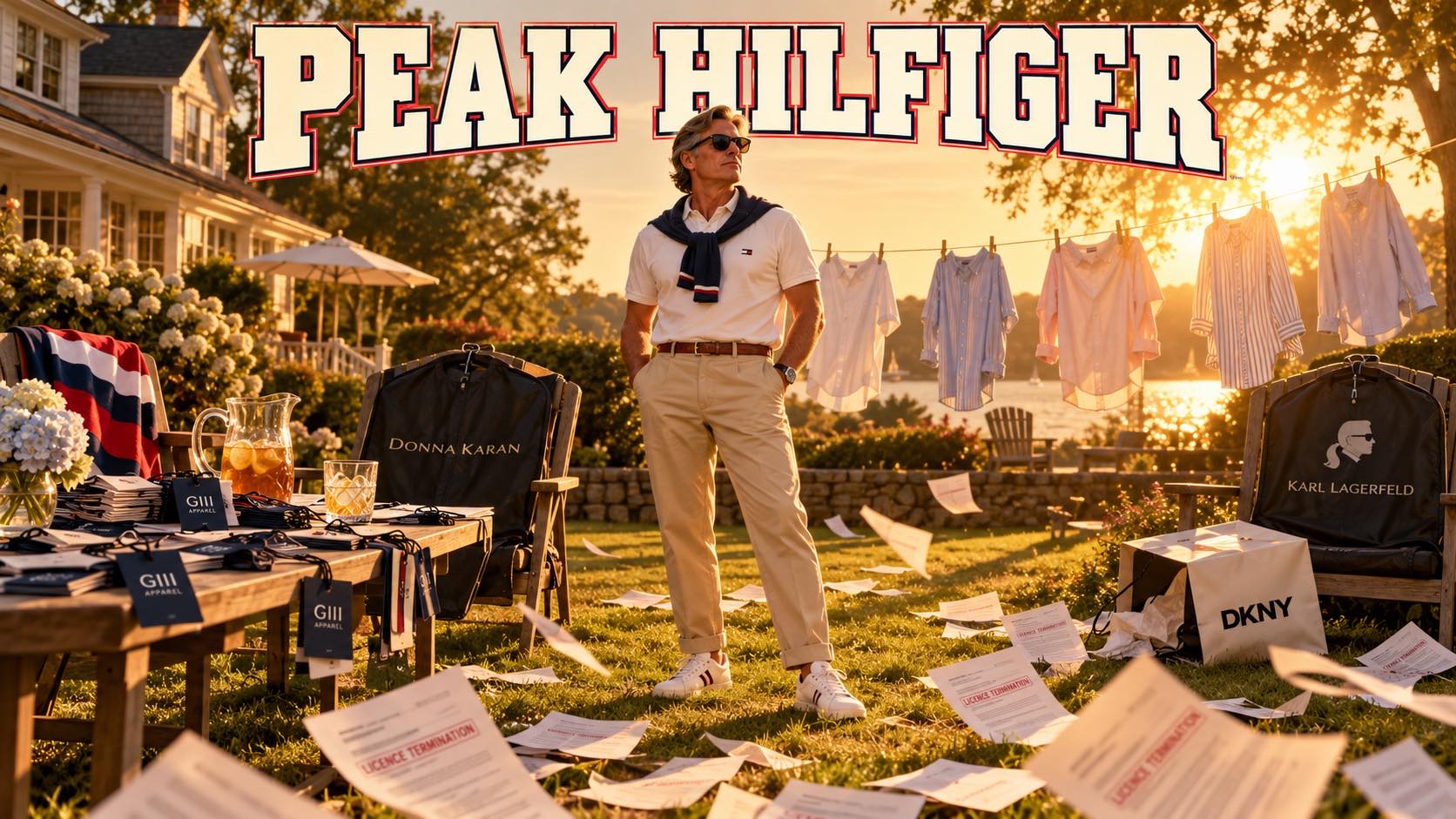
Calvin Klein started in 2005. Started with outerwear and then moved into suits, dresses, casual clothing, swimwear, handbags, luggage, jeans. Similar sort of issue with Tommy Hilfiger. And I think the turning point for them was when Hunter and I did a Father’s Day campaign for Tommy Hilfiger a couple of years ago.
I did hear talk that that was peak Tommy Hilfiger. They said it’s just all. Yes. What do [00:31:00] you– Well, how else would it work? I mean, you know, the, the campaign was look after yourself and you could look this good too when you’re in your 50s. Uh, go do kung fu.
Tony Kynaston: that tagline.
Cameron: No, I, we did A/B testing on it. We, you probably got the other version of it then.
It was peak Hilfiger, people said. Peak Hilfiger. You can’t s- It’s all downhill from when they had me in a campaign. G3 present terms. Uh, I was actually, I was surprised. I, I, I was expecting to get so much more modeling work after that, and it just didn’t, didn’t happen. I don’t.
Tony Kynaston: You turned it
Cameron: I wish I could say that.
I honestly can say I didn’t, I didn’t get any calls. Maybe, maybe they lost my number. Um, a G3 presentation from 2020 said they’d grown the PVH business from about 31 million in annual sales to 1.6 billion in that, in sort of 15 years. So huge [00:32:00] part of their business, and as I said, it got up to be about 50%.
2020 management described the relationship as having never been stronger, and then two years later, PVH decided to pull the pin. So whoops. Uh, there you go. But I guess that’s the risk, right? You’re building up somebody else’s brands, and, um, could go away. So, um, for the year ending January 2027, they’re expecting roughly 460 million less revenue from the PVH brands.
The September sales outlook was 2.71 billion for that year, excluding a new business that they just bought outright, which is called the Marc Jacobs business. He’s another fashion designer, apparently. More on that later. Oh, you know that one? Okay. They also license the Converse range. Um, [00:33:00] I, I own some Converse, so I know that one.
They also have the French Connection range that they license, um, and they’re, they’ve, um, just got that one. They just got Converse, um, in autumn of 2025. They launched a range of adult men’s and women’s clothing with Converse. Um, don’t think it’s the shoes. I think it’s other related sportswear. French Connection, they got in spring of 2026.
The split with PVH has also got a bunch of legal disputes, um, various claims and allegations about breaching of licensing agreements, counter-suing, going backwards and forwards. So it is a little bit messy, unfortunately. But the other problem they’ve got is with Saks. Well, it’s been and gone, really. So, um, Saks Global is the umbrella group of luxury retailing [00:34:00] outfits in the United States, Saks Fifth Avenue.
Then in 2024, they bought Neiman Marcus. They also own the Bergdorf Goodman store and Saks Off Fifth Avenue, which is a discount designer retailer. And G3 helped finance the 2024 acquisition of Neiman Marcus by investing in Saks Global, as well as Saks being a, a major retailer of their products, which, um, looked like it was a good deal.
They sank $20 million into Saks Global and another $20 million into SaksOffFifth.com, the online business. And that, um, that was a good deal until Saks Global went bankrupt in January 2026, and it all got written off. Apparently, the Neiman Marcus acquisition didn’t go well. Saks never fully recovered from the COVID [00:35:00] pandemic.
Competition from online outlets rose. Brands started selling more items through their own stores. And so G3 had to write off that $40 million, as well as losing money on stuff that, um, Saks had taken possession of as part of the wholesale deal that they hadn’t sold. So, you know, in s- They came out of Chapter 11, Saks did, in June 2026 under new ownership with a new parent company, Exemplar Luxury Group.
Obviously, the retail brands haven’t changed, but, um, I think, uh, G3 also had to book a $17.5 million loss for invoices it wasn’t gonna collect from Saks due to the bankruptcy. So they blew nearly $60 million on the Saks deal. So for the full year ending January 2026, revenue fell 7% from $3.18 billion to $2.96 billion.
Reported profit fell [00:36:00] further from $193.6 million to $67.4 million. And in the last quarter, ending July ’26, um, sales fell 10% down to $554 million. Management says that the continuing portfolio, so excluding Calvin Klein and Tommy, it grew at a high single-digit rate. Um, Donna Karan went up, but, um, it hasn’t replaced the departing sales yet.
So there are some positive signs with their existing brands, but it’s gonna be a while before it replaces the ones that they’re losing. The upside, though, is they retain more profit from the brands that they own. So gross margin actually rose in the July quarter from 40.8% to 45.2%, uh, which is good, right?
So lower [00:37:00] sales but higher profit margin on the sales that they’ve got. The prior year comparison was also hurt by import tariffs and as you, as we know, they get some of that back, then they lose some of it. It’s still a huge mess, the whole, um, tariff situation, and they’re getting a lot made in Vietnam and China and Bangladesh, as I said.
So there’s all of that stuff that’s been hurting them the last couple of years as well. Um, higher overheads as well has pushed their operating profit down from sixteen point three million to ten point eight million. That’s for the quarter. But interestingly, their, um, profit actually went up. Their net profit went f- up from ten point nine million to twenty point two million.
So operating profit went down, net profit went up, mostly because they got a tax [00:38:00] benefit, uh, from earlier losses, and they got interest on refunded import tariffs. So yeah, their adjusted net profit, if you take all that out, was pretty much flat. It was about eleven and a half million. Um, but bottom line is, they’re still generating cash.
For the completed 12 months ending July, operating cash flow was about three hundred and nine million. In their reported second quarter of twenty twenty-six, they retained about two point seven dollars of operating profit for every hundred dollars of sales. Not, not great, and if you compare it to PVH, which is the only comparison I did, they keep about six percent, uh, versus two point seven percent.
So for whatever reason, PVH is making double the money. I guess they own those big brands is probably some of it. Um, so they, they don’t have a lot of profit, but it’s, you know, it’s fashion, it’s retailing. Um, I don’t expect there to be huge profit margins. Um, it’s not [00:39:00] perfumes. I guess it depends on how much they can keep from the brands that they own and how quickly they can replace the stuff that they’re, they’re losing.
Tony Kynaston: And, and I think also to manage the margin changes you alluded to.
Cameron: Yeah
Tony Kynaston: uh, they, they can certainly handle a decrease in sales and it sounds like they’ve got a strategy to go out and try and replace that with other brands like Converse, as you said.
Cameron: Yeah
Tony Kynaston: um, there’s– it’s, it’s not a. It, it’s not an unusual pivot for a company like this.
So been other examples where companies have lost licensing or taken it back sometimes. It’s, you know, the flip side to, um, what’s happening with this company is what’s happening with PVH. They’re taking it back, and so they’re increasing their margins. So, um, if, uh, if this– if G3 can increase their margins on what they retain,
Cameron: Hmm.
Tony Kynaston: well for them, although [00:40:00] their sales might be down.
Cameron: Hmm.
Tony Kynaston: did it. I just look. I looked. Asked, um, I asked Gemini to give me a couple of parallels. They came back with Burberry. So, um, for decades they operated just largely as a licensing house, and then they, um, they took it back, um, or lost some of the, those, licenses. Some of them were unprofitable, so they were canceled by Burberry, and they started to back into a vertically integrated model, and they’ve been very successful doing that. and the other one was, uh, the eyewear company Luxottica, who, um, used to Armani and Chanel and Prada to, to stick on their s- their glasses. and then they lost a lot of those, and so they went out and bought Ray-Bans and Oakley, and even though it might be, uh, smaller in terms of revenue, they’re certainly as profitable, if not more profitable from owning the vertical. So, um, I think, I think the strategy for this company for G3 looks pretty [00:41:00] sound.
Cameron: Yeah. Well, it, it just depends on how well they execute,
Tony Kynaston: Yeah.
Cameron: From here on in.
Tony Kynaston: Yep
Cameron: But they’ve been around a long time, and they’ve survived, you know, the, um, slings and arrows of outrageous fortune, including bomber jackets not being popular forever. Um, I wonder if they got a boost in sales when the last Top Gun movie came out.
Yeah.
Tony Kynaston: they
Cameron: Yeah
Tony Kynaston: a sequel much sooner than two years ago
Cameron: They should have done what Scientology did, is just bought Tom Cruise to be their brand ambassador and pay for all of his legal bills. Um, on September 1st, 2026, they. So what’s that? Like nearly two months ago, they completed a weird acquisition of the Marc Jacobs business. I say it’s weird because they, they spent $500 million on it.
They bought the operating business of Marc Jacobs [00:42:00] and a half interest in the brand rights. They bought these off of, um, LVMH again.
Tony Kynaston: Ja
Cameron: So Marc Jacobs is a designer, um, driven– Their business is driven by handbags, small leather goods, and other accessories. Um, Marc Jacobs, the guy, is still the creative director.
And so G3 have the, the, the operating side of the business, so design the, design the stuff, the handbags, the leather goods, get it manufactured, wh-wholesale it, retail it, all that kind of stuff. But they own 50% of the brand this time around. The other 50% is owned by, uh, another company called WHP Global.
Apparently, they manage brand licensing. So I guess it’s different to the Calvin Klein and the Tommy Hilfiger thing because if they build up the Marc Jacobs business, they own the value of the [00:43:00] brand. But they didn’t get 100% of it for some reason. I don’t know why they didn’t buy it outright, but there you go.
Maybe it wasn’t, they, they– wasn’t available or, I don’t know who owns WHP Global. But yeah, so they bought a big chunk of it, um, but not all of it for some reason. So we’ll see what they can do with that and what they can turn that into. That’s basically the story. I couldn’t find any, uh, hidden secrets.
Some minor stuff about, you know, stuff getting made in Chinese sweatshops and things like that, but that’s what you’d expect. You don’t have any dirty dirt stories for me this week?
Tony Kynaston: hardly worth repeating. There was just, allegations around the, um, negotiations when the licensing was taken back about threats that were made, but there’s no, no point airing that dirty laundry here
Cameron: Yeah, I saw some minor stuff, but, uh, nothing that I thought was gonna have a major impact on the business. So I’ll just wrap up with the numbers. Um, so [00:44:00] share price was about $29.85 at the time, market cap of about 1.279 billion. Um, Pr/OpCaf was 4.14. The stock rank was 98, quality rank 92, and the F score six.
So I guess I’ll tell you what we scored it on. So the quality rank, yeah, 92, so we scored it for that. Stock rank, 98, we scored it for that. F score was six, we scored it for that. Price was not at or below IV1. Um, IV1 was about $9.90. Um, not at or below IV2 either. IV2 was $23.34, so it failed those. Um, it was below book though.
Book price is $42.42. So it scored for being below book price and below book plus 30
Tony Kynaston: You’d expect– Sorry to cut across you. You expect [00:45:00] a lot of, um, goodwill if you’re licensing deals and buying Marc Jacobs and things like that. So that’s probably why there’s a difference.
Cameron: Yeah, right. Good point. Um, has a three-point upturn obviously, or we wouldn’t be talking about it. Does not have a new three-point upturn though. The growth over PE is not greater than one point five. Um, it does have positive book value growth though, somewhat surprisingly. PE is not below, um, the dividend yield.
The yield is not above the benchmark. Debt rate, forecast IV is not greater than twice the price. Couldn’t score it for that. The Pr/OpCaf, as I said, is like four, so it’s below seven and we could score it for that. So all up, it finished with a quality score of seventy-six point nine two percent, ten out of 13, and a QAV score of zero point one nine.
[00:46:00] So, um, I kinda liked it. I thought, uh, you know, business that’s been around a long time, knows what it’s doing, making money, owns some big brands, has some licenses for some other brands. It’s got a tough sort of rejigging of its business, losing Calvin Klein and Tommy Hilfiger, but looks like they will survive.
The market is, uh, not treating them very well because their short-term numbers are gonna look not as good as they were. But nothing to me that suggests they’re not gonna continue to make money and, and, uh, you know, continue. Young Morris Goldfarb, um, probably doesn’t look that young anymore, but he, um, been running the company for a long time and, uh, seems to know what he’s doing, so wish him the best of luck.
So there you go. That’s, that’s. Yeah. That’s my assessment of G3, [00:47:00] Tony
Tony Kynaston: Well done. Thank you. business.
Cameron: Yeah. I mean, I–
Tony Kynaston: to buy it too
Cameron: And just another one of these classic value stocks, right? Old school classic value stocks. And you just watch, it’ll drop twenty-five percent in the next week now that I’ve said that, like some of those other stocks that I’ve said cl-classic value stocks. We’ll see.
Tony Kynaston: We’ll see.
Cameron: We’ll see
Tony Kynaston: by, by news if they acquire other brands or, get their supply chains worked out better for the ones that they own. That kind of thing will drive their margins, so. And their stock price. But yeah, it’s better to buy it now when it’s. What was the Pr/OpCaf? Like four times?
Cameron: Yeah, four times. By the way, um, just, just made me look it up. Remember the, um, Chinese watch company, uh, Zepp, that was up like 1,000%?
Tony Kynaston: Mm-hmm.
Cameron: Uh, it’s now down 15%. It’s negative 15% from where we bought [00:48:00] it
Tony Kynaston: Really? So it’s dropped from 1,000% up to 15% down.
Cameron: Yeah. So we bought it at
Tony Kynaston: who’s in the Australian club, is it? Do they?
Cameron: we bought it at $2.98. Uh, we didn’t buy it actually, but it was, uh. We did a Pulled Pork on it, $2.98. This is in July of last year, 2025. It went up to $47 and is now down to $2.54
Tony Kynaston: It sounds like a meme stock, doesn’t it?
Cameron: It does
Tony Kynaston: some trendy brands or something which sent it r-
Cameron: Yeah. Well, it did deals. It did a whole bunch of deals with sporting celebrities that were gonna promote its health smartwatch kind of thing. So I mean, it was bonkers. It, it was like completely bonkers where the share price went up, but there you go. It’s collapsed right back down again. So there you go.
You never, never know. Never, never know
Tony Kynaston: No Tree Grows to the [00:49:00] Sky camp
Cameron: Yeah. And, and, you know, because we don’t, um, sell things when they do well, if we had had that in our portfolio, we wouldn’t have sold it when it was up at 1,000% either. We would’ve waited for it to breach a sell line, so. I don’t know what its sell line would’ve been. I can probably look it up actually. Oh my God, what a chart. That’s a, that’s some chart. Yeah, so if I go back to, when did I s- when did I say we bought it? July 2025?
So I’ll say 1st of August ’25
So the 1st of August ’25, the sell price was $2.59. So, you know, yeah. We would’ve, we would’ve held onto it and ridden it all the way back down. That would’ve been depressing
‘Cause th-
Tony Kynaston: it before.
Cameron: it’s now a three-point sell. The sell price is still $2.98, yeah.
Tony Kynaston: Mm-hmm.
Cameron: So we would’ve sold it. Uh, you know, we would’ve broken even [00:50:00] on it, but, um, ’cause we bought it at, what did I say? $2.98. There you go. The sell price is the buy price, what we bought it at. But yeah. But yeah, these things happen
Tony Kynaston: Mm-hmm. And you never know whether– I mean, I haven’t seen enough evidence to say at a thousand times over what we paid for it is a good time to sell,
Cameron: Yeah.
Tony Kynaston: ’cause it could go up two thousand percent.
Cameron: Yeah.
Tony Kynaston: yeah.
Cameron: We’ve seen that kind of behavior happen over and over, haven’t we?
Tony Kynaston: yeah
Cameron: Well, that’s QAV America for this week. TK, um, you, you Melbourne Cupping next week?
Tony Kynaston: I am. Yeah, I won’t be here next week. Sorry
Cameron: Okay. I don’t have anything worked out yet, but we’ll talk about it during the week. We’ll sort something out.
Tony Kynaston: Okay.
Cameron: Thanks, TK. Happy hunting, everyone
Tony Kynaston: Cheers
Previous Pulled Porks
Here’s the performance of the “pulled porks” (eg deep dives) we’ve done on the show in the past.
| Ticker | Company | Covered | Price then | Price now | Return | Ep. |
|---|---|---|---|---|---|---|
| APA | Apa | 13 Oct 2026 | $45.88 | $48.44 | +5.6% | 74 |
| ATLC | Atlanticus Holdings | 6 Oct 2026 | $92.86 | $83.42 | -10.2% | 73 |
| CAL | Caleres | 28 Sep 2026 | $12.52 | $13.20 | +5.4% | 72 |
| VLGEA | Village Super Market | 21 Sep 2026 | $44.74 | $42.38 | -5.3% | 71 |
| OMF | OneMain Financial | 14 Sep 2026 | $62.75 | $55.35 | -11.8% | 70 |
| ARDT | Ardent Health | 7 Sep 2026 | $10.91 | $17.80 | +63.2% | 69 |
| SND | Smart Sand | 1 Sep 2026 | $5.27 | $4.77 | -9.5% | 68 |
| CRGY | Crescent Energy | 25 Aug 2026 | $13.85 | $12.12 | -12.5% | 67 |
| SLDE | Slide Insurance | 18 Aug 2026 | $21.60 | $25.77 | +19.3% | 66 |
| RJET | Republic Airways | 10 Aug 2026 | $21.39 | $20.14 | -5.8% | 65 |
| BBDO | Banco Bradesco SA | 3 Aug 2026 | $3.44 | $2.35 | -31.7% | 64 |
| RM | Regional Management | 27 Jul 2026 | $41.65 | $35.67 | -14.4% | — |
| PBR | Petrobras | 20 Jul 2026 | $17.97 | $18.34 | +2.1% | 62 |
| TEO | Telecom Argentina | 14 Jul 2026 | $13.47 | $10.57 | -21.5% | 61 |
| FG | F&G | 7 Jul 2026 | $28.55 | $23.28 | -18.5% | 60 |
| KSS | Kohl's | 1 Jul 2026 | $17.34 | $24.00 | +38.4% | 59 |
| CARE | Carter Bankshare | 23 Jun 2026 | $31.00 | $29.32 | -5.4% | 58 |
| AERO | Aeromexico | 18 Jun 2026 | $17.34 | $16.55 | -4.6% | 57 |
| NRIM | Northrim Bancorp | 1 Jun 2026 | $24.71 | $23.94 | -3.1% | 55 |
| MGA | Magna International | 27 May 2026 | $65.20 | $61.82 | -5.2% | 54 |
| BWLP | BW LPG Limited | 18 May 2026 | $21.06 | $22.58 | +7.2% | 53 |
| KNOP | Knot Offshore Partners Com Unt | 14 May 2026 | $10.78 | $9.05 | -16.0% | — |
| GSL | Global Ship Lease | 13 May 2026 | $41.79 | $43.05 | +3.0% | — |
| DB | Deutsche Bank | 4 May 2026 | $31.11 | $36.62 | +17.7% | 51 |
| UEIC | Universal Electronics | 29 Apr 2026 | $4.25 | $6.85 | +61.2% | — |
| OPRT | Oportun Financial Corp. | 20 Apr 2026 | $5.88 | $11.73 | +99.5% | 49 |
| PAGS | PagSeguro Digital | 13 Apr 2026 | $10.67 | $7.98 | -25.2% | 48 |
| CVGI | Commerical Vehicle Group | 6 Apr 2026 | $3.56 | $3.44 | -3.4% | 47 |
| PBI | Pitney Bowes | 30 Mar 2026 | $10.86 | $15.59 | +43.6% | 46 |
| KODK | Eastman Kodak | 23 Mar 2026 | $7.83 | $8.13 | +3.8% | 45 |
| GPRK | GeoPark | 17 Mar 2026 | $8.77 | $9.42 | +7.4% | 44 |
| MUR | Murphy Oil | 9 Mar 2026 | $34.55 | $36.82 | +6.6% | 43 |
| NBR | Nabor Industries | 3 Mar 2026 | $77.80 | $84.68 | +8.8% | 42 |
| BFH | Bread Financial | 28 Feb 2026 | $70.86 | $98.61 | +39.2% | 41 |
| SHG | Shinhan FInancial Group | 17 Feb 2026 | $69.83 | $66.59 | -4.6% | 40 |
| EC | Ecopetrol | 3 Feb 2026 | $12.57 | $15.43 | +22.8% | 38 |
| CHRD | Chord Energy Corporation | 24 Jan 2026 | $95.53 | $149.93 | +56.9% | 37 |
| AMTD | AMTD IDEA Group | 20 Jan 2026 | $61.20 | $12.40 | -79.7% | 36 |
| VLRS | Controladora Vuela Compania de Aviacion SAB de CV | 13 Jan 2026 | $9.45 | $7.99 | -15.4% | 35 |
| TUSK | Mammoth Energy Services, Inc. | 10 Jan 2026 | $2.45 | $3.26 | +33.1% | 39 |
| XIFR | Xplr Infrastructure | 6 Jan 2026 | $10.17 | $7.60 | -25.3% | 34 |
| AMCX | Amc Networks | 1 Jan 2026 | $9.52 | $9.50 | -0.2% | 33 |
| ZD | Ziff Davis, Inc. | 16 Dec 2025 | $36.48 | $51.49 | +41.1% | 32 |
| VALE | Vale SA | 11 Dec 2025 | $12.90 | $11.22 | -13.0% | 31 |
| AER | AerCap Holdings NV | 29 Nov 2025 | $131.82 | $175.69 | +33.3% | 30 |
| KEP | Korea Electric Power Corporation | 29 Nov 2025 | $16.74 | $10.16 | -39.3% | 29 |
| PCG | PG&E Corporation | 24 Nov 2025 | $15.67 | $13.25 | -15.4% | 28 |
| CALY | Topgolf Callaway Brands Corp. | 12 Nov 2025 | $10.60 | $17.10 | +61.3% | 27 |
| CALM | Cal-maine Foods, Inc. | 23 Oct 2025 | $94.56 | $66.45 | -29.7% | 25 |
| AAL | American Airlines Group Inc. | 20 Oct 2025 | $13.78 | $13.17 | -4.4% | 26 |
| DCH | Dauch | 9 Oct 2025 | $6.16 | $4.69 | -23.9% | 24 |
| CYH | Community Health Systems, Inc. | 3 Oct 2025 | $3.01 | $2.24 | -25.6% | 23 |
| MEOH | Methanex Corporation | 15 Sep 2025 | $39.81 | $70.51 | +77.1% | 21 |
| SUZ | Suzano Inc. | 1 Sep 2025 | $9.73 | $9.65 | -0.8% | 20 |
| KE | Kimball Electronics, Inc. | 26 Aug 2025 | $28.65 | $19.74 | -31.1% | 19 |
| TITN | Titan Machinery Inc. | 14 Aug 2025 | $18.98 | $22.57 | +18.9% | 18 |
| GTN | Gray Media, Inc | 7 Aug 2025 | $4.42 | $5.99 | +35.5% | 17 |
| SENEA | Seneca Foods Corporation | 30 Jul 2025 | $102.12 | $176.47 | +72.8% | 16 |
| BHC | Bausch Health Companies Inc. | 22 Jul 2025 | $6.32 | $8.35 | +32.1% | 15 |
| SSL | Sasol Limited | 17 Jul 2025 | $4.99 | $14.30 | +186.6% | 14 |
| ZEPP | Zepp Health Corporation | 11 Jul 2025 | $2.98 | $2.78 | -6.7% | 13 |
| PKX | POSCO Holdings Inc. | 1 Jul 2025 | $48.49 | $50.09 | +3.3% | 12 |
| PDS | Precision Drilling Corporation | 27 Jun 2025 | $47.78 | $95.83 | +100.6% | 11 |
| IX | Orix Corporation | 19 Jun 2025 | $21.00 | $34.39 | +63.8% | 10 |
| JXN | Jackson Financial Inc. | 11 Jun 2025 | $83.00 | $138.95 | +67.4% | 9 |
| IHS | IHS Holding Limited | 30 May 2025 | $5.38 | $8.42 | +56.5% | 7 |
| F | Ford Motor Company | 21 May 2025 | $10.80 | $11.91 | +10.3% | 6 |
| ENIC | Enel Chile SA | 14 May 2025 | $3.97 | $4.22 | +6.3% | 5 |
| CM | Canadian Imperial Bank Of Commerce | 8 May 2025 | $63.76 | $115.80 | +81.6% | 4 |
| DAC | Danaos Corporation | 2 May 2025 | $82.47 | $150.12 | +82.0% | 3 |
| CX | Cemex Publicly Traded Stock Corporation With Variable Capital | 28 Mar 2025 | $5.66 | $10.55 | +86.4% | 2 |
| ZIM | Zim Integrated Shipping Services Ltd | 13 Mar 2025 | $17.97 | $29.34 | +63.3% | 1 |
4 more recent picks from the last 30 days are available to QAV America members — members hear every deep dive a month before it appears here. Become a member
Returns exclude dividends and are measured from the price on the day each stock was covered on the show. Prices as of Sat 14 Nov 2026, 3:42 pm ET. Updated automatically. Not financial advice.