This week we dig into Republic Airways Holdings (RJET), a regional airline contractor that flies for United, American, and Delta under their livery while keeping a remarkably low profile. Cameron runs through the full QAV numbers, which come out strong despite a company history packed with bankruptcies, pilot shortages, disk-wiping CFOs, and a former CEO who is now running the FAA. The portfolios took a knock this week too, so we recap what’s going on and run through some of the better performers from past Pulled Pork episodes.
This week’s full episode is for QAV Club members only. The free episode is available below. Also check out our podcast archives link and our pages on Apple Podcasts or Spotify or watch clips on TikTok. Or visit our homepage to learn more about QAV and how it works as a value investing system that you can learn and apply to beat the market.
Transcription
QAV America 65
Cameron: [00:00:00] welcome to QAV America, Tony. Episode 65. It’s the 11th of August, 2026. Our portfolios in America dipping. Had a bad week, our American portfolios. Uh, the model portfolio was up 40% a week ago. It’s now only up 25%. It’s a big dip. I mean, the S&P, uh, is up 13– Uh, no. Yeah, 13% over
Tony Kynaston: period’s that? time. period?
Cameron: Uh, couple of years
Tony Kynaston: okay. Since inception. All right.
Cameron: since inception,
yeah. So we’re still doing, um, double market or more or less, but we were doing way better than that. our light portfolio, which we started in December last year, fell from 12% to 10% versus the S&P 13%, uh, for that period of time as well. So, um, I don’t know. Don’t know why.
I had a look into it. Nothing really. You know, couple of, couple of reports that weren’t great, but I think it’s just [00:01:00] markets being markets. know, um, good old, uh, WLFC, Willis Lease Finance, dropped like 25% over the last week, but it’s still up 289% since we bought it, so, you know, what’s 25% between friends? it’s, uh, just, I think, you know, oil prices and th-
Tony Kynaston: But thank you
Cameron: the US economy and profit taking. Yeah, Yeah.
is. Anyway, so I d- I, I started to drill into it and try and figure out what was going on. Mostly financials, uh, that are down. Um, Carter Bank, CVGI, F&G, some of the biggest drops, but at the end of the day, um, there’s nothing really to be seen there.
It’ll probably be up by 25% next week. You know, it’s, it’s crazy over there still at the moment. You got any American stories you wanna talk about before I get into my pulled pork for this week, Tony?
Tony Kynaston: don’t, no. No, no, no big news [00:02:00] over in America that I can think of.
Cameron: Nothing
Tony Kynaston: Nothing going on.
Cameron: going on, no.
Tony Kynaston: Little bit of news in Israel, but not much going on
Cameron: Try we were laughing off air. Trump now wants, uh, reparations from Iran for inva- uh, for having, having to invade having to fail at an invasion of Iran, he wants reparations for making him look bad, I think is what it is. He’s like, “Listen, you didn’t let me have a quick win. reparations. Made me look bad.”
He thinks countersuing works in geopolitics like it’s always worked for him, domestically. If somebody sues him for not paying a bill, he just countersues. He thinks that’s gonna work with Iran. “Ah, no, I, I sue you. I, I, I, I sue you too.” “What are you suing us for?” “Well, for, for making me sue you. Uh, for suing me.
I’m suing you for suing me. How do you like them apples?” [00:03:00] Uh, it’s ridiculous. Anyway, pulled pork this week is a company called Republic Airway Holdings. You ever heard of them before, Tony?
Tony Kynaston: No, not before I looked, looked at your notes and had a look at them. A bit like Alliance Aviation in Australia that we did the pulled pork on two weeks ago.
Cameron: like that. Yeah.
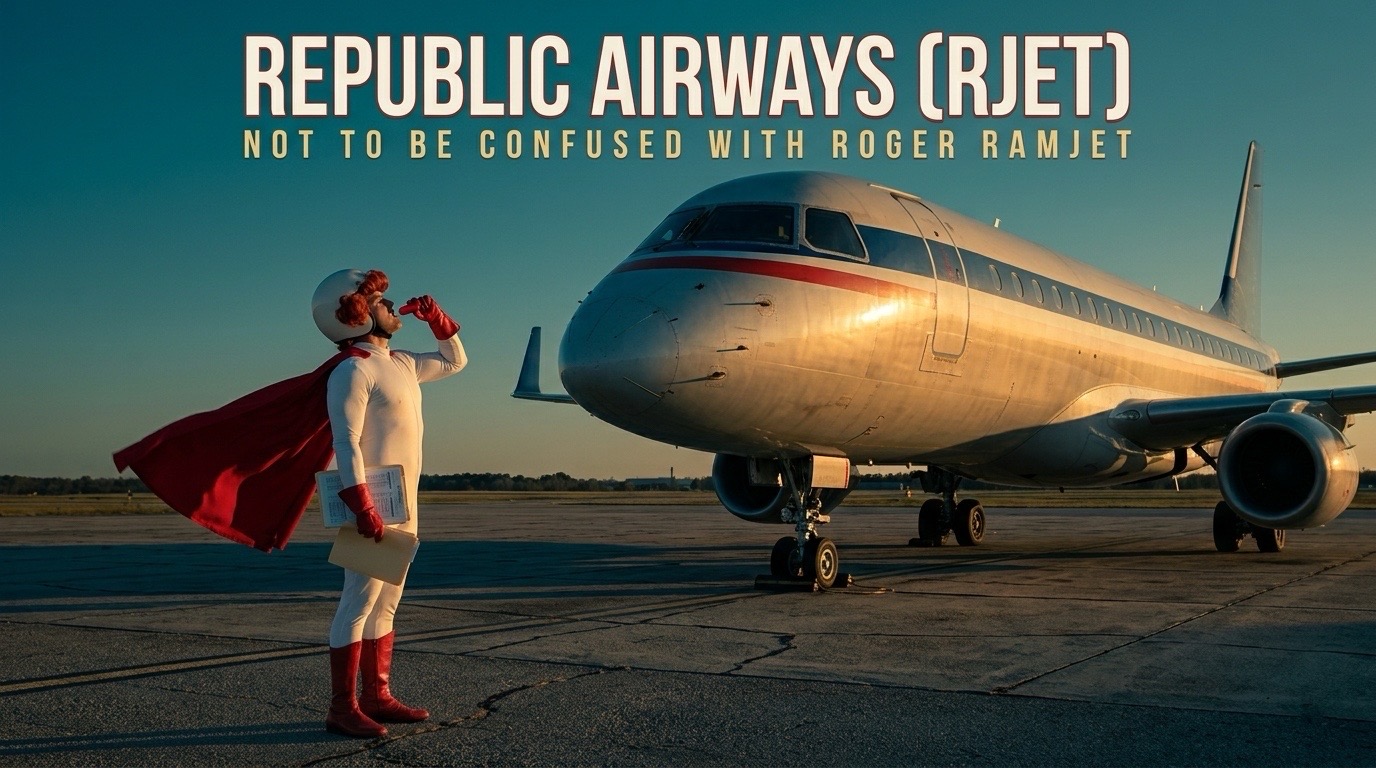
Uh, their ticker code, they’re on the NASDAQ, their ticker code is RJET. Uh, that’s what excited me ’cause I thought it was, um, Roger Ramjet at first. Roger Ramjet, he’s our man, hero of the nation. For his adventures, just be sure and
Tony Kynaston: Down you to the station. So gather around and all you kids.
Cameron: all you kids, for lots of fun
Tony Kynaston: laughter is Roger Ramjet and his gang.
Cameron: get
Tony Kynaston: All the crooks they’re after.
Cameron: thereafter. Yeah. Was it him who took the proton
Tony Kynaston: It was
Cameron: of 20 men for a period of 20 seconds?
Tony Kynaston: that’s the guy with the biggest square jaw I’ve seen since Chesty Bond.
Cameron: He had a Jay Leno [00:04:00] jaw. Kids, uh, people listening to this have no idea what we’re talking about. American TV that we were it was
Tony Kynaston: Ooh.
Cameron: down our throats to turn us into good American patriots little Australian kids in the ’70s, ’60s
Tony Kynaston: TV in the ’70s though, wasn’t it?
Cameron: Well, yeah.
Tony Kynaston: Mm-hmm
Cameron: the hell? Why? Why? Some of the other characters, Lance Crossfire, uh, General G.I. Brassbottom, Lotta Love. Uh, 1965,
Tony Kynaston: Wow
Cameron: NBC, according to Wikipedia, ran from ’65 to ’69. for its simple animation, frenetic pace, frequent references to pop culture which appeal to adults as well as children. Roger Ramjet is a patriotic and highly moral hero who is typically out to save the world with help from his proton energy pills, gave him the [00:05:00] strength of 20 atom bombs for a period of 20
seconds.
Tony Kynaston: So
Cameron: bombs
Tony Kynaston: was, basically an update of Popeye then, wasn’t it? Instead of spinach, he had a proton pill, yeah.
Cameron: yeah.
yeah.
Tony Kynaston: Yeah
Cameron: But it gave him the strength of 20 atom bombs. That’s, uh,
Tony Kynaston: lot.
Cameron: Yeah, I, I don’t think he needed to take a full, a full proton energy pill, to be honest. He could’ve
Tony Kynaston: Nein.
Cameron: away with, like, one-20th of
Tony Kynaston: Mhm.
Cameron: energy pill would’ve been. What did that do to his testicles, do you think, over a period of time?
It’s not good.
Tony Kynaston: Irradiation
Cameron: you think he, uh, they shrunk up? Yeah. That’s, testicles shrank and his jaw. Anyway, RJET. Um, they’re based out of Carmel, Indiana,
Tony Kynaston: Oh,
Cameron: California.
Tony Kynaston: Wow.
Cameron: I’ve been to Carmel. I told you my
Tony Kynaston: I’ve been to Carmel as well. Carmel No
Cameron: I was in Carmel, um, uh, for God, I don’t know, 25 years ago maybe, um, [00:06:00] working from a cafe there during the day, waiting for a friend of mine to, who lived there, to come and pick me up.
And, uh, standing in the car park at the shopping center, just wa- hanging around, and see Clint Eastwood drive past,
Tony Kynaston: Right
Cameron: parking his car. I was like, “Oh, look at that. There you go.” Anywho, different, different place. Carmel, Indiana. Um, here’s a thing from the company website. “We believe that every associate, regardless of personal beliefs or worldview, has been created in the image and likeness of God.” It’s a interesting statement for a public, public company on their website, I thought.
Tony Kynaston: Yeah
Cameron: You don’t see, see that
Tony Kynaston: No. I’d rather know about their policy for on time, you know, flights or charging for overhead lockers or whatever, but
Cameron: Yeah. Well, Yeah
Image and likeness of God. Yeah, when they went bankrupt in [00:07:00] 2016, um, you know, that’s, uh, there’s a classic God move. Um, and all their shareholders lost everything, you know. So it’s, it was their way of like biblical, going biblical on the shareholders. Anyway, look, this company’s only been publicly traded for nine months.
Why? Well, Airways have been around for a long time in one form or another, but they went bankrupt in 2016, emerged as a private company in 2017, stayed that way for eight years, then came back onto the market 2025 by merging, kind of a backdoor grandfather listing thing with a company called Mesa Air Group. They took over Mesa’s stock exchange listing. Republic shareholders got 88% of the combined company, Mesa shareholders got 6%, and the legal survivor is Mesa, but called Republic. So, and the ticker changed, converted from a Nevada to a Delaware [00:08:00] corporation, did a one-for-15 reverse split or a 15-for-one reverse split, um, on you believe Claude or ChatGPT, ’cause they couldn’t agree on which way it went.
But, uh, there was a, there was a reverse split somewhere along the way there. Uh, Republic’s management runs it. Republic’s board dominates it. So for all intents and purposes, Republic bought Mesa, not the other way around. Which is why if you look at the financials in Stockopedia, it looks kind of crazy. In 2020, they did 545 million. In the following few years, 504, 531, 498, 476. Then all of a sudden in 2025, 1.677 billion, and the trailing 12 months at the moment is 2.587 billion. It’s because it was Mesa for the first few years there, and then, um, the Republic [00:09:00] kicked in when they did this, uh, merger. You gonna say something?
You look like you were about to say something
Tony Kynaston: Oh, I’ve got lots of things to say. I was just waiting for you to get through, get through yours. Um, do you know why they went bankrupt?
Cameron: Yes.
Tony Kynaston: Oh, okay.
Cameron: it’s all, all to come.
Tony Kynaston: Hold the camera. All right.
Cameron: Don’t jump ahead. so what do they do? They’re, they’re not really an airline, um, I don’t think. They’re a company that runs airplanes for other airlines really. sell flying by the hour under contract. think of a mid-sized American city, um, Chattanooga, which is where my mother-in-law, one of my mother-in-laws is from. Chrissy says it’s fantastic. Uh, we should visit there sometime. I’ve, I’ve only spoken to. This is Chrissy’s stepmother. I’ve only spoken to her a few times ’cause Chrissy doesn’t really talk to her dad if she can avoid it, but her stepmother’s got a great [00:10:00] accent. They live in Georgia, but she’s, uh, she’s got this great southern Chattanooga, Tennessee, “Well, now, y’all come on back on, y’all around you here.”
It’s great. She’s. Really sweet accent. Anyway, so if you wanna, uh. So the big airlines, American, Delta, United, they all wanna fly in and out of these smaller towns, but they don’t wanna send their own 737s flying in and out, so they basically have agreement with Republic that operates the aircraft, the crews, everything that’s required to fly in and out of these smaller destinations, they do it on contract. Uh, so it’s sort of like it’s a contract, but it’s, um, it’s, uh- What the hell is that? Can you
Tony Kynaston: You’re fine
Cameron: Why is
Tony Kynaston: It’s the fern. The fern.
Cameron: is.
Tony Kynaston: Uh,
Cameron: What?
Tony Kynaston: and we spoke, we spoke about this with Alliance Aviation in Australia [00:11:00] recently, which is a similar sort of company which leases, uh, planes. And funnily enough, Embraers, um, in both cases. Although, uh, one of the things that tripped up Alliance Aviation was their fleet of Fokkers, which, uh, this company, RJET, doesn’t have.
So they’re one step ahead of, uh, Alliance Aviation. They’ve got Embraers, which Alliance was moving towards, so that was good. Um, but yeah, not only were the, were the big, uh, US carriers using this company to do their small runs with smaller planes, which didn’t have, um, good economics for the large carriers, but they’re also shareholders in the rebirthed company as well.
Um, so the three large carriers all have a reasonable stake in this company. Um, and then they use the company to service their regional networks
Cameron: Yeah. Because of the bankruptcy, right?
Tony Kynaston: Ooh.
Cameron: was all part of the deal. So, uh, [00:12:00] yeah, these guys, you know, the big airlines, you know, they, they set the schedule, sell the seats, keep every dollar of the fare, paint their own brand on the plane, and you never hear the word Republic probably if you’re a passenger.
But, uh, Republic supply, it all, the aircraft, the pilots, the cabin crew, the engineers, the dispatchers, and get paid a fixed rate for what’s called a block hour. As best I understand it, a block hour is everything from gate to gate, including taxi time, and turns up in the financials. That’s sort of something they report on, is how many block hours they delivered on. The big airlines carry the demand risk, so if they can’t sell the seats, that’s on them. Doesn’t really matter to Republic, and fuel risk as well. It’s a pass-through. So Republic just gets paid a straight contract fee to run the operation. I guess their [00:13:00] risk is really what they’re gonna get paid from these three big airlines and their ability to actually deliver on their end of the bargain, which you pointed out, is one of the reasons both of them actually, Mesa and Republic, uh, went into liquidation over, um, sort of between 2016 and 2022, I think, was Mesa’s, uh, issue. So, um, the, the other thing that they get sort of benchmarked on is what they call completion factors. It’s the percentage of scheduled flights, scheduled flights that you actually operate. The, it’s the number at the end of the day that helps you maintain the contract and not get sued or fired if your completion factor falls below a certain rate.
You say you’re gonna fly 10 flights a day, and you, you, you fly seven long enough, you get yourself into trouble. So [00:14:00] Delta sued Republic in 2015 for not flying the full schedule, they ended up going into liquidation as a result of Chapter 11. Then American fired Mesa in 2022, and if you look at the numbers in Stockopedia, you’ll see that Mesa went from making a $64 million operating profit in 2021 to $185 million loss in 2022. But apparently this was because of a pilot shortage, and the reason they couldn’t deliver their things was a pilot shortage. I didn’t drill down into why they had a pilot shortage. I mean, I assume it was somewhat COVID-related, but what was the pilot shortage about,
Tony Kynaston: Well, I think this was pre-COVID, wasn’t it? They went into, into administration. But anyway.
Cameron: 2022.
Tony Kynaston: Oh, sorry. Okay
Cameron: was 2022. The Republic was 2015, 2016
Tony Kynaston: So interestingly enough, they, one of the, one of the interesting situations was if you’re flying for one of the big carriers in 737 jets as a pilot, [00:15:00] you’re part of a union, you’re getting paid a much higher rate than
Cameron: Mm-hmm
Tony Kynaston: regional pilots are being paid. And one of the things that the pilots’ union had in place was it did allow for lower rates for these regional pilots, but it capped it.
So you could only fly a certain number of, um, you know, destinations, a certain number of flights, a certain number of pilots could be outside the award wage. Um, and, uh, the forerunner for RJET now, uh, got around this by setting up lots of different companies. They had two or three different companies, and so they could get round the cap by putting a third in each one.
And, um, they would then, as, as they started to reach the cap, they would transfer pilots back and forth between these sub-companies that they got around the union, uh, prohibition on, um, and kept their cap, kept their regional pilot salaries right down to the point where they couldn’t attract pilots because [00:16:00] they were going either to the big carriers overseas or they were saying, “Hey, you’re paying us so little, we can’t afford to go through pilot school and get trained for your plane and then become a pilot there.”
So they kind of became their own death knell in a way by priding themselves on being anti-union, anti-pilots union, and keeping the. doing everything they could to structure things to keep the, the pilots’ wages low. Which made sense because they’re competing for the business from the big carriers, so they had to keep their costs under control.
But eventually it got to a stage where they couldn’t find pilots to fly that cheaply on their planes.
Cameron: Hmm. Right. And this probably ties in with, uh, uh, the flight school that they run and what they were trying to push through the FAA.
Tony Kynaston: Yeah. so like one of the ways to get around the problem of pilots not being able to afford to learn how to fly on their planes and then get paid little money in return was they now have their own in-house flight school, and they provide the, the service
Cameron: And they, and they tried to get [00:17:00] the FAA to let them, instead of having to have 1,500 hours, to have 750 hours to get some sort of a flight certificate. That was one of the other big. Sorry.
Yeah, That was another big driver. So I think the FAA at the time went from 150 hours to 1,500 hours certification, which then dried up the pilot pr- the pilot pool as well. So they’ve been trying to argue to get it back to a more reasonable number for their, for their needs.
Yes. And who’s the chairman of the FAA now?
Tony Kynaston: Ooh, no, I don’t know.
Cameron: The Roger Ramjet? No,
close, Brian Bedford, the guy who
Tony Kynaston: no.
Cameron: Republic for 25 years.
Tony Kynaston: Right.
Cameron: Anyway, more on that later. That’s good. So the history of the company is actually interesting. It traces its roots to Chautauqua Airlines,
Tony Kynaston: Chautauqua
Cameron: found- [00:18:00] You say Chautauqua,
Tony Kynaston: I’m, pulling you up on the pronounce, you can say Chautauqua. The reason I’m saying Chautauqua and I’m excited by it is it was a racehorse in Australia called Chautauqua, spelt the same way. Famous racehorse.
Oh
Cameron: here says, “Not named after the Australian racehorse, The Grey Flash,” ’cause I knew you would go there
Tony Kynaston: Do you know what was special about Chautauqua or the racehorse, though?
Cameron: The fact that you pronounced its name incorrectly?
Tony Kynaston: Well, so does everybody else who went to the track in Australia and watched it.
Cameron: right. it was a suc- a successful racehorse, would’ve won at least one Group 1. Famously, towards the end of its career, it wouldn’t leave the gates in a race. It– We used to call it the smartest racehorse in Australia because it had worked out you could be looked after, pampered, trained, taken to the beach for a swim.
Tony Kynaston: But on race day, you didn’t have to race. You could just stand in the gates. And they had to retire it because it did it two or three times and
Cameron: yeah
Tony Kynaston: the other trainers started to get worried that it would teach the [00:19:00] other horses what to do on race day.
Cameron: Sounds like the, uh, greyhound that we’ve been babysitting, Pepsi. A friend of ours who lives around the corner, when she travels for work, she leaves her greyhound with us and we look after it for four or five days. um, know, I’ll take it for a walk, uh, and it, it doesn’t wanna. It won’t go where I want it to go.
It’ll just stand there and just like, “No.” I had to– Literally, I had, I had food in the oven a couple of weeks ago, and I thought I’d take it for a half-hour walk. I had the food in the oven for an hour, and then it w- we’d been out for an hour, and she just refused to move. And I had to pick her up, full bloody sized greyhound, and carry her r- All
Tony Kynaston: All right. So why would she walk if she knows you’re gonna pick her up and carry her?
Cameron: Exactly, right?
Yeah.
Tony Kynaston: Yeah
Cameron: Anyway, this is named after Lake Chautauqua in New York, and th- uh, there’s an interesting story about a social movement. I assume the airline was actually named after, this social [00:20:00] movement, the Chautauqua Movement. It was started in the 19th century, originally as a way to train, Sunday school teachers in, like, a summer school kind of thing around this lake. then it kind of evolved into an American adult education and social movement. It spread across the, the US, mostly in rural areas. It was like a traveling tent show. Bit like, it was the opposite of vaudeville, so instead of having sort of, you know, uh, tits and ass shows and raunchy comedians, it was motivational speakers and religious speakers and politicians and educators that would just go from town to town in, like, a circus, but would give lectures.
Before TV, before radio, before film, it was a traveling education show.
Tony Kynaston: the, PBS of its time. But,
Cameron: yeah. [00:21:00]
Tony Kynaston: Is that why the policy for this company is that we’re all created in God’s image
or whatever it is?
Cameron: I, I, I’m guessing there’s probably some connection somewhere to that. I couldn’t really track it down, but yeah. um, this was a big thing and, uh, uh, uh, there was a famous guy, one of the most prolific speakers was a guy called Russell Conwell, an American Baptist minister who delivered a famous speech called Acres of Diamonds.
Tony Kynaston: perfect name for a minister, isn’t it? A Baptist minister, Conwell.
Cameron: Conwell.
Tony Kynaston: Yeah. Yeah.
Cameron: yeah, yeah. A famous speech which I’ve actually, I’ve read this back when I was in my early 20s called Acres of Diamonds. You ever read it?
in your reading career?
Tony Kynaston: No.
Cameron: He delivered it, they reckon 5,000 or 6,000 times on the circuit. Um, as I recall, it was, uh, a retelling of a story that Conwell heard when he [00:22:00] was in the Middle East. F- uh, you know, one of his guides told him this story. It sounds like it was something from the, you know, Arabian Nights. But it was about a guy who wanted to get rich, and he so- he, he left, home to travel the world to try and get rich, and he sold his house and his property to someone else who discovered, uh, a m- diamond mine underneath the house. So, um, the basic i- uh, speech that Conwell was giving was to get rich where you are, figure out how to get rich. But it was also about how money and power should be in the hands of good people, you’re good, so if anyone’s gonna be rich, it should be you. You have no right to be poor. It is your responsibility as a good American to get rich, because if you’re not rich, who’s gonna be rich?
You’re just gonna leave it to the bad guys, uh, and girls? [00:23:00] Huh? So that’s.
Tony Kynaston: Right
Cameron: Teddy Roosevelt is often quoted, not about the Russell Conwell thing, but about Chautauqua as saying, “It was the most American thing in America.” Um, uh, I think it’s misquoted. He, he really said, um, a source of positive strength and refreshment of mind and body to come and meet a typical Ameri- at a meet- a typical American gathering like this, a gathering that is typically American, that it is typical of America at its best.” Apparently, Teddy Roosevelt liked saying the word typical and America a lot. You know, if you just repeat that over and over again, it’s, uh, gonna go well.
Tony Kynaston: It was appealing to a typical American.
Cameron: Exactly. So, so anyway, uh, going back to the airline as it is today, um, it has a bit of a moat. know, getting back to this union contract that you were talking about before, as I understand it, it, it, it was [00:24:00] set. whole idea of, um, the, these, this limit on how, on, on how the big airlines can run the regional stuff is that there was deregulation of the airlines in 1978, and the major airlines started up these hubs with contractors, and by the 1990s this had become a way to move flying off the mainline seniority list permanently.
You have your mainline pilots and your, your regional pilots, mainline captains and regional captains. They’re flying the same passengers between the same cities, but they were paying the regional captains and pilots a lot less than they had to pay the mainline guys. They were ho- uh, hiring the cheaper pilots, so the pilots’ union kicked up a stink, and since 2012, all three big US airlines have had a restriction on the size of the planes that they can use for these rural contracts, seats and [00:25:00] 86,000 pounds maximum takeoff weight. And there’s only one regional airplane still in production anywhere on the planet that fits that limitation, and that’s the Embraer E175. Guess who owns all of the Embraer
Tony Kynaston: Ajit
Cameron: and guess who owns 8.8% of RJET
Tony Kynaston: The big carriers
Cameron: No, they own about 75%.
Tony Kynaston: Oh. They’ll do that.
Cameron: 8.8% of Republic because when Republic went into liquidation, owed Embraer
a lot Yeah, right.
Embraer ended up
with ownership of the company. So it’s it’s kind of a moat that they have that there’s only this one particular plane that can be bought that’s still in production, and they are owned in l- you know, nearly 10% of the company is owned by Embraer, and [00:26:00] they own a big chunk of it. Not that no one else can get into the business, but it’s sort of a limitation. There’s only one other large independent regional left in America, that’s SkyWest. A couple of other smaller independent operators, but, um, the rest are owned outright by the majors and I think, um, even some of the smaller ones have got significant chunks owned by the majors. So anyway, so it’s a bit of a moat that these guys have. They’re, they’re owned by the majors. United owns 22%, American owns 21%, Delta owns 14.4, and Embraer owns 8.8. Uh, they’re a Brazilian, uh, corporation by the way, Embraer. They’re the third largest producer of civil aircraft in the world after Boeing and Airbus
Tony Kynaston: I’m glad we have a Brazilian connection this week, Cam, I was.
Cameron: right? yeah.
Tony Kynaston: Well done.
Cameron: to Yeah. I was getting withdrawal. South American withdrawal.
Yeah, yeah, yeah. Um, so that’s basically what the business does. Um, now as a [00:27:00] result of all of this ownership between the majors and Embraer and a couple of other f- um, distressed equity funds that bought in, the free float is actually pretty tiny. Uh, it’s about 155,000 shares is the average trading volume. Uh, so the biggest shareholders have this strategic holding. They’ve come out of lockup. I think Ameri- I don’t know about the others, but Americans’ lockup actually expired in late May. they may be able to start selling off shares. I don’t have any evidence that they are, but more of that shareholding that they hold might end up on the market. But, um, at the moment it’s r- relatively limited amount that’s available, um, outstanding for punters to get their hands on. So the Brian Bedford story is a little, is interesting. As I said, he was the CEO for, it was actually 26 years from 1999 to 2025, right through the liquidation, [00:28:00] um, and back out the other end.
He managed to survive all through that as CEO, which is kind of unusual. Y- would think that the guy that put them into liquidation would get his ass handed to him, but that wasn’t the case. In fact, he got promoted in a way. In March 2025, Trump nominated him to run the FAA, he got confirmed by the Senate, retired from Republic, but, um, or David Grizzle, who was the chairman, stepped in as CEO.
He ran it through the merger and then handed over to the current CEO, a guy called Matt Koscal, a couple of months ago, just on the 15th of June this year. So they’ve had three chief executives in 12 months. But to Brian Bedford, Roger Ramjet. Um, he signed an ethics agreement in June 2025 when he was nominated to run the FAA, which required him to sell all of his Republic shares within 90 days of [00:29:00] confirmation, which would’ve been the 7th of October. But, uh, he asked for a 60-day extension. The Office of Government Ethics, surprised that
still exists,
uh,
Tony Kynaston: Where’s that been?
Cameron: back I think Trump got an exemption from that. Uh,
Tony Kynaston: yep
Cameron: yeah. Lifetime exemption, like he’s got a lifetime exemption from being investigated by the tax department. Um, uh, they knocked his request back, being busy wasn’t a good enough reason to ask for an extension. The merger closed on the 25th of November. Remember, he was supposed to sell by the 7th of October.
Tony Kynaston: Uh
Cameron: Merger closed on the 25th of November, and then he testified the 17th of December that he still held his shares, and the value of them had gone up $12.8 [00:30:00] million in the period of time from when he was supposed to have divested them and that period of time.
Tony Kynaston: Did he sell them though? Were they, were they in Chapter 11 though when he was required to sell them? If, if it was pre-merger, didn’t the company re-list after the merger?
Cameron: Yeah. Yeah. Uh, I, I don’t know how you go about selling, I mean, you sell your shares if it’s not publicly listed, but I guess,
Tony Kynaston: Or you find a buyer, but yeah. Yeah But, you know, why don’t you just go to a Goldman Sachs and say, “Hey, buy my shares for a year and I’ll get them back off you at the end,” or something. It’s not– Like it’s not, it’s not a big barrier. Re- I understand why you have to divest if you’re regulating the industry, but surprising he couldn’t find a way to, uh, to satisfy all stakeholders, including himself.
Cameron: Too busy, Tony. Too
Tony Kynaston: Right.
Cameron: Too busy.
Tony Kynaston: He must have lost his protein, lost his protein pills.
Cameron: Yeah. [00:31:00] So there are some pe- he did sell apparently in February 2026, four months past his deadline. People are calling for an investigation. Anyway, not really relevant to Ramjet, but just a fun story.
Tony Kynaston: Yeah
Cameron: Um, so I mentioned already the Lift Academy, their flight school.
Um, they. He, when he was running Republic in 2022, positioned the FAA to let them grant a restricted airline transport pilot certificate at 750 hours of training instead of 1,500. FAA denied it, said it wasn’t in the public interest. Now he’s running the FAA. Uh, when he was going through the hearings, the, the confirmation hearings, they asked him if he would recuse himself from granting exemptions to his former company, and he said, “No. No, I will not recuse myself from doing that.” They said, “Would you commit to leaving the 1,500-hour rule alone?” And he said, “No. No, I won’t commit to that. Um, not committing to anything.” So, and he got confirmed anyway, so welcome to America. [00:32:00] Anyway
Tony Kynaston: Oh, he couldn’t– He’s stamping his little foot because he couldn’t sell– he, you know, had– couldn’t keep a hold of his shares. He had to sell those, so that was enough. That was the, that was the line he wouldn’t cross anymore.
Cameron: Yeah.
Tony Kynaston: Yeah.
Cameron: Right. No, didn’t cross any.
Tony Kynaston: Hmm.
Cameron: So, um, uh, there’s a couple of other stories before their bankruptcy. They did buy a couple of airlines. Uh, 2009 they bought Midwest Airline for $31 million. Private equity had paid $450 million for it two years earlier, they bought it in the middle of the GFC. Um, the private equity firm made a 93% loss, which is why Warren Buffett says never, never buy airlines, I guess. Mm-hmm. They should’ve listened. Midwest apparently, this company that they bought, was famous for baking choc cl- chocolate chip cookies on board the plane. Their slogan was “The best care in the air.” [00:33:00] I don’t know. I don’t know. I don’t know if that’s a good thing or a bad thing. Like, uh, I don’t wanna be sitting on a plane smelling freshly baked chocolate chip cookies.
Tony Kynaston: That would be lovely.
Cameron: to keep my weight down as it is. No,
Tony Kynaston: Hmm
Cameron: to wanna eat them. Uh, that’s not, that’s not nice. You’re trapped, trapped in a plane with freshly cooked cookies, freshly baked cookies. Anyway,
Tony Kynaston: that, they did have that weight cap for takeoff too. So lu-lucky, lucky it wasn’t in place for landing.
Cameron: yeah. Uh, they also bought a company called Frontier, an airline called Frontier out of bankruptcy for 108.75 million. They later sold it in a transaction advertised at being worth, as being worth 145 million. But that included $109 million of debt that remained with Frontier. There’s only $36 um, of [00:34:00] cash for the equity, they actually recorded a $210.5 million pre-tax accounting loss. I think there was a big tax that they got by buying it and selling it and doing something with the tax. Anyway, they, when they went into Chapter 11, they had $3.6 billion of assets and $3 billion in liabilities. There’d been this eight-year pilot pay standoff that they finally settled at about $50 million a year extra. There was the pilot shortage that you mentioned. sued them for not flying the schedule, and the shareholders were wiped out completely. Chapter 11 plan said all existing interests were canceled and the shareholders received nothing. stock traded at about three cents. Two hedge funds, Axar Capital and Man Group, bought about a quarter of the equity for $45 million, that the company was solvent. They ended up getting [00:35:00] zero. So it was an expensive exercise. I can understand why people might be a little bit shy of wading into somebody l- with this background. Anyway, when they finally emerged pr- as private in April 2017, the fleet had been cut from 242 aircraft to 170. kept his job, as I mentioned. Then the Mesa side of this is interesting. In 2006, Mesa launched an inter-island airline in Hawaii called Go!, exclamation mark. They had apparently been talking to Hawaiian Airlines about being a potential investor, looked at Hawaiian’s books and then decided to set up a competition airline instead of investing. Hawaiian sued and Mesa’s chief financial officer used disk wiping software to permanently erase laptops and network [00:36:00] drives
Tony Kynaston: you, you gotta take them into the lab and i- into the workshop and put a drill through them
Cameron: Uh, these weren’t the people that, uh, obviously were made in God’s image, uh, Tony. Um, that was, that was just the Republic side of things. found that the conduct was intentional, deliberate, willful, and in bad faith, ordered Mesa to pay $80 million in October 2007. They fired the CFO and, uh, settled, uh, in the following April.
Hawaiian got $52.5 million. Don’t know why they didn’t get the full 80. Aloha Airlines also sued them over below-cost fares, and Aloha went bankrupt then in March 2008, predatory pricing. This was before the GFC really, wasn’t it? GFC didn’t kick in until later that year. So anyway, there you go. That’s the [00:37:00] messy story of r- of these sort of, uh, rural airlines, uh, over the last 20 years or so.
Very messy. Lots of bankruptcies, lots of liquidations, but, you know, who knows what the, what that means for the future
Tony Kynaston: I find it– I always find it interesting how Chapter 11 works in the States compared to how administration works in Australia and the differences. Most times when a company in Australia goes into administration, which is similar, uh, they don’t continue, they don’t come out of administration. The assets are divided up, sold off, creditors get a little bit, um, staff get a little bit, et cetera, et cetera.
So it’s, it’s very rare to see a restructuring, whereas in the, in the US with the airline industry as a case in point, it’s almost like a business plan, isn’t it? It’s like we’re gonna go hell for leather, and if we fail, we’ll just restructure and come out the other side somehow.
Cameron: Yeah. It’s the most American thing ever, as Teddy Roosevelt would have said.
Tony Kynaston: Typical, yeah. Most [00:38:00] typical American thing.
Cameron: Yeah. Yeah, just go bankrupt and then pick up again tomorrow and keep going. Don’t
Tony Kynaston: Ooh
Cameron: to pay our debtors, uh, creditors, and off we go
Tony Kynaston: Well, like, you might. You’ve got to do a deal with them, but they might just take equity in the company going forward as the airlines did
Cameron: Yeah.
Tony Kynaston: or Embraer did, yeah.
Cameron: Too big to fail.
Tony Kynaston: Hmm
Cameron: Um, oh, so I’ll run through the numbers. Um, price when I did my analysis was, uh, less than our EV number one. Our EV number one $131, share price was $21.39, so well and truly below our IV number one. Our IV number two, we didn’t have one because there’s no forecast EPS available for the stock, so I couldn’t produce an IV number two. The price, uh, again, $21.39. The book value per share was $29.61, so book value is l- um, sorry, price [00:39:00] is less than book value. Also means its price was less than book value plus 30, so I scored it for that. The price to operating cash flow was 2.16, below our threshold of seven, so that’s good. Um, they don’t have a dividend, so couldn’t score it for PE less than yield or yield higher than the benchmark rate. Positive book value growth. Yes, but, you know, it’s kind of a bit of a
Tony Kynaston: Yeah, right.
Cameron: value growth,
Tony Kynaston: Okay
Cameron: you know, it is what it is. No new three-point upturn. Um, the Piotroski score is seven, which is extremely high. score anything over four and a half, so that was good. The qu- the Stockopedia quality rank is a 64, which is above our threshold of 60. The stock rank was only 88, slightly below our [00:40:00] threshold of 90, so I couldn’t score them for that. Um, but they ended up getting a QAV score of 83% and a QAV score of 0.385
Tony Kynaston: Sorry, quality was 83% and QAV was. You said QAV for both? Yeah
Cameron: QAV quality score, I
Tony Kynaston: Yeah, okay.
Cameron: sorry.
Tony Kynaston: that’s all right
Cameron: And a final QAV score of 0.385.
Tony Kynaston: So hard
Cameron: Very, very high and, um, you know, despite all of the horror stories of their predecessors or versions of this that I mentioned. In terms of a business, business model, where it’s at, um, I, I, I don’t know what the future holds for air travel in the United States, and I don’t care to know, but, um, it is, it’s pretty good. it is, um, [00:41:00] or was, uh, a Josephine the other day. It wasn’t when I did it, but it, it is today. So when I did my analysis, the share price was a little bit higher. It is a Josephine today, if people are thinking about adding it to their portfolios having heard this, maybe wait until the share price starts to tick up again and gets above their, previous month end, which was $20.65.
It was 20.20 when I checked it this morning, but it was, you know, $21 something when I did my analysis over the weekend. Um, but that’s it. You know, that’s, uh, the American economy’s, uh, beyond my pay grade to figure out what’s gonna happen to it in the next year. Um, whether or not the, President Trump is able to successfully sue Iran for forcing him to go to war with them and for all of the American soldiers that have been killed by, because they’ve been in Iran or attacking Iran or in [00:42:00] Lebanon or, I don’t know.
He sa- he claims that they’ve killed a lot of Amer- He’s actually, he, he wants reparations paid for them killing their own people, the regime. He wants them to pay reparations for killing their own people.
Tony Kynaston: To him though, not to the people
or the families, right?
Cameron: To him personally. To the Trump, yeah, yeah, Trump’s personal bank account. I don’t know, man. Who knows what the hell’s going on?
But, uh, yeah, where, that’s, that’s my analysis of RJET. Roger Ramjet
Tony Kynaston: Oh, it’s the. Yeah, Roger Ramjet. Interesting company, interesting history. Um, lot to like about it as the numbers are compelling. Uh, you know, the risks, I guess, are that it’s, it’s got these contracts in place with the major airlines and, you know, if they can’t keep their costs below, um, what they’re getting paid, they’ll have trouble.
But given the major airlines are also major shareholders, at least for now, that kind of guarantees that they’ll do okay, I would’ve thought. Um, or, or they could [00:43:00] renegotiate if they were in trouble. And given that the ex-CEO is now the regulator, um, it’s kind of like there’s a few cards stacked up in their favor at the moment, isn’t there?
Cameron: Few.
Tony Kynaston: A few, yeah. Capitalism at its finest
Cameron: I’m just gonna, before we go, I’m gonna have a quick look at the, uh, Pulled Porks that we have done and see what jumps out at me. Um, well, Regional Management that I already mentioned, um, I think last week, it’s down 25% since, uh, I added them to the live portfolio a couple of weeks ago. We still hold them in the model portfolio. They’re still up, but they’ve come down a lot. Banco Bradesco’s down 7% since we talked about it last week, Tony. it’s not a good start. What else is jumping out at me, though? Um, do, do, do, do, do. Oportun Financial Corp, don’t even remember what they did. Do you remember what [00:44:00] they
Tony Kynaston: No
Cameron: OPRT? I think they’re one of the Latin American operations.
They’re up 31% since we talked about them in April. Eastman Kodak’s up 27%. They don’t even make cameras anymore.
Pit- Pitney Bowes, they, they do the, um, franking machines.
Tony Kynaston: yep
Cameron: They’re up 56% since we talked about them in March. Bread Financial, I vaguely recall that had nothing to do with bread. It
Tony Kynaston: Mm-hmm.
Cameron: a euphemism for money.
They’re up 53% since we talked about them at the end of February. Um, wow. Mammoth Energy Services up 37%. Ziff Davis up 48%. Topgolf up 60% since we talked about them
Tony Kynaston: fantastic. Given the prices they charge when Roddy and I went and played it, it’s, it’s not cheap
Cameron: Now that’s, that’s why you went there and their share price went up. [00:45:00] Seneca Foods Corporation. Do you remember Seneca?
Tony Kynaston: got an alert for them recently.
Cameron: What did it
Tony Kynaston: Oh, that they– Oh, what did it say? That they’d done something, they bought something or something they bought had done well.
Cameron: Right.
Tony Kynaston: quickly look it up
Cameron: They’re up 76% since we talked about them a year ago,
Tony Kynaston: they just– 2025 And all they do is, uh, freeze, yeah, freeze frozen food. Uh, Green Giant, they bought a company called Green Giant and that in- that boosted their sales.
Cameron: Heard of Green Giant. Think they’ve been around a long Yeah
company. Sasol. Uh, all I remember about Sasol was it was a dirty oil company.
Tony Kynaston: Mm-hmm.
Cameron: Um, uh, South Africa’s coal to chemicals giant, the apartheid era synthetic fuels monopoly. We, we, we covered them in July last year. They’re up 130%
Tony Kynaston: Wow.
Cameron: about them. [00:46:00] So, uh, yeah, lots of good stories, uh, in the Pulled Pork list since we’ve been doing them in the last year and a half.
Tony Kynaston: And flying under the radar, I mean, you know, I’d never heard of most of these companies before we talked about them
looked at them. Yeah
Cameron: Yeah. Precision Drilling Corporation 70% since we talked about them a year ago. Anyway, there you go, Tony. That’s, uh, that’s QAV America. Oh, no, we’re gonna do, uh, after hours. After hours, Tony.
Tony Kynaston: that’s right.
Cameron: Yeah
Tony Kynaston: Uh, we should. Um, my after-hours relates to an Australian book, so I’m not sure if it’s gonna be of, uh, interest to American listeners. So,
Cameron: Yeah, they should broaden their horizons
Tony Kynaston: So I’ve been reading a biography of Margaret Olley at the moment, which is lovely.
Cameron: wow.
Tony Kynaston: Yeah.
Cameron: very famous Australian
Tony Kynaston: Australian female artist, yeah. So, and, uh, and, uh, I think maybe born in New South Wales, but spent a lot of time in Queensland, so it’s, it’s good fun to read [00:47:00] about, uh, Tully and Tweed Heads and Brisbane back in the day, back in World War II when the Battle of Brisbane was going on.
So US listeners should look up that. It was an interesting time to be in Brisbane. Um,
Cameron: Che
Tony Kynaston: when I was going to school ha- has Douglas MacArthur’s desk at home. Des Mc- Des McCawley, who you know.
Cameron: Uh, yeah, I do. Yeah,
Tony Kynaston: yeah. Uh, so Douglas MacArthur based himself in Brisbane during World War II when the Battle of the Pacific was going on, and his desk still resides at Coorparoo, in Coorparoo in Brisbane
Cameron: There’s actually a little Douglas MacArthur Museum at the American Embassy in Brisbane.
Tony Kynaston: Oh, right
Cameron: Every time Chrissy and I have to go in for her passport stuff or Fox’s passport renewed or whatever, there’s like photos and his pipes and I, I thought that– I think they have a desk of his there too. Obviously not the one Des has, but maybe, Des has got a fake
Oh, he [00:48:00] probably had a couple of
Tony Kynaston: fake news, fake desk, yeah.
Cameron: Yeah
Tony Kynaston: well, next time you go in there, ask them about the Battle of Brisbane. Very interesting story. When the, uh, local people, local males in Brisbane got jack of the US troops coming in and
Cameron: Oh, yeah
Tony Kynaston: being flush with funds, and then they had to, the US troops had to barricade themselves into one of the hotels on Queen Street because they were being overrun by the locals.
Cameron: Yeah.
Tony Kynaston: story.
Cameron: Yeah
Tony Kynaston: Yeah. Anyway, Margaret Olley, great painter. Look up her works if you’re not familiar with her. No reason for you to be, but, um, wonderful, wonderful painter.
Cameron: Hmm.
Tony Kynaston: Australian artist
Cameron: Got anything else for me?
Tony Kynaston: Uh, racehorses, not just Chautauqua, but, uh, uh, Stars of Dom runs on the weekend, um, in Flemington on Saturday. It is.
Cameron: out for listeners, yep
Tony Kynaston: And Lake Forest, another one of mine, runs on Sunday. [00:49:00] So he’s, he’s won his last two starts, so we’re fingers crossed. We’re hopeful for that. Uh, and a couple of mine are selling at the moment online in the English digital sale.
Color Dorado’s been listed. Hmm
Cameron: Had any wins lately?
Tony Kynaston: No, well, Quello ran, Quello Dorado ran last week and didn’t do so well. So we think she’s at the, or he’s at the end of, uh, his useful racing life for us, but someone will find a home for him in the country and keep racing, no doubt,
Cameron: Dog food
Tony Kynaston: Townsville or Kalgoorlie or somewhere like that.
Yeah
Cameron: Hmm. Well, I watched a good film this week, Riff Raff. Um, think it’s on Amazon Prime. You come across that?
Tony Kynaston: No. Is that– Wasn’t that the character in, uh, what’s it called? Rocky Horror Picture Show? Wasn’t it Riff Raff, the main character? Is it based on that
Cameron: No, it’s not based on that and it could’ve, you know, could’ve been something like that. This is a film, [00:50:00] uh, 2024 film, stars Ed Harris, Jennifer Coolidge, Bill Murray, and Pete Davidson. Sort of a family/gangster film. Um, comedy, drama, gangster
Tony Kynaston: Oh, good.
Cameron: good.
Yeah, quite I’ll check it out.
yeah.
Tony Kynaston: Thanks
Cameron: Jennifer Coolidge not playing her usual character.
A little bit, uh, similar, but a little bit off type. Bill Murray is a, an old gangster, uh, which is, Bill Murray’s always great, of
Tony Kynaston: Yeah
Cameron: Um, oh, and I, I discovered that in 2007, Lucasfilm, I think he made, George Lucas made this thing, um, The Young Indiana Jones Chronicles, a TV series, and it had. I never saw it, but it apparently
Tony Kynaston: Ooh. R-River Phoenix, wasn’t it?
Cameron: No, that was a film,
I [00:51:00] think.
But this is, um, a young indie teenager only getting involved in major events in the early 20th century. And Lucasfilm made a series of documentaries to go along with that, telling the real stories about all of these major events, and they’re now on YouTube. And I watched the one on the Russian Revolution.
They’re like half an hour long, each one. One on the Russian Revolution, and then one on Vladimir Lenin, and they’re pretty good.
Tony Kynaston: Pretty good.
Cameron: documentaries with some good scholars, and they’re relatively balanced so far. always surprising when you have an American documentary about, say, the Russian Revolution that is somewhat balanced.
The one on Lenin I thought was a little bit, bit harsh, but not too bad. worth a, worth a watch. I’ve been enjoying those. And speaking of Russia, uh, yesterday, the 10th of August, was the anniversary of Shostakovich’s passing in 1975. So [00:52:00] I listened to Shostakovich all day, listened to three different recordings of his Fifth Symphony, uh, on repeat, and his last piece, his cello concerto that he did.
So, um, I, I’ll say it again, I know you had a crack at it, didn’t get into it, but anyone
Tony Kynaston: Try again.
Cameron: haven’t listened to Shostakovich, absolute, absolute masterpiece. The Fifth Symphony, ugh, absolutely thrilling. it out. I cannot plug Shostakovich enough ’cause I’m
obsessed. All right.
Oh, you don’t have to.
You know,
Tony Kynaston: No, I, I will. I’m. I like your recommendations, and I’ll try again
Cameron: it’s for people that haven’t got into it, you know, they might listen to it and it might have the effect on them that it had on me. I’ve also been listening to Michael Palin’s, um, diaries from the Python years.
Tony Kynaston: They’re great, aren’t they? I, I haven’t heard them. I’ve, I’ve read
Cameron: right, I’m them
to the audiobook when I’m doing stuff,
Tony Kynaston: Right.
Cameron: the dog and whatever. Talking
a carrying the dog?
[00:53:00] carrying the dog, yeah. Him talking about, uh, I don’t know, dental work and Yeah, right
that kind of stuff. But, uh, the stuff about Python, like just fascinating f- him reading from his diaries, about coming up with the name and coming up with the theme music and how no one really took it very seriously.
And even the Python crew didn’t really think it was gonna last more than, you know, a season, and no one really knew that it was gonna become what it became. So to get a firsthand account of how busy they all were doing other things like doing advertising gigs and working on other TV shows, and was just, uh, gig out of many gigs
Tony Kynaston: Yeah
Cameron: all had going on at the time
Tony Kynaston: Yeah. they were writing for other shows. Um,
Cameron: Hmm.
Tony Kynaston: amongst others. Yeah. And I think Cleese only lasted, was it one series or two series in the Pythons and then he left? So if you watch, so I think it’s season three onwards, it’s, he’s, he’s not [00:54:00] there.
Cameron: Right. Yeah. And, uh, uh, we didn’t do an RIP for Bill Oddie last week,
Tony Kynaston: No
Cameron: um, the passing of a man who meant a lot to us in our childhoods
Tony Kynaston: Around the time of Roger Ramjet, I think probably. I was also watching The Goodies from the UK. Yeah. Hilarious
Cameron: know how many Am- I mean, how many Americans would be familiar with The Goodies, but, um, British comedy show in the ’70s, and, uh, ran for 10 or 11 years, I think, and it was on repeat constantly in Australia
Tony Kynaston: I remember there was one, tying it back to Monty Python, there was one of the Goodies episodes where, um, Graeme Garden says something like, “I’ve got to turn on the TV. It’s almost time for the nine o’clock news.” And he turns it on and the, the Monty Python, uh, theme music fires up, and the whole audience cheers.
And then he goes, he turns it off and goes, “Rats, I missed the nine o’clock news.”
Cameron: [00:55:00] Yeah. Yeah, Bill Oddie. And I know Bill Oddie went on and had a terrific career as an environmentalist and,
Tony Kynaston: Bird watcher
Cameron: programs and gardening and all that kind of stuff.
Tony Kynaston: Yeah
Cameron: saw any of that. I, I wasn’t, uh, across all of that, but, um, certainly his role in The Goodies, huge impact on my childhood. So I, I, RIP, I thank him for the, his contributions
Tony Kynaston: Mm-hmm. No, very much so
Cameron: All right.
That’s it for this week. Thanks, TK. Have a great week everyone. Happy hunting.
Tony Kynaston: See you, Cam.
Previous Pulled Porks
Here’s the performance of the “pulled porks” (eg deep dives) we’ve done on the show in the past.
| Ticker | Company | Covered | Price then | Price now | Return | Ep. |
|---|---|---|---|---|---|---|
| SND | Smart Sand | 1 Sep 2026 | $5.27 | $5.35 | +1.5% | 68 |
| CRGY | Crescent Energy | 25 Aug 2026 | $13.85 | $13.56 | -2.1% | 67 |
| SLDE | Slide Insurance | 18 Aug 2026 | $21.60 | $24.14 | +11.8% | 66 |
| RJET | Republic Airways | 10 Aug 2026 | $21.39 | $17.06 | -20.2% | 65 |
| BBDO | Banco Bradesco SA | 3 Aug 2026 | $3.44 | $3.76 | +9.3% | 64 |
| RM | Regional Management | 27 Jul 2026 | $41.65 | $32.77 | -21.3% | — |
| PBR | Petrobras | 20 Jul 2026 | $17.97 | $24.14 | +34.3% | 62 |
| TEO | Telecom Argentina | 14 Jul 2026 | $13.47 | $12.51 | -7.1% | 61 |
| FG | F&G | 7 Jul 2026 | $28.55 | $22.01 | -22.9% | 60 |
| KSS | Kohl's | 1 Jul 2026 | $17.34 | $19.53 | +12.6% | 59 |
| CARE | Carter Bankshare | 23 Jun 2026 | $31.00 | $30.55 | -1.5% | 58 |
| AERO | Aeromexico | 18 Jun 2026 | $17.34 | $15.52 | -10.5% | 57 |
| NRIM | Northrim Bancorp | 1 Jun 2026 | $24.71 | $24.67 | -0.2% | 55 |
| MGA | Magna International | 27 May 2026 | $65.20 | $64.92 | -0.4% | 54 |
| BWLP | BW LPG Limited | 18 May 2026 | $21.06 | $25.94 | +23.2% | 53 |
| KNOP | Knot Offshore Partners Com Unt | 14 May 2026 | $10.78 | $10.39 | -3.6% | — |
| GSL | Global Ship Lease | 13 May 2026 | $41.79 | $45.86 | +9.7% | — |
| DB | Deutsche Bank | 4 May 2026 | $31.11 | $34.97 | +12.4% | 51 |
| UEIC | Universal Electronics | 29 Apr 2026 | $4.25 | $5.49 | +29.2% | — |
| OPRT | Oportun Financial Corp. | 20 Apr 2026 | $5.88 | $8.38 | +42.5% | 49 |
| PAGS | PagSeguro Digital | 13 Apr 2026 | $10.67 | $10.95 | +2.6% | 48 |
| CVGI | Commerical Vehicle Group | 6 Apr 2026 | $3.56 | $3.00 | -15.7% | 47 |
| PBI | Pitney Bowes | 30 Mar 2026 | $10.86 | $16.81 | +54.8% | 46 |
| KODK | Eastman Kodak | 23 Mar 2026 | $7.83 | $10.03 | +28.1% | 45 |
| GPRK | GeoPark | 17 Mar 2026 | $8.77 | $11.28 | +28.6% | 44 |
| MUR | Murphy Oil | 9 Mar 2026 | $34.55 | $38.39 | +11.1% | 43 |
| NBR | Nabor Industries | 3 Mar 2026 | $77.80 | $83.16 | +6.9% | 42 |
| BFH | Bread Financial | 28 Feb 2026 | $70.86 | $98.90 | +39.6% | 41 |
| SHG | Shinhan FInancial Group | 17 Feb 2026 | $69.83 | $78.46 | +12.4% | 40 |
| EC | Ecopetrol | 3 Feb 2026 | $12.57 | $17.25 | +37.2% | 38 |
| CHRD | Chord Energy Corporation | 24 Jan 2026 | $95.53 | $139.11 | +45.6% | 37 |
| AMTD | AMTD IDEA Group | 20 Jan 2026 | $1.02 | $1.02 | -0.4% | 36 |
| VLRS | Controladora Vuela Compania de Aviacion SAB de CV | 13 Jan 2026 | $9.45 | $6.45 | -31.7% | 35 |
| TUSK | Mammoth Energy Services, Inc. | 10 Jan 2026 | $2.45 | $2.84 | +15.9% | 39 |
| XIFR | Xplr Infrastructure | 6 Jan 2026 | $10.17 | $10.19 | +0.2% | 34 |
| AMCX | Amc Networks | 1 Jan 2026 | $9.52 | $11.14 | +17.0% | 33 |
| ZD | Ziff Davis, Inc. | 16 Dec 2025 | $36.48 | $55.98 | +53.5% | 32 |
| VALE | Vale SA | 11 Dec 2025 | $12.90 | $14.15 | +9.7% | 31 |
| AER | AerCap Holdings NV | 29 Nov 2025 | $131.82 | $143.29 | +8.7% | 30 |
| KEP | Korea Electric Power Corporation | 29 Nov 2025 | $16.74 | $11.17 | -33.3% | 29 |
| PCG | PG&E Corporation | 24 Nov 2025 | $15.67 | $12.35 | -21.2% | 28 |
| CALY | Topgolf Callaway Brands Corp. | 12 Nov 2025 | $10.60 | $14.28 | +34.7% | 27 |
| CALM | Cal-maine Foods, Inc. | 23 Oct 2025 | $94.56 | $64.99 | -31.3% | 25 |
| AAL | American Airlines Group Inc. | 20 Oct 2025 | $13.78 | $12.83 | -6.9% | 26 |
| DCH | Dauch | 9 Oct 2025 | $6.16 | $5.65 | -8.3% | 24 |
| CYH | Community Health Systems, Inc. | 3 Oct 2025 | $3.01 | $2.76 | -8.3% | 23 |
| MEOH | Methanex Corporation | 15 Sep 2025 | $39.81 | $60.65 | +52.3% | 21 |
| SUZ | Suzano Inc. | 1 Sep 2025 | $9.73 | $8.43 | -13.4% | 20 |
| KE | Kimball Electronics, Inc. | 26 Aug 2025 | $28.65 | $28.23 | -1.5% | 19 |
| TITN | Titan Machinery Inc. | 14 Aug 2025 | $18.98 | $25.33 | +33.5% | 18 |
| GTN | Gray Media, Inc | 7 Aug 2025 | $4.42 | $4.63 | +4.8% | 17 |
| SENEA | Seneca Foods Corporation | 30 Jul 2025 | $102.12 | $177.66 | +74.0% | 16 |
| BHC | Bausch Health Companies Inc. | 22 Jul 2025 | $6.32 | $5.89 | -6.8% | 15 |
| SSL | Sasol Limited | 17 Jul 2025 | $4.99 | $14.05 | +181.6% | 14 |
| ZEPP | Zepp Health Corporation | 11 Jul 2025 | $2.98 | $3.86 | +29.5% | 13 |
| PKX | POSCO Holdings Inc. | 1 Jul 2025 | $48.49 | $58.23 | +20.1% | 12 |
| PDS | Precision Drilling Corporation | 27 Jun 2025 | $47.78 | $88.22 | +84.6% | 11 |
| IX | Orix Corporation | 19 Jun 2025 | $21.00 | $37.34 | +77.8% | 10 |
| JXN | Jackson Financial Inc. | 11 Jun 2025 | $83.00 | $133.85 | +61.3% | 9 |
| IHS | IHS Holding Limited | 30 May 2025 | $5.38 | $8.45 | +57.1% | 7 |
| F | Ford Motor Company | 21 May 2025 | $10.80 | $12.15 | +12.5% | 6 |
| ENIC | Enel Chile SA | 14 May 2025 | $3.97 | $4.31 | +8.6% | 5 |
| CM | Canadian Imperial Bank Of Commerce | 8 May 2025 | $63.76 | $110.32 | +73.0% | 4 |
| DAC | Danaos Corporation | 2 May 2025 | $82.47 | $165.82 | +101.1% | 3 |
| CX | Cemex Publicly Traded Stock Corporation With Variable Capital | 28 Mar 2025 | $5.66 | $9.54 | +68.6% | 2 |
| ZIM | Zim Integrated Shipping Services Ltd | 13 Mar 2025 | $17.97 | $28.93 | +61.0% | 1 |
5 more recent picks from the last 30 days are available to QAV America members — members hear every deep dive a month before it appears here. Become a member
Returns exclude dividends and are measured from the price on the day each stock was covered on the show. Prices as of Tue 6 Oct 2026, 3:11 am ET. Updated automatically. Not financial advice.
0 Comments