This week we dive into a Pulled Pork on Crescent Energy (CRGY), a US onshore oil and gas roll-up play with KKR pulling the strings behind the scenes, and a compensation structure that would make Charlie Munger raise an eyebrow. We also run through portfolio updates, the Jackson Hole Symposium, fresh US sanctions on Iran and Canada, and a quick scorecard on 65 stocks covered since March 2025, with a 74% win ratio to show for it.
This week’s full episode is for QAV Club members only. The free episode is available below. Also check out our podcast archives link and our pages on Apple Podcasts or Spotify or watch clips on TikTok. Or visit our homepage to learn more about QAV and how it works as a value investing system that you can learn and apply to beat the market.
Transcription
QAV America 67
[00:00:00]
Cameron: Welcome back to QAV America, Tony. This is episode 67. It’s the 25th of August, 2026. Not much going on, Tony, in America. It’s, you know, it’s just smooth sailing, I think is how I would, uh, frame it for smooth sailing. Chris- clear blue skies ahead. No, no bad signs whatsoever. Nothing going on that anyone needs to pay attention to.
What do you think?
Tony Kynaston: I think you’re being very sarcastic.
Cameron: I had to, I had to, yeah, point that out to, uh, one of my AIs that I was talking to about stuff earlier today. Just, just to be clear, I’m being sarcastic when I say that, ’cause I know you’ll take me literally. The S&P 500 fell 0.24 to 0.28% over the course [00:01:00] of, uh, Monday in the US. It’s a little bit down over there recently.
Uh, fresh US sanctions on Iran. They’re gonna crush Iran economically, which, you know, like, haven’t you been trying to do that since 1979? I don’t think this is news to the Iranian regime. And they’re gonna crush Canada as well. Iran and Canada, their two biggest enemies now, America.
Tony Kynaston: Yeah, that’s very strange, I thought. Yeah. What did Donald Trump say? Canada’s just another state. It’s a line on a map.
Cameron: Yeah.
Tony Kynaston: Yeah.
Cameron: Yeah,
Tony Kynaston: country, it’s a line on a map
Cameron: Line on a map. Well, you know, traditionally the t- uh, like traditionally, Canada was a big enemy of the United States going back a few hundred years ago.
Tony Kynaston: Won the
Cameron: [00:02:00] Yeah. Yeah.
Tony Kynaston: against the
Cameron: Yeah, he’s just reviving old rivalries. Uh, uh, what else is going on? Um,
Tony Kynaston: Bond
Cameron: oh, as we talked, yeah, as we talked about on our Australian show this week, uh, Bessent, Treasury Secretary, has decided they’re gonna,
US government’s gonna buy bonds issued by the Fed for the US government, so the US government has more money for the US government, something. Yeah.
Tony Kynaston: That’s, that’s approximately what Donald Trump said and the way he said it, but yeah, besides trying to buy long-dated bonds back and then pay for it by cycling or issuing short-term bonds,
Cameron: New bonds.
Tony Kynaston: bonds. It’s had a, had a little bit of an effect, but it’s not, not really making a big dent in the market. He’s also gonna spend the, um, [00:03:00] the 900 billion or so the US has lying around in spare change to also buy, um, buy bonds.
But again, it’s a $40 trillion debt. It’s not gonna make a big difference, I don’t think. It’ll make some difference by a couple of percentage points, but doesn’t solve the longer term problem, which is they have lots of debt and inflation’s going up.
Cameron: Hmm. Which as I said on the last show, uh, can’t possibly be true. I think this is all fake news because when Donald Trump was elected the first time, he said he was gonna get rid of the entire $19 trillion debt. So the fact that it’s now over 40 trillion can’t possibly be true because Donald Trump wouldn’t say something and then taco, uh, on it.
Tony Kynaston: He had to buy a w- had to build a wall, had to buy a wall. So, you know, debt’s up.
Cameron: About to buy one?
Tony Kynaston: Yeah. And it must cost a lot to bring all those troops home from
Cameron: No, hold on. He said Mexico was gonna pay for the wall.
Tony Kynaston: That’s right. [00:04:00] Maybe they, maybe they bought bonds.
Cameron: Yeah.
Tony Kynaston: Hmm.
Cameron: Yeah. Yeah, it’s a, it’s a complete,
the Jackson Hole Symposium. You ever been to Jackson Hole?
Tony Kynaston: Nej. Nope.
Cameron: I love Jackson Hole. Jackson Hole’s one of my favorite places.
Tony Kynaston: That’s in Utah?
Cameron: No, it’s in Wyoming.
Tony Kynaston: Right.
Cameron: It’s, it’s ri- it’s very close to the Grand Tetons or the big titties as I like to call them, the Grand Tetons, which is a beautiful part of the world.
Tony Kynaston: Mm-hmm.
Cameron: Um, yeah, it’s very, very, very, very pretty part of the world, Wyoming.
Um, anyway, the Jackson Hole Symposium runs, uh, 27th to the 29th of August, later this week. This is where the new Fed chair, Kevin Warsh, will be delivering his first keynote. So everyone’s looking forward to hearing his,
Tony Kynaston: gonna talk to the market. that his big
Cameron: he’s not talking to the market. He’s talking to the Jackson Hole Symposium.
That’s, [00:05:00] that’s different.
Tony Kynaston: Right. That’s the 1% of the market.
Cameron: Mm-hmm.
Tony Kynaston: Mm-hmm. Right.
Cameron: Meanwhile, uh, WTI crude is down a little bit, 1.62% this week. It’s about $85 a barrel last time I checked. Brent was about $93 a barrel. It was also down about 1.4%, but we’ll see what happens. Gold is up about 1%, little bit less. It’s highest since mid-May. But, um, you know, we’ll see what, what effect these crushing sanctions Donald Trump is gonna put on Iran will have.
Tony Kynaston: As, um, Alex Passmore said on the show recently that, uh, gold in the long term correlates to the US debt increasing, seems to be the case.
Cameron: Well, I’m sure Donald Trump’s gonna take care of [00:06:00] that, Tony. You don’t have to worry.
Tony Kynaston: Not worried.
Cameron: One little portfolio note. I had to sell FG last week after it dropped by, uh, 19%, I think. I’m not exactly sure why. This is, uh, the insurance company, F&G Insurance. Our portfolios, I should do a portfolio update. Portfolios are, uh, not having the best year in the US.
Uh, if I look at our model portfolio, which has been running since October, no, September 2023. Over that period of time, it’s up 105% versus the S&P 500 up 72%. So it’s, uh, doing well. It’s not doing double market at the moment. It’s come down quite a bit, but it’s doing okay. The QAV America Light portfolio, which has been running since December [00:07:00] last year, 23rd of December 2025, is currently up roughly 9% versus roughly 11% for the S&P 500.
It’s spiked a little bit in the last week, but is down over the last, or, uh, month, last three weeks. It’s taken a few hits with the, uh, ups and downs of the US economy and the Iran war and the oil price and et cetera, et cetera, et cetera. Um, a lot of our financial stocks are down. CVGI is down in the light portfolio.
Bread Financial is down. Northrim Bancorp is down. Carter Bankshares is down. Woori Financial, Interactive Brokers, Shinhan Financial is also down. Hamilton Insurance. Um, but some are up. Universal Insurance is up. Uh, Opportune Financial is up. Deutsche Bank is up. So I don’t know. Hard to, hard to see [00:08:00] rhyme or reason there, but doesn’t really matter.
Some are up, some are down. The rules take care of themselves long term. It’ll all be good. But yes, I had to sell FG from the portfolio, uh, this week. That’s about it.
Tony Kynaston: And it’s, it’s been quarterly reporting season in the US too, so maybe that was the reason for the sell-off.
Cameron: Oh, well, for the FG it was. It was something in their financials. I think it was their growth forecasts that the market didn’t like. So yeah, they took a hit. But generally speaking, things are just tracking along. Got any other news before I jump into my Pulled Pork?
Tony Kynaston: I didn’t. No, I, I just had a quick look and scoured the papers, but I couldn’t find anything pertinent to us other than the macro themes you just spoke about. I guess the one thing that caught my eye was, uh, one of the banks, might’ve been UBS, uh, came out and said that, it had been an interesting reporting season for the [00:09:00] quarter in the US because a lot of stocks that had beat their, uh, estimates were still being sold off because of, um, uh, you know, lower guidance on growth and what was expected or in some cases, um, uncertainty about AI and how it would impact the industry the company was in, um, or capital expenditure that was gonna be required going forward.
So yeah. I forget now what the stats were. I should’ve pulled the article out to talk about. But anyway, um, it was an unusual number of sell downs for companies that beat forecast anyway. Hmm. An
Cameron: the good thing
Tony Kynaston: market
Cameron: Right. Well, you know, as I said many times, the good thing about QAV from my perspective as a new investor, newish, is that whatever’s going on with the market doesn’t really matter that much. You know, I pay a little bit of attention to it, but, uh, really the QAV rules just [00:10:00] tell me what to do on a daily, weekly, monthly basis.
I don’t need to worry too much about it. So with that, I’m gonna get into my Pulled Pork for this week, which is a company called Crescent Energy. They’re listed on the New York Stock Exchange. The ticker code is CRGY. And
they’re a US onshore oil and gas producer. Uh, not surprisingly, um, oil, gas, mostly oil, these guys have been interesting buys for us in various ways. Some oil transport, a lot of oil companies we’ve had on the buy list. Oil and financials has been a big theme recently, and this is another one that was fairly high up in the buy list this week.
I think it was in the top five. It was one that I didn’t already own or hadn’t already talked about. And it’s got some interesting components. The business [00:11:00] is pretty straightforward, but the ownership structure and control structure of it is kind of interesting, so we’ll get into that. But this business was born of a merger in 2021 and has spent most of the last five years just buying other producers.
It’s basically a roll-up play. And, uh, it’s debt driven and it’s, seems to be doing okay, seems to be making money. Um, but there are some risks involved in leveraging to buy a bunch of businesses as we’ll see when we get into it. It now has major positions in the Eagle Ford, the Permian, and the Uinta Basins.
I don’t think it’s Unita. U- Uinta Basin.
I think my, uh, autocorrect may have screwed that up. Um, it’s in Utah. Production is up year [00:12:00] on year, but that’s mostly because of mergers, which we’ll get into. Costs are down. Guidance has improved. I mean, the basic business model as I understand it here is they try and buy regions or wells in regions where they can connect them up and reduce overall management and administrative costs and, but also can do longer, longer drilling, longer wells because they buy plots that are near to each other, s- scoop them all up, add them all together.
And, you know, it’s a pretty straightforward business model, I guess on the surface of things, gobble up a bunch of businesses that are close to each other and try and consolidate and keep more margin. This, I learned some interesting things about the different levels of ownership of oil wells. You have the [00:13:00] people that actually drill, but then the people that own the rights to the land or the mineral rights that just charge you money to, to drill.
And these guys have tried to buy up a lot of the mineral rights as well, not only for their own oil wells or gas fields, but others as well they’ve picked up as part of their merger strategy. But the key thing here is this strange setup that I mentioned earlier. So, uh, KKR, I can’t remember what that st- What does KKR stand for?
Kravis Kohlberg. That’s right. Kravis Roberts. What was the, what was the book on Michael Milken from the ’80s?
Tony Kynaston: talking about Michael Milken,
Cameron: Barbarians at the Gate?
Tony Kynaston: yeah, that, that was KKR were in that,
Cameron: Oh, that was the KKR book.
Tony Kynaston: the A- A- RJR Nabisco buyout. Mm.
Cameron: Right,
Tony Kynaston: Yeah, good movie too.
Cameron: Yeah. I remember reading the book.
Tony Kynaston: Mm.
Cameron: Right. Yeah, I remember I, yeah, I saw both [00:14:00] of the, uh, I, I read the book back in the day, saw the film. Anyway, they’re still around. And in this operation, they own 1,000 special preferred shares with no ordinary economic interest. So it doesn’t, these shares don’t give them any particular special interest in the profits.
But they have exclusive rights to appoint the entire board, run the management, and, uh, they, they have an interesting payment scheme too, which we’ll get into. And their, their incentives are interesting, but, uh, I’ll get into that a little bit later on. But that’s, that’s the key interesting thing about this story, is KKR’s angle.
And it reminds me a little bit of Milrose Properties that we did a review on a couple of months ago. It seems to be a, um, a model in the US where you [00:15:00] outsource the management of a business to a professional management outfit that get paid to manage it. Anyway, um, what does the company do? Well, they’re headquartered in Houston, incorporated in Delaware, you know, Joe Biden special, and they’ve got a market cap of about 4.65 billion US dollars.
Their product mix is oil, natural gas, and natural gas liquids. And as a reminder to people like myself who don’t know much about natural gas, uh, natural gas liquids are propane, butane, those sorts of hydrocarbons that get separated from the gas stream. But they’re mostly an oil business. The vast majority of their revenue comes out of oil.
Second quarter production was around 335 barrels of oil equivalent a day. A barrel of oil equivalent is, you know, when [00:16:00] you take the oil, but it’s also the gas. You t- you figure out what the energy equivalent is in terms of one barrel of oil. It’s a way of, I think of just having a sense for what it all means as a, as a level playing field.
Um, oil represents 42% of production. Liquids represent, liquids including oil and the natural gas liquids represent 64%. Uh, and they operate mostly in those three regions I, I mentioned earlier. So Eagle Ford is in South Texas, the Permian is in West Texas and New Mexico, and Uinta, that’s what it is, U-I-N-T-A, Uinta, is in Utah.
Northeastern Utah. I’ve spent a lot of time in Utah. As you know, my wife is from Utah. Her fam- a lot of her family still lives in Utah. Uh, I love Utah. It’s a tremendous place to visit. [00:17:00] Beautiful, beautiful landscape. Lots of red cliffs and, uh, canyons and beautiful climates. This place is, Uinta’s about 150 miles east of Salt Lake City, up US 40.
Um, so I look forward to doing a roadshow visit when the management invite me to come out and have a look at that next time I’m in Utah. They also own mineral and royalty interests. So, uh, basically they buy established oil field neighborhoods, they join adjacent blocks, remove the duplicated costs, drill the best remaining sites, and then they hedge some of the future output, which is interesting and, and probably not unusual, I imagine.
I know we’ve talked about hedging on this show before, but, you know, we, when we’re doing commodity graphs and we’re deciding whether or not a stock is, like, for example, before I [00:18:00] bought this stock, I made sure that WTI was in a buy status, ’cause it wasn’t recently, but it is back to being a buy now.
Tony Kynaston: Mm-hmm.
Cameron: I was, uh, gonna ask you, if, if they’re hedging the oil price, how does that tie into us using the commodity chart to determine whether or not a stock is in a buy or a sell phase?
Tony Kynaston: Um, I guess if they are 100% hedged, it might, um, might, yeah, it might break the correlation between their share price movement and the underlying commodity. Um, oftentimes companies aren’t 100% hedged, and they’re hedged at different amounts because, um, they often hedge to either protect a contract or to protect an investment.
So if I’m gonna a company and it’s gonna cost me a billion dollars, I, I wanna make sure I’m, can sell the oil for at least a billion dollars, so you enter a contract to sell it [00:19:00] for $1.1 billion in two years’ time or whatever. That’s a hedge. Um, yeah. So it ju- I g- I’ll give you the management consultant answer: it depends. So it’s
Cameron: Yeah,
Tony Kynaston: yeah. Um, if they’re 100% hedged, then no, it, it does break the con- the connection. But if most companies are in and out of hedging, I would have thought, depending on their shipments or hedging contracts or hedging, large, uh, acquisitions or, you know, um, large capital investments in an oil field for development reasons
Cameron: I came to the conclusion when I was thinking about it that it’s just easier to tie it to the commodity price and not worry too much about it.
Tony Kynaston: Yeah,
Cameron: Too hard.
Tony Kynaston: Yeah.
Cameron: Hmm.
Tony Kynaston: Yep. And of course it, like hedging isn’t permanent, so, um, it, you know, it’ll come off at some stage as well and, and they’ll be back to being exposed to the underlying commodity.
Cameron: Right. But I ma- uh, I think it’s like [00:20:00] revolving debt, right? They’ve always got some hedging going on.
Tony Kynaston: be, yeah, for sure. But if– but like what I’m saying is that if you’re hedged at, uh, $100 a barrel now for the next 12 months, then are going, “Okay, that’s fine, but let’s look at what happens in a year’s time. What do, what do you– if you’re gonna lock in hedging, what’s it likely to be higher or
Cameron: Yeah.
Tony Kynaston: You know?
Cameron: Yeah
Tony Kynaston: it might be a phased connection to the commodity, but there’s still some connection to the commodity
Cameron: So as I said earlier, they were formed in December 2021 by the merging of two companies, Independence Energy and Contango Oil and Gas. Independence’s owners received about 76% of the merged entity. Contango’s owners got about 24%. The shares started trading the next day. So yeah, simple, relatively simple business.
Um, but as we know, the value of these [00:21:00] things lives and dies by the price of oil and gas, and also the execution of this idea. Like, it, it’s all well and good to say we’re gonna merge a bunch of businesses together and reduce the costs and keep the profit, and it’s all happy days. But we all know lots of examples where the execution of that, for various reasons, doesn’t play out and
Tony Kynaston: Yep
Cameron: businesses collapse.
And in fact, one of the businesses they recently bought was a classic example of that
Luckily for them though, there’s nothing really major going on in the world’s oil supply at the moment. So, um, it’s just, uh, clear, clear skies.
Tony Kynaston: Right
Cameron: blue skies as far as anyone can see. It’s business as usual. Everything’s, everything’s A-okay.
Tony Kynaston: awesome.
Cameron: [00:22:00] Yeah.
Tony Kynaston: Yeah
Cameron: you an example, WTI ranged from $55 in December 2025 to $120 in March 2026, and now is around $87.
So yeah, nothing. N- no, no volatility in the oil price whatsoever right now
Tony Kynaston: And I, I mean, um, you spoke about the Permian Basin where this, this company operates, it’s– which is the setting for “Landman,” that series, uh, on Paramount Plus. If anybody wants to know what the Permian looks like and how it operates, check it out. It’s a good series. Um, but, uh, Billy Bob makes the point in that, that, uh, y- if, if the oil price drops too far, um, they make– don’t make money, and if the oil price goes too high, they don’t make money because demand drops, people stop going up. And so s- I think from memory, he said around 85 bucks is the sweet spot for,
Cameron: Right.
Tony Kynaston: uh,
Cameron: For shale?
Tony Kynaston: Yeah. Well, whatever comes out of the [00:23:00] Permian. Is it shale or is it, uh, traditional fossil fuel?
Cameron: I think it’s shale. Yeah. I think fracking is what a lot of these, what these guys are into. Maybe not in all of their plays, but I think so.
Tony Kynaston: I know in the Landman TV series they’ve got those old kajunker, kajunker, ka-kajunker.
Cameron: Eh,
Tony Kynaston: oil drillers,
Cameron: that may be the case with these guys, too. So in the last couple of years, they’ve bought a number of businesses. They bought a company called SilverBow Resources in July 2024. Cost them about 2.1 billion. To pay for that, they coughed up $382 million in cash and issued 51.6 million shares. That helped them expand and connect their Eagle Ford position.
Eagle Ford, as I mentioned before, is, uh, sort of Texas, and made them the largest, the second largest, sorry, producer in that basin. [00:24:00] Some interesting notes about Eagle Ford. Uh, fossils are relatively common in Eagle Ford rocks. Fossilized plesiosaurs, mosasaurs, fish, shark teeth, crustaceans, sea urchins, feather stars, ammonites, oysters, clams, and other gastropod shells have all been found there So go, go fossil hunting in Eagle Ford if you want to find a fossil.
They bought a company called Ridgemar Energy in January 2025 for about 905 million. This time they paid about $830 million cash and issued 5.4 million shares. And there’s also $170 million of contingent earn-out payable for that deal in FY26 and FY27 if WTI clears certain thresholds, and where it’s been this year, that is possibly a reality.[00:25:00]
Then they merged with Vital Energy in December 2025. That was a deal worth 3.1 billion. This time they issued about 73.3 million shares. Sh- shares? Shares. This made them a, a major player in the Permian Basin. Interesting story here is that Vital was actually looking for a buyer, and Crescent was the only full bid they received.
So Vital had been running Crescent’s playbook. They had leveraged up through 2023, 2024, and bought a company called Point Energy, I think. Borrowed a lot of money, went and bought a company on the theory that they’d be able to rewrite based on reducing costs, et cetera, et cetera, and it didn’t work. Prices fell, and they ended up realizing they weren’t gonna get out of it alive, [00:26:00] so they went and looked for a buyer to pick them up.
So, you know, the entire pitch that Crescent is based on acquisition-led consolidation creating value, obviously, again, as I said before, depends on a lot of factors, timing, execution, luck, all those sorts of things Then they spent another $358 million just earlier this year on buying Eagle Ford mineral and royalty interests.
And as I half explained before, there are two separate ownership layers on top of every producing well. The mineral owner is the one that owns the, the site. You own the hydrocarbons in the ground, you own the, the block of land, and you lease out the drilling rights to an operator who pays all of the costs to get it out of the ground, takes all of the risk, and you as the [00:27:00] mineral rights owner just gets a royalty of everything that they pull out, somewhere between 20 to 25%.
And what these guys have been doing is buying up the rights, both of stuff they own and stuff, well, stuff they drill, sorry, and stuff they don’t drill. So the, the, as I understand it, if you, if they get the mineral rights for the places where they’re drilling, they get to keep that 20, 25% that they would’ve previously been paying out as a royalty.
And in some cases, if you’re only getting 75% of the money, that can make or break
Tony Kynaston: Right.
Cameron: the, the, the economics of the well. If you’re keeping 100%, makes a big difference. So it makes some of these sites more viable than they would be for them otherwise. And in other cases, they’re just getting paid a royalty by other operators that are [00:28:00] drilling on different blocks of land, which they may have an intention to acquire later on.
We don’t know. You’re an ex oil man, Tony. Is there anything I’ve left out of that,
Tony Kynaston: I don’t think so.
Cameron: that’s pertinent?
Tony Kynaston: No, doesn’t all make sense
Cameron: I didn’t understand that. I, I think we have talked about it before, but I’d forgotten. But yeah, it’s interesting the different, uh, economic layers. So, uh, what else can I tell you? They’ve also sold off more than $900 million of non-core assets during the last year or so, used most of the proceeds to reduce their debt position.
But of course, every time they issue new shares to go and acquire something, that’s diluting existing shareholders, and they’ve been diluted quite substantially over the years. If you look at their share price chart, it has, uh, plummeted a lot over the last few years as this has gone on. [00:29:00] And as it turns out, KKR get paid in multiple ways every time this company issues new shares.
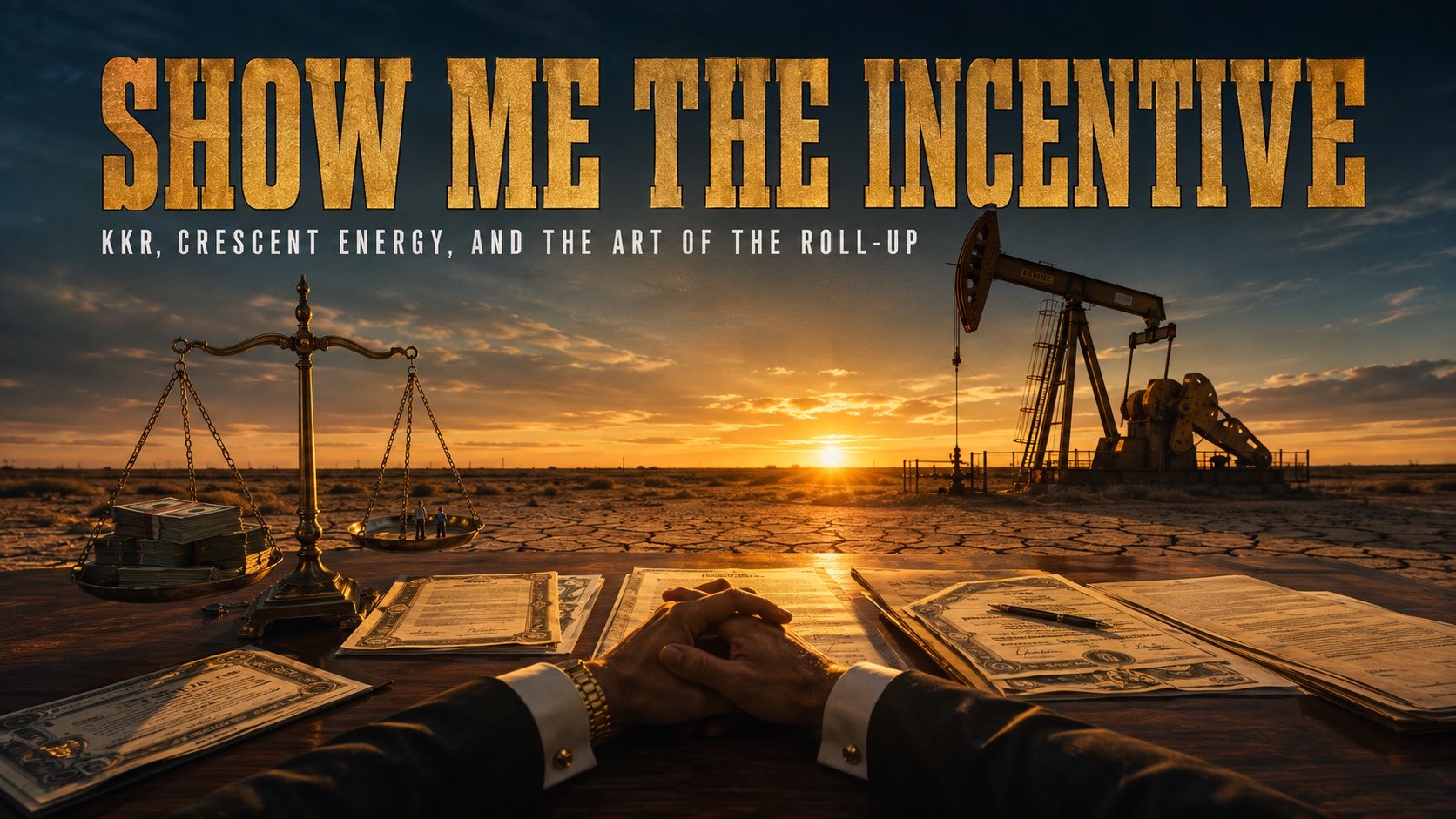
So there’s an incentive for the company that gets to appoint the board for it to buy new companies by issuing new shares and diluting shareholders. So that’s an interesting incentive scheme. What did Charlie Munger say about incentives? I know he’s got a good quote
Tony Kynaston: show me the incentive and I’ll show you the result.
Cameron: Exactly. Yeah. Mm.
Tony Kynaston: So
Cameron: Microsoft, w-
Tony Kynaston: Sorry
Cameron: used to say sh- “Show me, show me what gets measured and I’ll show you what gets done,” which is,
Tony Kynaston: similar
Cameron: Bill probably stole from Warren, who got it from Charlie.
Tony Kynaston: Yeah. Yeah, so you gotta expect more dilution to come. And as
Cameron: Yeah
Tony Kynaston: makes up for it, that’s not a bad thing. But yeah, if [00:30:00] something falls off par, then, um, yeah, you’ll– you’re worse off. KKR aren’t, but the shareholders are
Cameron: Yeah. I’ll get more into the KKR story in a little bit, but, um, like, just on the surface of it, the numbers look pretty good,
Tony Kynaston: Mm-hmm.
Cameron: have to say. I mean, I’ll, um, just bring up their Stockopedia, uh, overview
Tony Kynaston: I think it’s– While we’re talking about the M&A activity that’s going on, which is pretty aggressive, it’s not just KKR in the, the US fields. It, it’s– there’s rampant M&A going on to consolidate lots of small players, um, into big ones. So I shouldn’t– we shouldn’t just single out KKR as being behind this.
It’s, it’s commonplace
Cameron: No, but they’re driving the CRGY they’re in. Yeah. So if you look at their total re– Now, uh, keep in mind that when I talk about revenue and profit numbers, l- lot of this is a [00:31:00] result of acquisitions, right? But their revenue’s gone from $1.087 billion in 2019 to, uh, trailing 12 months is running about $4.309 billion.
So it’s CAGR of 27%. Uh, operating profit’s gone from $227 million in 2019 to TTM is $839 million. Has– Was higher and they had a bumper year in 2022 for some reason. It’s come back a little bit, but leaving that aside, net profit has gone from $45.8 million in 2019 to 54.8 is the trailing 12 months, was 133 in 2025.
Um, EPS is, uh, going the wrong way, though. It was dollar six in 2019. Trailing 12 months is about negative six cents. Not exactly sure what the cause of that [00:32:00] is. Didn’t drill down into that. But EPS normalized is 76.6 cents, so I guess that’s probably the important number there. Operating margin is around about, uh, 20%.
Operating cash flow per share, according to Stockopedia, is about 6.15. Dividend per share, they actually went ex-dividend on the 17th of August. The, it’s payable on the 31st, so we’re in the middle of that period. We’re gonna miss out on the dividend, but their dividend is tracking annually at about 48 cents.
I think it’s about 12 cents a quarter. They also have some cash, I think 300 odd million set aside for share re- buybacks, purchases. I don’t think they’ve done any recently, but they do have money set aside for that. They’re sitting on about $265 million worth of cash at the moment. Their net debt is $4.9 billion.
Book value of $5.15 [00:33:00] billion. So it’s, you know, you can tell it’s a, a debt driven business. But, um, all in all, you know, pretty solid sounding story if you just look at the, the pure numbers. But of course, it’s, as I said, it’s coming from acquisitions. It’s not, um, growth. And acquisitions, I guess, have to run out at some point.
But as long as you’ve got a business that’s still making money and we can buy it at a good price, I’m happy with that
Um, drilling down into some of their recent numbers, um, most recent quarter numbers look pretty good on the surface. Production rose 27% from 263,000 to 335,000 barrels of oil equivalent a day. Oil production itself was about 140,000 barrels a day. They drilled 43 operated wells, 26 were in Eagle Ford, [00:34:00] nine are in the Permian, and eight are in Uinta.
They brought 32 operated wells online during the quarter. That’s, that’s a lot of wells. That’s, that’s awesome wells, level of wells. Uh,
Tony Kynaston: Awesome.
Cameron: awesome, awesome, awesome. Awesome wells, awesome. Revenue rose, uh, 55%. Oil revenue more than doubled to 1.227 billion. Natural gas liquids revenue rose 32% to 129 million. Gas revenue fell 79% though to 34 million, most entirely based on the gas price.
Gas volumes went up, but the gas price was down. But oil is doing most of the work for these guys. Gas is pretty much a rounding error. Oil was 88% of Q2 revenue. Gas was about 2.4%. So their fortunes sit almost entirely on the oil price right now. Operating [00:35:00] income rose from 80 million to 581 million. General and administrative expenses fell from 125 million to 61 million, but apparently a lot of that was due to unusually high equity compensation expense in the earlier period.
Their recurring cash G&A actually rose 30% from 29.3 million to 38.1 million, quote, “Primarily due to an increase in manager compensation as a result of the Vital Energy merger,” end quote, according to their latest report.
Tony Kynaston: But so KKR are benefiting from the transactions and incentivizing management to do more transactions.
Cameron: Exactly. It’s a, s- it’s a sweet gig. Sweet gig. So as I said before, they, they use hedges to fix or limit the price, um, uh, on the production and this cuts both ways. Um, if the oil price goes down, it’s a good thing that if [00:36:00] you’ve hedged at a higher price, if it goes up, it can cost you money. Um, so they lock in a price, uh, a, a bit like agreeing to sell next year’s crop at a set price, I guess.
Cuts both ways, but we assume that these guys know what they’re doing and they’re professionals. So, um, something that did come out in their latest report is the efficiencies that they said they were gonna get out of the Vital merger actually s- so, so far seem to have been better than they thought.
They’re now expecting 250 million to 300 million of annual synergies, which is about three times what they originally thought they were gonna get. They say that 190 million have already been captured. Now that’s, it’s only happened, uh, a year or so ago, I think less than a year ago, so yet to be seen if all of this comes to fruition.
But, uh, according to management, [00:37:00] they think there’s gonna be a lot of upside in efficiencies gained by the Vital merger, which is good. Uh, I talked about the dividend already.
Tony Kynaston: the y- what’s the yield, Cam?
Cameron: Uh, well, I don’t know what it is. I told you how what it is as a cent. I don’t– I, I, I do have it, I have it in my numbers. I’ll get it, I think, later on.
Tony Kynaston: All right
Cameron: Uh, oh, hold on. I can just scroll down. Um, doo, doo, doo, doo, doo. The yield is 3.41%.
Tony Kynaston: Okay. Not, not overly high
Cameron: No
Tony Kynaston: I just wonder whether, like the s- as you said, the stock’s been going roughly sideways for a while because of the acquisitions. Um, sometimes that’s compensated for by a higher yield, but that’s, you know, not overly high
Cameron: No, it’s compensated by paying KKR for KKR. They’re being compensated.
Tony Kynaston: And management.
Cameron: Which is, yes. So I want to [00:38:00] explain the KKR situation because it’s a sweet gig. So I said they’ve got 1,000 preferred shares. They, they get the right to appoint the entire board. Ordinary shares still have voting rights, but they don’t get to elect the board.
KKR chooses the board, supplies the key executives, provides management services, and earns fees. The, the president’s executive team and the management services, services are provided by a company called KKR Energy Assets Manager, which reminds me of the Milrose Properties things that, that we talked about in an earlier episode, right?
Sort of outsourced the, the management of it. But KKR also gets paid in a fourth way, the underwriting fees. So the, the structure is that they get paid every time the company issues more shares. There’s three separate, or four separate [00:39:00] mechanisms if you include the underwriting. But in terms of the share issuances, there’s three separate mechanisms that are all in the management agreement whereby KKR gets paid.
I don’t want to get into the details because I did and it was, it’s just too convoluted.
Tony Kynaston: Mm-hmm.
Cameron: essentially, they’re all indexed to the gross size of the share count, the amount of shares that are out there. Not, it’s not indexed to per share cash flow or p- per share earnings or per share anything.
Tony Kynaston: Profit. Yep
Cameron: Yeah. It’s all based on the outstanding shares getting bigger, the, the total size of the float, I guess, getting bigger. So you can see this in the Q2 numbers.
Average basic shares were up 30%, average diluted shares up 49%. So a shareholder that owned 1% of Crescent in June 2025 now owns about [00:40:00] 0.77% of the basic share count or about 0.67 on a fully diluted basis because there’s a bunch of, you know, options and bonuses and stuff like
Tony Kynaston: Yep.
Cameron: get converted into ordinary shares at some point in time.
But K- KKR earns more just by the increasing size. So every time they gobble up a company, they issue more shares, KKR gets paid more through a series of mechanisms for the increased number of the, um, shares, outstanding shares, the total float. Plus they make money as the underwriter of the shares, plus they run the management company that does, does the whole thing.
So it’s a, it’s a sweet gig for KKR. You gotta, it’s like capitalism at its finest. It’s, you really gotta admire it. Yeah, yeah.
Yeah
Tony Kynaston: So it, um, reminds me of the Macquarie Bank model. Um, yeah, so Macquarie. For US [00:41:00] listeners, Macquarie Group was a bank, still is a bank, but is now much more. company, investment bank, and adopted, maybe even pioneered, the outsource manager model. So they would, you know, put a whole of assets together and then put a management company above them and then charge them s- charge the assets fees to run the company.
This is very similar sort of model that KKR is running here oil assets
Cameron: Hmm. Yeah, well, it makes sense. If you’ve got a big investment in something, you wanna make sure it’s run well, so you go, “Okay, we’re gonna run it as well.” But my question for you is, as an investor, is this a good thing or a bad thing? I know when the Vital merger happened, the Vital shareholders, uh, pushed back on this arrangement.
They actually fought KKR over it. They said it was a disincentive for the shareholders, for [00:42:00] KKR to have all of this power. Uh, they lost majority. There was a few issues where they got some movement on. I think there’s a cap on some level of fees that KKR get, but they basically lost. The, um, Crescent management said, “Yeah, KKR, uh, heard your version and they don’t like it, and they’re not, they’re not buying into it.”
But, so it’s, it’s more than just, um, legal wallpaper, this stuff. It actually is m- was meaningful enough to the Vital shareholders that they tried to get it overturned or modified to some extent and failed, so they obviously thought it was important.
Tony Kynaston: Yep
Cameron: But as a, as an outsider, um, potential investor, how, how would you think about this?
Tony Kynaston: Oh, look, you know, my first thought is, um, it, you don’t buy the asset, you buy the manager. That’s always the rule in these kind of situations. The manager rakes off lots of fees and a small capital base, the RO-ROE is pretty high. So that’s, uh, that’s the [00:43:00] capital light business model and, um, it’s been well tested and well proven. So we’re, we’re buying this, the asset side of things, the ore companies, on the basis that, you know, it meets our criteria at the moment. Yeah, it’s, um, it’s gonna pay a lot of fees to KKR and you’re gonna get diluted along the way. But, know, at the moment the numbers are good
Cameron: Yeah. Yeah, like that, that was the way I approached it. I was like, my job is not to question, um, how the management gets paid at the end of the day. Whether it’s KKR managing it and making money out of it or CEO for hire or somebody else getting paid.
Tony Kynaston: or whatever, yeah.
Cameron: Yeah, my job’s to look at the numbers
Tony Kynaston: Yep
Cameron: and let, let the, let the system tell me whether or not it’s a good buy or it’s not a good buy.
And so,
Tony Kynaston: Yeah.
Cameron: as I said, score’s very high
Tony Kynaston: And as we’ve seen with lots of, um, oil companies around the world that, uh, with [00:44:00] the, the barrel price high, they’re all making lots of money, so it’s a good time to buy them
Cameron: We’ll see. Um, the auditor is Deloitte. They’ve been their auditor since 2021. Most recent opinion was clean. They did identify a couple of critical audit matters, but they were related to oil and gas reserves and levels of depletion, depreciation, impairment, those sorts of things which they called out as being rather subjective, which I think is the nature of the business. So that’s the business, that’s the setup.
Uh, scoring was, as I say, uh, was very, very. scored very, very well for us. The price is not less than IV number one, though. Um, IV1 came in at $3.93. Share price was about 14 bucks when I did my analysis, so it’s well above that. But it did come in as less than IV2. IV2 came in at $23.07, so [00:45:00] we scored it for that.
The price was also less than the book value. Book value per share is about $15.59, so I priced, uh, I could score it for that and also of course scored it for price being less than book plus 30. Of course, the price to operating cash flow is less than seven or it wouldn’t be on our buy list at all, and it came in at 2.37.
Very, very low Pr/OpCaf for a business like this. Uh, price is not less than the yield. As I said, the yield is 3.41%. Sorry, PE, not less than the yield. PE was 18.35. Um, yield is also not higher than the benchmark rate. Um, does have positive book value growth, though. The three-year CAGR of book value per share is about 82.53%, driven of course by acquisitions, but it is what it is.
They do have a new three-point upturn. Uh, [00:46:00] as you said, the share price has been tracking along sort of horizontally, but it did bump up, uh, in the last, uh, few weeks, so scored it for that. The Piotroski F-score, Stockopedia’s, uh, financial strength score, was an 8.0 out of nine,
Tony Kynaston: Very
Cameron: one of the highest F scores I’ve ever seen, which, on our buy list, which is a good sign.
The quality rank is a 70 on Stockopedia, which is above our threshold of 60, so it scored for that. And the stock rank is a 95, which is above our threshold of 90. So it scored on all three of the Stockopedia, um, metrics, which is rare, but good. Um, and then it failed growth over PE being greater than 1.5.
All up, it [00:47:00] had a QAV quality score of 85.71% and a QAV score of 0.362
Tony Kynaston: Very hot
Cameron: Very high. That’s CRGY, C-R-G-Y, um, oil producer KKR, oil producer behemoth,
Tony Kynaston: Right
Cameron: and I added it to, um, QAV Light America this week. Not to our portfo- oh, did I add it? I don’t think I added it to our portfolio though, ’cause I think we’re fully, uh, invested, but just put it out there for people that are building their light portfolio.
So we’ll see how it goes. But yeah, some of the, uh. Uh, before I go, some of the other, uh. No, come here. Just so you know, some of the stocks that we’ve talked about recently not doing well. Um, Slide Insurance is up 9% since we talked [00:48:00] about it last week though. That’s, had a good one. Republic Airways, Roger Ramjet is down 12% since we talked about it.
Banco Bradesco’s down 7. Regional Management is down 16.9. Petrobras was before that, it’s up 3.5. Telecom Argentina is neutral. F&G, I talked about, is down 19%. Uh, what else have we got? Aeromexico’s down 17% since we talked about it in the middle of June. Um, BWLPG though is up s- uh, 17% since we talked about it in the middle of May.
Deutsche Bank’s up 23% since we talked about it. Opportune Financial is up 29%. Pitney Bowes is up 52. Eastman Kodak is up 23. Who’s the big winners here? Let me see. The best is still Sasol, [00:49:00] is up 146% since we talked about it in July last year. Lot of big winners, couple of big losers, which our rules would have got us out of.
But, uh, all over, I think we’ve talked about 65 companies, including today’s, uh, that we’ve done since March of 2025. Out of those 65, 48% are up, 15% are down, which is a win ratio of about 74%. So that’s pretty good.
Tony Kynaston: Yeah, that
Cameron: It’s a pretty, pretty good win ratio.
Tony Kynaston: six out of 10’s good I think.
Cameron: Yeah. Well, this is 7 out of 10, even better.
Tony Kynaston: Hmm
Cameron: So that is QAV America for this week, TK.
I’m going to kung fu. What are you doing for the rest of the day?
Tony Kynaston: Talking to property agents about buying a
Cameron: Ah, lovely. All right. [00:50:00] Have fun
Tony Kynaston: Thanks
Cameron: Happy hunting everyone
All right
Previous Pulled Porks
Here’s the performance of the “pulled porks” (eg deep dives) we’ve done on the show in the past.
| Ticker | Company | Covered | Price then | Price now | Return | Ep. |
|---|---|---|---|---|---|---|
| OMF | OneMain Financial | 14 Sep 2026 | $62.75 | $54.64 | -12.9% | 70 |
| ARDT | Ardent Health | 7 Sep 2026 | $10.91 | $11.95 | +9.5% | 69 |
| SND | Smart Sand | 1 Sep 2026 | $5.27 | $5.26 | -0.2% | 68 |
| CRGY | Crescent Energy | 25 Aug 2026 | $13.85 | $12.85 | -7.2% | 67 |
| SLDE | Slide Insurance | 18 Aug 2026 | $21.60 | $25.67 | +18.8% | 66 |
| RJET | Republic Airways | 10 Aug 2026 | $21.39 | $15.76 | -26.3% | 65 |
| BBDO | Banco Bradesco SA | 3 Aug 2026 | $3.44 | $3.68 | +7.0% | 64 |
| RM | Regional Management | 27 Jul 2026 | $41.65 | $33.38 | -19.9% | — |
| PBR | Petrobras | 20 Jul 2026 | $17.97 | $25.94 | +44.4% | 62 |
| TEO | Telecom Argentina | 14 Jul 2026 | $13.47 | $12.42 | -7.8% | 61 |
| FG | F&G | 7 Jul 2026 | $28.55 | $19.43 | -31.9% | 60 |
| KSS | Kohl's | 1 Jul 2026 | $17.34 | $21.15 | +22.0% | 59 |
| CARE | Carter Bankshare | 23 Jun 2026 | $31.00 | $30.03 | -3.1% | 58 |
| AERO | Aeromexico | 18 Jun 2026 | $17.34 | $16.04 | -7.5% | 57 |
| NRIM | Northrim Bancorp | 1 Jun 2026 | $24.71 | $24.11 | -2.4% | 55 |
| MGA | Magna International | 27 May 2026 | $65.20 | $64.45 | -1.2% | 54 |
| BWLP | BW LPG Limited | 18 May 2026 | $21.06 | $24.89 | +18.2% | 53 |
| KNOP | Knot Offshore Partners Com Unt | 14 May 2026 | $10.78 | $9.83 | -8.8% | — |
| GSL | Global Ship Lease | 13 May 2026 | $41.79 | $43.15 | +3.3% | — |
| DB | Deutsche Bank | 4 May 2026 | $31.11 | $32.80 | +5.4% | 51 |
| UEIC | Universal Electronics | 29 Apr 2026 | $4.25 | $4.98 | +17.2% | — |
| OPRT | Oportun Financial Corp. | 20 Apr 2026 | $5.88 | $8.78 | +49.3% | 49 |
| PAGS | PagSeguro Digital | 13 Apr 2026 | $10.67 | $10.83 | +1.5% | 48 |
| CVGI | Commerical Vehicle Group | 6 Apr 2026 | $3.56 | $2.78 | -21.9% | 47 |
| PBI | Pitney Bowes | 30 Mar 2026 | $10.86 | $16.75 | +54.2% | 46 |
| KODK | Eastman Kodak | 23 Mar 2026 | $7.83 | $8.78 | +12.1% | 45 |
| GPRK | GeoPark | 17 Mar 2026 | $8.77 | $11.59 | +32.2% | 44 |
| MUR | Murphy Oil | 9 Mar 2026 | $34.55 | $39.31 | +13.8% | 43 |
| NBR | Nabor Industries | 3 Mar 2026 | $77.80 | $78.20 | +0.5% | 42 |
| BFH | Bread Financial | 28 Feb 2026 | $70.86 | $98.96 | +39.7% | 41 |
| SHG | Shinhan FInancial Group | 17 Feb 2026 | $69.83 | $70.71 | +1.3% | 40 |
| EC | Ecopetrol | 3 Feb 2026 | $12.57 | $17.90 | +42.4% | 38 |
| CHRD | Chord Energy Corporation | 24 Jan 2026 | $95.53 | $146.18 | +53.0% | 37 |
| AMTD | AMTD IDEA Group | 20 Jan 2026 | $1.02 | $1.02 | -0.4% | 36 |
| VLRS | Controladora Vuela Compania de Aviacion SAB de CV | 13 Jan 2026 | $9.45 | $5.94 | -37.1% | 35 |
| TUSK | Mammoth Energy Services, Inc. | 10 Jan 2026 | $2.45 | $2.71 | +10.6% | 39 |
| XIFR | Xplr Infrastructure | 6 Jan 2026 | $10.17 | $9.89 | -2.8% | 34 |
| AMCX | Amc Networks | 1 Jan 2026 | $9.52 | $10.76 | +13.0% | 33 |
| ZD | Ziff Davis, Inc. | 16 Dec 2025 | $36.48 | $57.42 | +57.4% | 32 |
| VALE | Vale SA | 11 Dec 2025 | $12.90 | $13.21 | +2.4% | 31 |
| AER | AerCap Holdings NV | 29 Nov 2025 | $131.82 | $144.29 | +9.5% | 30 |
| KEP | Korea Electric Power Corporation | 29 Nov 2025 | $16.74 | $10.66 | -36.3% | 29 |
| PCG | PG&E Corporation | 24 Nov 2025 | $15.67 | $13.15 | -16.1% | 28 |
| CALY | Topgolf Callaway Brands Corp. | 12 Nov 2025 | $10.60 | $13.54 | +27.7% | 27 |
| CALM | Cal-maine Foods, Inc. | 23 Oct 2025 | $94.56 | $63.19 | -33.2% | 25 |
| AAL | American Airlines Group Inc. | 20 Oct 2025 | $13.78 | $11.79 | -14.4% | 26 |
| DCH | Dauch | 9 Oct 2025 | $6.16 | $5.19 | -15.7% | 24 |
| CYH | Community Health Systems, Inc. | 3 Oct 2025 | $3.01 | $2.98 | -1.0% | 23 |
| MEOH | Methanex Corporation | 15 Sep 2025 | $39.81 | $63.43 | +59.3% | 21 |
| SUZ | Suzano Inc. | 1 Sep 2025 | $9.73 | $8.56 | -12.0% | 20 |
| KE | Kimball Electronics, Inc. | 26 Aug 2025 | $28.65 | $27.23 | -5.0% | 19 |
| TITN | Titan Machinery Inc. | 14 Aug 2025 | $18.98 | $22.76 | +19.9% | 18 |
| GTN | Gray Media, Inc | 7 Aug 2025 | $4.42 | $4.33 | -2.0% | 17 |
| SENEA | Seneca Foods Corporation | 30 Jul 2025 | $102.12 | $181.78 | +78.0% | 16 |
| BHC | Bausch Health Companies Inc. | 22 Jul 2025 | $6.32 | $5.89 | -6.8% | 15 |
| SSL | Sasol Limited | 17 Jul 2025 | $4.99 | $15.63 | +213.2% | 14 |
| ZEPP | Zepp Health Corporation | 11 Jul 2025 | $2.98 | $3.45 | +15.8% | 13 |
| PKX | POSCO Holdings Inc. | 1 Jul 2025 | $48.49 | $56.72 | +17.0% | 12 |
| PDS | Precision Drilling Corporation | 27 Jun 2025 | $47.78 | $85.03 | +78.0% | 11 |
| IX | Orix Corporation | 19 Jun 2025 | $21.00 | $36.43 | +73.5% | 10 |
| JXN | Jackson Financial Inc. | 11 Jun 2025 | $83.00 | $130.03 | +56.7% | 9 |
| IHS | IHS Holding Limited | 30 May 2025 | $5.38 | $8.42 | +56.5% | 7 |
| F | Ford Motor Company | 21 May 2025 | $10.80 | $12.05 | +11.6% | 6 |
| ENIC | Enel Chile SA | 14 May 2025 | $3.97 | $4.42 | +11.3% | 5 |
| CM | Canadian Imperial Bank Of Commerce | 8 May 2025 | $63.76 | $110.45 | +73.2% | 4 |
| DAC | Danaos Corporation | 2 May 2025 | $82.47 | $161.96 | +96.4% | 3 |
| CX | Cemex Publicly Traded Stock Corporation With Variable Capital | 28 Mar 2025 | $5.66 | $9.52 | +68.2% | 2 |
| ZIM | Zim Integrated Shipping Services Ltd | 13 Mar 2025 | $17.97 | $29.84 | +66.1% | 1 |
4 more recent picks from the last 30 days are available to QAV America members — members hear every deep dive a month before it appears here. Become a member
Returns exclude dividends and are measured from the price on the day each stock was covered on the show. Prices as of Wed 14 Oct 2026, 9:22 pm ET. Updated automatically. Not financial advice.