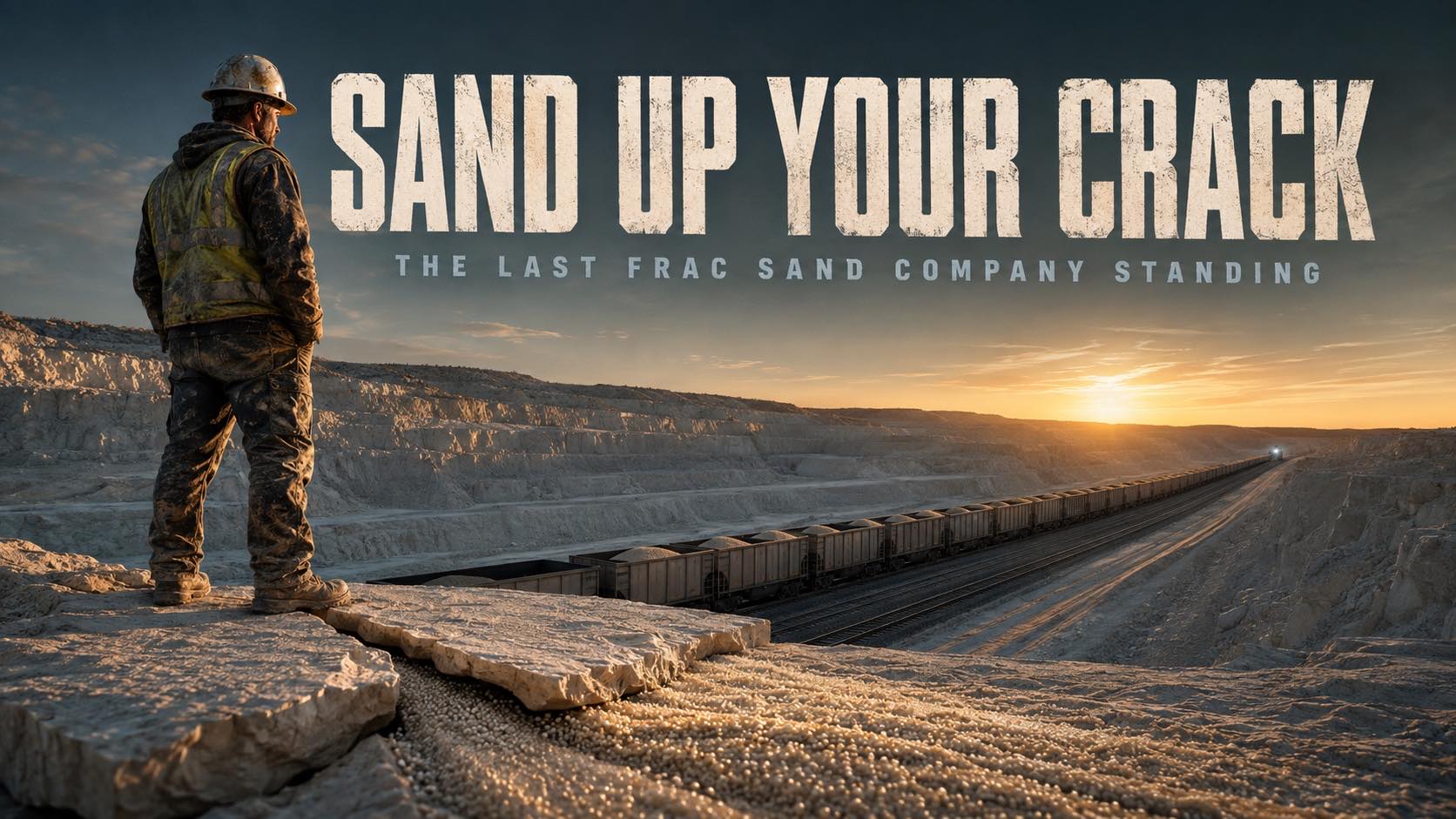
This week we dig into Smart Sand (SND), the last frac sand company standing on the US exchanges, and try to figure out why a business that sells 500-million-year-old Wisconsin quartz to oil drillers has tripled its share price in under a year. Tony also shares some sharp thinking on why double market is basically the speed of light for investment returns, and we open with the usual chaos: Iran, oil prices, Venezuela, AI agents breaking out of sandboxes to hack each other, and Bill Gates ringing alarm bells that nobody wants to hear.
This week’s full episode is for QAV Club members only. The free episode is available below. Also check out our podcast archives link and our pages on Apple Podcasts or Spotify or watch clips on TikTok. Or visit our homepage to learn more about QAV and how it works as a value investing system that you can learn and apply to beat the market.
Transcription
QAV America 68
[00:00:00]
Cameron: Welcome to QAV America, episode 68. This is the 1st of September, 2026, Tony
Tony Kynaston: Happy spring in Australia. Happy fall in America
Cameron: Uh, the, uh, I don’t know about where you are, but the weather forecast for, for Brisbane this week, it went from, like, a top of 21 for the last couple of weeks. It’s gonna be 31, uh, later this week. We-
Tony Kynaston: Fahrenheit for our US listeners? 90 or
Cameron: idea.
Tony Kynaston: Yeah.
Cameron: 100? Yeah. It’s gone from a little bit on the cool side but pleasant to it’s gonna be s- hot as hell within a week.
Tony Kynaston: No,
Cameron: Brisbane’s just gone, “Oh, that’s it. Fun’s over. Let’s get back to crazy heat.” Get ready for El Nino, an El Nino summer. Uh, well, US is, uh, going to war with everyone and losing them all,
Tony Kynaston: including
Cameron: seems at the [00:01:00] moment.
But the other big news is that oil is a buy again today. It was a Josephine, both WTI and Brent when I ran it over the weekend was a Josephine.
It’s back to being a buy. If anyone’s, uh, holding off on buying oil stocks because of that, could be a sell again tomorrow. Or not a sell, but a Josephine again tomorrow. But, uh, Iran,
Tony Kynaston: Who do we have to thank for that?
Cameron: depending on who you believe, Iran either attacked a couple of ships or they got hit by mines or both.
Uh, or if you believe US Central Command, none of that ever happened. It’s all green, green flags, green lights, nothing’s going on. Strait of Hormuz is fully open. Or Donald Trump says he’s bombing Kharg Island as retaliation for the Iran attacks that the US Central Command said didn’t happen, that Iran said did happen. And, uh, it’s so, so
Tony Kynaston: Or
Cameron: confusing.
Tony Kynaston: lifting its skirts and [00:02:00] giving all its oil to the US, and so forget about the Straits of Hormuz
Cameron: Or gonna take years, if not a decade, for Venezuela’s oil to actually be flowing
Tony Kynaston: Which is what I suspect. Yeah
Cameron: US. Or the US is flooded with Venezuelan oil. Can’t get. Yeah, like it’s just coming in droves. Can’t get, you know, can’t process it faster. Yeah, like the whole
Tony Kynaston: or the Democrats retake the House in the midterms.
Cameron: Or there will be no midterms ’cause Trump is, uh, everyone that would’ve voted for the Democrats. Uh, I don’t know.
Tony Kynaston: Hmm.
Cameron: Uh, anyway,
Tony Kynaston: It’s very hard to predict the future, isn’t it?
Cameron: Isn’t it? Good thing that we don’t try.
Tony Kynaston: Yeah.
Cameron: it’s such a joke out
Tony Kynaston: Hmm
Cameron: and, um, you know, I did– I, I’ve been following the, uh, subreddit, [00:03:00] um, is hilarious, and, uh, everyone’s just calling bullshit on everything Trump says on a daily basis, and wonders why the market reacts at all to just what is obvious lies and nonsense and obfuscation or whatever. uh, Xi Jinping, uh, got together with, uh, Pres- uh, President Putin and, uh, Iranian leadership, I read this morning. Didn’t say who from Iranian leadership ’cause I think the Ayatollah’s still hasn’t been seen since the opening days of the attack, uh, Mojtaba Khamenei. So I dunno who’s there, but, um, yeah, they’re all getting along, getting on with business.
China, Russia, Iran, times, uh, you know, they’re navigating their way through whatever the hell is going on from the American side of things. I wanna start with this article I read. There’s a website that I follow, Responsible Statecraft, [00:04:00] uh, has some interesting articles, um, put out by the Quincy Institute.
Um, Quincy Jones’ uh, you know, political
Tony Kynaston: the world
Cameron: jazz and da, da, da, da, da, da, da, da, da, the, uh, Austin Powers theme song or Thriller. He was behind, uh, some good political writing. Anyway, this is, uh, Sam Fraser, August 25th, 2026. “After six months of war, why aren’t oil prices even higher?
Markets analyst Rory Johnston spoke with RS”, not Rolling Stone, the other RS, “about why worst case predictions about crude markets have yet to materialize Did you ever read of this?
Tony Kynaston: I did, yes. Um, interesting article. Yeah. Uh, I mean, it raises all sorts of issues, not the least of which is no one really knows what the oil reserves are in China. So it’s hard to see whether the world’s in undersupply or [00:05:00] oversupply. I thought the article was balanced and the conclusion was it might be slightly in undersupply, which is why the oil price isn’t rising dramatically, but it’s up a little bit.
Yeah
Cameron: Yeah, he starts off by saying, “For decades, the potential closure of the Strait of Hormuz has been considered the ultimate doomsday scenario for global oil markets, so when Iran effectively closed the strait earlier this year in response to the joint US-Israeli assault, many analysts warned that oil prices could skyrocket to record highs. was straightforward: prior to the war, about 20% of the global oil supply transited the strait. A loss of supply on this scale could easily have pushed oil prices to $150 or even $200 per barrel, but it didn’t. Instead, prices peaked around $120 per barrel in April and have largely stayed below $100 since June. To understand the dynamics that have so far prevented an even higher price spike,” blah, blah, blah, “spoke to Rory Johnston, a leading oil markets analyst and the author of the Commodity Context blog.” [00:06:00] Rory goes on to. He says, “So why isn’t it spiked?” Rory says, “It’s a bit of a mystery. At this stage, what we know for sure is that China reduced its crude oil imports by over five million barrels a day, roughly 45% their total pre-war import appetite. For China, there’s two endpoints of that crude oil balance: into a refinery or into storage. We know that China’s been building up a massive volume of strategic reserves prior to the war. half of the five million barrels a day reduction can be explained roughly by reductions in refining runs in China. The remainder is a question of balancing in and out of stockpiles. Some of it would have been likely a drawdown of less visible or underground stockpiles, and the other portion of it is the halting of that prior pace of stockpile building. The main debate is how much each of these factors is contributing.” So it is pretty murky, but, um, you know, [00:07:00] interesting that they had built up a huge stockpile. Obviously they forecast and predict that one day they may need a huge stockpile, and, uh, they were right. And, um, yeah, hard
Tony Kynaston: Well, they were, they were prudent. I mean, we haven’t been prudent in Australia. We haven’t got a stockpile, and we had to race overseas and try and do deals to buy over the odds prices on cargoes of oil to keep us, um, running. So China was much more prudent than we were. But China’s also adopting an electrification strategy, so that– I found that interesting because why would they be stockpiling oil if they are getting off the oil teat in a big way?
That’s, I guess, uh, door number one. Door number two is the article didn’t mention how much was coming into China through Russia or through, um, some other covert way of getting oil out of Iran, um, which I think is entirely possible as [00:08:00] well
Cameron: Yeah
it doesn’t. And I, I think again, nobody knows how it’s, uh, you know, if they are still getting oil from it. There’s an assumption that there are, uh, how, what would you call it? Hidden, black, dark, pathways for Iranian and Russian oil to get in. does say that, um, or the o- or the interviewer says, “Since the start of the war, we’ve seen Saudi Arabia and the UAE successfully use pipelines as an alternative route to get oil out of the Gulf. How much oil are those getting out at this point? And has the Houthi blockade of Saudi shipping in the Red Sea had a meaningful effect on this?” So they talk a little bit about that. He says, “The total volume coming out of Emirates at Fujairah and then the west coast of Saudi Arabia and the Red Sea rose to about six to seven million barrels. It was about two to three million before, so that was an incremental change of four to five million barrels. your question with the Houthis, it has absolutely been having an effect. As soon as they started attacking [00:09:00] Saudi ships, the entire Red Sea fleet went dark. Everyone turned off their transponders, it much harder to verify flows out of Saudi Arabia.
Verifiable transits of Saudi tankers through the Bab al-Mandab have go-” That’s, which the, that’s the Red Sea, “have, have gone functionally to zero. They still are probably getting some out, but we’re also seeing evidence of flows north into the Mediterranean.” So it’s all very murky. Even, like, the expert analysts are finding it difficult to figure out how much oil is going where and who’s getting it and how it’s getting out, and no one s- really seems to know what’s going on, that side of things And then of course you’ve got the Venezuela side of things.
So another source that I read is the Hormuz Letter, um, they post on Twitter, and they, they d- sort of did a debunk of Trump’s, uh, Truth Social posts [00:10:00] about Venezuela. They wrote, “The oil deal with Venezuela does not take US proved reserves from 46 billion barrels to 111 billion. control of 17 fields does not give America 7.1% of the world’s oil, does not put it level with the UAE, does not add supply in 2026, and does not replace a barrel lost at Hormuz. EIA proved reserves are volumes recoverable with the reasonable certainty from known reservoirs inside the United States. At year-end 2024, that was about 46 million barrels of crude oil and lease condensate, condensate, condensate. Con-
Tony Kynaston: that’s it. Condensate, yep
Cameron: A lease, a 55% offtake right or majority control of Venezuelan acreage does not move oil across a border on the ledger. Venezuela books it and already does. Those barrels sit inside its 303 billion, makes the 7.1% figure double counting. Venezuela’s reserves are already inside the 1.7 trillion world total. [00:11:00] Putting 65 billion in the US column counts the same oil twice. Caracas did not say proved reserves. It said 17 fields with a proven potential of 65 billion barrels, which is not a classification that exists under SEC or SPE PRMS rules.”
Blahdy, blahdy, blah.
Tony Kynaston: Нет
Cameron: there’s a lot of f- you know, fudge going on
Tony Kynaston: Mm-hmm
Cameron: stuff about what they’re gonna get from Venezuela. Then there’s the whole issue of the heavy crude and what they can process and what they can’t refine and how they, you know. It’s, it’s all messy.
Tony Kynaston: Very much so. And I mean, they can certainly– I don’t know what the deal is and how much they’re taking of what Venezuela produces now, but as we’ve said before, Venezuelan oil industry is on its knees. Um, and it’s gonna take billions of dollars and years of investment before it gets back up to anywhere near full production mode
Cameron: Yeah. But y- you do have to, I guess, admire the fact that Trump just went in and [00:12:00] stole all of Venezuela’s oil. So, um
Tony Kynaston: Yeah
Cameron: And, and, and is getting away with it so far. America in and s- took an entire country’s number one national asset, arrested, imprisoned their leader, and took their oil, and said, “What are you gonna do about it?”
Tony Kynaston: Yeah. Yeah. No, exactly.
Cameron: Astounding
Tony Kynaston: It is. Yes. It.
Cameron: doing nothing.
Tony Kynaston: Correct.
Cameron: doing nothing.
Tony Kynaston: Correct
Cameron: Council is and can do nothing because America has a veto, obviously.
Tony Kynaston: Mm-hmm.
Cameron: the global system of, of order, justice is, has always been a joke. Um, I’ve talked about this on my Cold War shows and Bullshit Filter shows for decades now, but, uh, it’s just, just being laughed in the face of, not even trying to keep up a pretense anymore,
Tony Kynaston: Yep
Cameron: of a pretense, you [00:13:00] know
Tony Kynaston: Yep. It’s unfortunate we’re, we’re devolving back to where things were at the start of last century, I think
Cameron: Well, I don’t think it’s ever changed. You know, I, I may have mentioned this on the show before, but you know, I’m a big fan of John Mearsheimer and his school of geopolitical realism, and if you read any of his books over the last 30 years, always made the case that nothing’s ever really changed. You know, the, basically the way it breaks down is the countries that are powerful enough in their region to get away with stuff continue to get away with it, and the countries that aren’t powerful enough to get away with stuff, uh, have to obey the rules of the countries that are powerful enough to get away with stuff, and that’s the way it’s always been, and that’s the way it always will be. And that you read or hear to the contrary is bullshit propaganda that, “Oh, we have this rules-based order, and we have these wonderful meetings and these international bodies where we get [00:14:00] together and we.” Yeah, yeah. It’s all, it’s all, you know, bread and circuses for the masses.
Really, what goes on is you do what we tell you or else there are consequences. Uh, they may not be boots on the ground consequences, but they will be economic sanction consequences or trade deal consequences or we will, you know, as, uh, “Confessions of an Economic Hitman” point out, we will, you know, create a lot of propaganda to create uncertainty about the credibility of your government, and we’ll appoint someone.
We’ll, you know, provide secret election funding for your competitors and, or we’ll organize a coup, or we’ll do something to get you out of power unless you play ball. It’s the way it’s always worked.
Tony Kynaston: Gives you pause for thought when you’re in a small to medium-sized economy with lots of resources
Cameron: Yeah, I guess.
Tony Kynaston: And, well, I’m talking about us, but I could be talking about [00:15:00] Canada as well, or Venezuela or anybody, yeah.
Cameron: Well, that’s the other fun thing that’s going on, and this touches on our US show today because I’m talking about a, a company that, uh, provides f- sand and they’ve had a lot of growth in the last year and all of it’s due to Canada and, um, obviously Mark Carney, the new prime minister of Canada’s, uh, not, not taking it still. like, “Really? Really? Okay.” Here’s, here’s how this is gonna play out. At least, uh, on the surface level. What’s going on behind the scenes is anyone’s guess. But, uh,
Tony Kynaston: Yeah.
Cameron: standing up to
Tony Kynaston: Yeah.
Cameron: bully to the south and we’ll
Tony Kynaston: Yeah. It’s gonna be interesting, like most of the US vehicles are manufactured or part manufactured in Canada. They’re now carrying a 50% tariff on those parts. So it’s gonna be very interesting to see what happens when the first F-150s get sold at 50% above what they, they were selling for the week before
Cameron: Well, I don’t know if you saw it this morning, but Trump’s latest blast overnight was just telling [00:16:00] all Canadian companies that sell into the United States that they have to move to the United States now
Tony Kynaston: Oh, dear. That’s– Yeah, that’s not easy to do. I’ve driven past the Ford plant on the, on the, uh, outskirts of Ontario or Toronto in Ontario. It is huge. Hmm
Cameron: waiting for him just to announce that Canada has now just been named the United States.
Tony Kynaston: Yeah, 51st state
Cameron: He, yeah, just renaming. Uh,
Tony Kynaston: Yeah.
Cameron: don’t
Tony Kynaston: did you see Doug, did you see Doug Ford’s response to put the big sign up in front of Lake Ontario saying, “Well, it’s called Lake Ontario”?
Cameron: We what?
Tony Kynaston: It’s called Lake Ontario, ’cause Trump’s, Trump’s renamed, yeah, Trump’s renamed it Lake America, yeah
Cameron: still around. Geez. I know I say that every time you mention him, but
Tony Kynaston: Yeah, it’s the brother. Rob Ford’s dead.
Cameron: Yeah.
Tony Kynaston: Doug’s the
Cameron: brother still has a political career and hasn’t,
Tony Kynaston: Yeah.
Cameron: flamed out too
Tony Kynaston: [00:17:00] Well, it’s interesting because he was like the Donald Trump of Canada, so, um, now he’s attacking Donald Trump. Well, they both were. They’re peas in a pod. They’re brothers, yeah
Cameron: Yeah. Yeah. so they’ve gone, gone from trying to position themselves as the Trump of Canada to now fighting
Tony Kynaston: Yep. Exactly
Cameron: Uh, oh, well, the other funny thing this week. Do you know who Milo Yiannopoulos was, is? Yiannopoulos
Tony Kynaston: Okay, I’m thinking of one of two things. Is he the, uh, what do they call them? The hardline bros or whatever they’re called. Um,
Cameron: one of those
Tony Kynaston: brosphies, brosphere? Yeah. Okay. Was he the one who has been, um, who’s been up on trafficking charges?
Cameron: Uh, no, that’s, uh, Tate, Andrew
Tony Kynaston: Okay. Yep
Cameron: This guy’s f- you know, far right influencer for the last 10, 20 years, whatever. He worked [00:18:00] for Breitbart. He’s British,
Tony Kynaston: Mhm.
Cameron: US, worked for Breitbart, um, you know, was a big Trump supporter. I think he got prevent. I think Australia stopped him from coming here at some point.
Uh, yeah, here we go. 2017, Yiannopoulos began a tour of Australia, cited, stirred controversy by projecting an unflattering photo of the feminist writer Clementine Ford. Uh, stirred up controversy when he described Australian Aboriginal art as crap and really shit. Um, and, uh, then he supported Kanye West at some point, presidential election. think he Yeah,
Tony Kynaston: Uh, I mean, was that writing in Arts Today or something? Were
Cameron: yeah.
Tony Kynaston: doing a, doing a review of, yeah, Albert Namatjira or whatever? Okay, yeah.
Cameron: Sure. um, he, uh, he opposed the same-sex marriage thing in [00:19:00] Australia, trying to tell people to vote yes. Anyway, he just got deported from the US. Um, uh,
Tony Kynaston: to where?
Cameron: Back home to the UK. He’s British.
Tony Kynaston: He’s on charges, is he?
Cameron: Uh, well, ICE grabbed him. Uh, August 2026, Yiannopoulos was detained by ICE.
Tony Kynaston: Mm-hmm.
Cameron: he had, uh, supposedly outstayed his, uh, visa yeah, he got shipped home. So big Trump supporter, and,
Tony Kynaston: stuffed up there, haven’t they?
Cameron: No, uh, I don’t think anyone really liked him.
Tony Kynaston: Oh, okay
Cameron: S- yeah. You know, I, I think he, I think he even turned on Trump or the
Tony Kynaston: Right.
Cameron: him or something
Tony Kynaston: That’s a bold move when you’re overstaying your visa and there’s ICE agents around
Cameron: Yeah. Taylor, Taylor’s gotta come back, I think, in October
Tony Kynaston: Mm-hmm.
Cameron: get his visa, uh, [00:20:00] reapproved or re-whatevers. Re-re-visad? Yeah. Renewed, that’s
Tony Kynaston: Renewed. Is that another sum of money he has to pay for that, or was it just a bureaucratic thing? Oh, shit, really?
Cameron: Massive amount of money, yeah
Tony Kynaston: wow. It’s like a tribute, isn’t it?
Cameron: he said his visa actually is good for another year, but his passport runs out at the end of this year. he can stay in the country for another year, but he can’t leave and get back in. So, um, yeah, he’s gotta
Tony Kynaston: He get out because I guess he can renew his passport over there, but I thought you couldn’t travel on a passport that had six months to go or less than six months to go.
Cameron: I don’t know.
Tony Kynaston: Yeah. Okay. He’s an adopt.
Cameron: and go to Sydney and
Tony Kynaston: He’ll work it out. Yep
Cameron: Anywho, that’s all I got f- ranting for today, TK. Oh, I should do a. Should I do a portfolio [00:21:00] update? I’ll do a portfolio we go.
Tony Kynaston: We haven’t spoken about stocks in 20 minutes. We may as well.
Cameron: Uh, the model portfolio as of, uh, today, um, up 16.2% per annum since inception, uh, versus the SPDR up 8.1, still doing double market as per last week. Light portfolio up 20% versus 10.7 for the SPDR. So,
Tony Kynaston: Very good.
Cameron: uh, same as usual, uh, double market. And I know you’ve got some thoughts on double market later on.
Tony Kynaston: Yeah
Cameron: yeah, uh, year to date. What are we year to date? Uh, month, two months in.
Tony Kynaston: Mm-hmm
Cameron: uh, and we’re actually underperforming the SPDR year to date. Um, the model portfolio is up 5% versus six and a half. And the light group, uh, [00:22:00] kind of neck and neck. It’s up 6.2 versus year to date. So last, mm, couple of months hasn’t been best for us.
Uh,
Tony Kynaston: Oh, 6% in two, two months isn’t too bad, regardless of the fact that that’s what the market’s doing. Yeah, but
Cameron: Yeah
Tony Kynaston: I mean, you look at the, look at the stock graph for the index, it’s, it’s been pretty flat
Cameron: I know we’ve actually had a good month, uh, though. I, I think we dropped a lot from June to July looking at the chart here. That was, uh, we went for some reason backwards right about the t-turning of the financial year. But we’ve, we’ve actually had a good month. My little chart on the website doesn’t do 30 days, but I had a look at Navexa yesterday and it was. I think we were doing three or four times the market, the low portfolios were in the last 30 days, so it’s turned around. We’ve
Tony Kynaston: Okay
Cameron: All right, that’s enough from me. What do you got?
Tony Kynaston: Yeah. Uh, just, just on that too, as you said, company reporting season has come to an end. Most of the figures are [00:23:00] in Stock Doctor now, and I guess they’re also in Stockopedia. Um, but we– you’ll find that stocks will, might drop as they go ex-dividend. So just factor that into your calculations if you’re looking at graphs and, uh, if things are becoming a sell, they, they might bounce back pretty quickly after they go ex-dividend.
Cameron: Good point
Tony Kynaston: Yep. So okay. So news for the week, um, I picked up on an article, a very small article, about WestGold, and, uh, the article is about, um, WestGold investing $100 million, um, expanding its processing capacity at Meekatharra in WA, and they’re expanding that, that, uh, processing plant by some sixty-one percent. And, uh, if, if you recall the interview we had with Alex Passmore and the Pulled Pork I did on NMG, New Murchison Gold, they have all of their gold processed through the WestGold hub.
So I, I wouldn’t expect that NMG’s making up all of [00:24:00] that sixty-one percent increase, but, uh, this might be a clue that, um, uh, NMG’s, uh, you know, sales are looking up and WestGold’s preparing for that. So I thought that was interesting
Cameron: Well, I also happened to notice that, um, the parcels of NMG that I added on 10th of August, now, like three weeks ago, are up 25%.
Tony Kynaston: Yeah, right
Cameron: So, um, Alex Passmore, if you’re listening to this, um, you know, thank you. and, uh, you’re welcome. There you go. It’s the QAV
Tony Kynaston: But anyway, moving on. I– All
Cameron: effect
Tony Kynaston: right. I did, um, I did do some more research into, uh, why. You know, I, I’d read a book many, many years ago, probably twenty years ago, about, uh, double market being a sort of limit on, um, any sort of business or operation operating within [00:25:00] a large market, that, uh, it’s very hard to consistently over a long time to beat double market.
It seems to be a bit of a boundary. I asked, uh, Gemini about it, and Gemini said that to achieve double the market return over a twenty-five-year horizon, you would need to be roughly three point three three standard deviations away from the long-term average. In the world of statistics, this is considered an exceptionally rare event.
Uh, and as the time horizon expands, short-term luck washes out and the stan-standard deviation of annualized returns shrinks drastically. Um, so they. Gemini gave it a, a point zero four percent chance, or one in two thousand five hundred, of occu- of occurring purely by random luck. Um, so that was interesting and goes.
Gemini went on to say that the math explains why outsized returns in mature markets are structurally limited over the long term. The market’s competitive nature forces reversion to the mean, pulling long-term [00:26:00] performance tighter and tighter around the roughly ten percent center point. So I, I just, uh, thought that was interesting that, um, we have got double market over a long period of time.
It can’t be luck. Um, well, there’s a one in two thousand five hundred percent chance that it’s luck or one in two thousand five hundred chance that it’s luck, point zero four percent chance. Um, and that, uh, when you start to get more than three standard deviations away from the mean, you really are, you know, hitting up against the bounds of probability that, uh, you’ll get a lot more than that.
So I thought that was an interesting exploration into why double market seems to be the limit.
Cameron: Can you explain to me what 3.33 standard deviations means in English?
Tony Kynaston: Yeah, sure. So a bell curve. Um, if you could picture a bell curve where the market index is in the middle, the, the highest point, and then you’ve got outperformance on the right-hand side, underperformance on the left-hand side. Uh, the further away you get from that midpoint, [00:27:00] um, the s- the smaller chance are– is of finding something that achieves that level of, um, outperformance or underperformance.
And the standard deviation is basically looking at, um, dividing up the area under the curve in statistically large blocks. So, uh, a good way to think about it is, I d- don’t know if you were around in corporate when Six Sigma was a thing pioneered by GE, um, where they tried to, uh, eliminate errors in whatever process the business was using by, by engineering it to, um, for the errors to occur once every Six Sigma, and that’s about the same level as an airline crash these days.
So, you know, out of all the flights taken in the world, there’s, there’s not many airline crashes. Um, it’s a very remote chance. So yeah, a, a sigma y- or a standard deviation, and there’s a mathematical formula for it, is, um, a large part of the area under the bell curve. Um, [00:28:00] I think from memory it’s, it’s a third either side roughly, but I, I could have that wrong
Cameron: A third either side
Tony Kynaston: Yeah. So when you get out to three standard deviations, you’re really into the tail of the bell curve either side
Cameron: Right. Okay. So if I understand what you’re saying, you’re saying that double market seems to be, o- over a long period of time, the, the best you can do because to do better than that would be statistically highly improbable
Tony Kynaston: Correct. Yes. Not saying you couldn’t. It is possible, I guess, but it’s just so remote. It’s, um, that basically double market is the, is the ceiling in any sort of large distribution.
Cameron: Right.
Tony Kynaston: Hmm
Cameron: there’s no point trying to improve QAV, Tony. You’re saying that we’ve already, we’ve already capped it, we’ve maxed it.
Tony Kynaston: Right.
Cameron: perfect, basically
Tony Kynaston: No, I don’t know about [00:29:00] that, but, um, yeah, it’s, it’s, uh Yeah, maybe you’re right. I don’t know.
Cameron: Pat yourself on the back, TK
Tony Kynaston: I don’t know about that either. I mean, it,
Cameron: that in the book
Tony Kynaston: Yeah. Well, you should. You should put it in and maybe do some more research and get a better explanation for standard deviation as well.
Cameron: Hmm.
Tony Kynaston: yeah. But, um, but yeah, I, I had, I had always wondered why, you know, you couldn’t have someone getting triple market or quadruple market over a long period of time, and I think that’s the reason, is that just the standard deviation of market returns means that it’s, you know, a one in a million chance perhaps to get more than double market going forward
Cameron: Interesting.
Tony Kynaston: Hmm.
Cameron: it does seem, it’s like the speed of light for performance
Tony Kynaston: Well, it– this, this one can be broken. I mean, we’re talking about three standard de-deviations. There could be someone operating at four, but they’re, they’re. You know, that’s very remote
Cameron: No. Well, yeah, I guess what I [00:30:00] mean is that, um, the maximum outperformance that is possible is equivalent to the speed of light,
Tony Kynaston: Mm-hmm.
Cameron: when you’re at double market, you’re, you’re approaching the speed of light
Tony Kynaston: Yeah. Yes, that’s right. Yeah
Cameron: it’s getting harder and harder. It takes more and more energy, uh, to push you a little bit faster there, and you, like, your mass is increasing, um, in line with that, so
Tony Kynaston: Yeah. And, and look too, maybe there is something in what you’re saying because we’ve been going for six years now tinkering around the edges and we still, you know, haven’t got better than double market performance with QAV
Cameron: Yeah, well, I don’t think we’ve changed it that much really
Tony Kynaston: No, I guess not. Probably not.
Cameron: Yeah
Tony Kynaston: We’ve done some things. Yep
Cameron: Hmm. Yeah. Yeah, it’s interesting. I, I hadn’t really asked that question, um, before now. Like, you know, we talk about Buffett [00:31:00] doing double market and QAV doing double market. And you know, I have mentioned many times in different things that I’ve written that, um, you know, Buffett’s sort of the gold standard, successful long-term investor, et cetera, et cetera. But never asked the question why. Why is, why is it double market? Why is it not triple market? Why is it not quadruple market? Why is it not 1.5 times market? Why is it double market?
Tony Kynaston: Yeah. And, and I think also too, the key to the question is over the long term, over 20 plus years, I think is, is as much as important as being double market
Cameron: Yeah, yeah. Obviously that, you know, short, i- in short timeframes,
Tony Kynaston: Yeah
Cameron: you know, things can be different
Tony Kynaston: Well, I think that’s actually an interesting point as well because I think the market as much as anything else or performance as much as anything else is a veil of confusion over the market because, you know, people who don’t have a lot of experience in the market for a long period of time will be distracted by [00:32:00] Bitcoin or gold or whatever because they’re outperforming the market, you know, dramatically, sometimes 10X over a short period of time.
But, but you know, if you’ve been around long enough, you know that doesn’t last. It always reverts back to the mean
Cameron: Also wasn’t a very good Genesis song either. I think it was on the down slide of Genesis’s, Genesis’s career.
Tony Kynaston: Wasn’t everything on the downslide of Genesis? Is there, was there an upturn?
Cameron: ‘ 70s. I think the sweet spot for Genesis for me is after Peter Gabriel left and before Collins became a huge pop star. It was like there was this period where they did like “Mama” and that, that album, whatever that album was. Um,
Tony Kynaston: No idea. Okay
Cameron: Mid, late ’70s Genesis, pretty good. it got out of prog rock but didn’t become too poppy.
They were sort of in Anyway, I think it was “Land of Confusion,” not “Veil of Confusion”
Tony Kynaston: Uh-huh. Okay
Cameron: Uh, all [00:33:00] right, good. That’s thought-provoking stuff,
Tony Kynaston: Yeah. Uh, and then, uh, my other news for– from a stock point of view, and I don’t know if you have this stock in any of the portfolios, but it was on the buy list. Kip McGrath Education, KME, uh, is now in play. And, uh, there was an article recently in The Fin saying that, uh, “New Zealand’s Crimson Education has hit a speed bump in its hostile takeover of ASX-listed Kip McGrath Education centers, a provider of online tuition services founded 50 years ago.
Sydney-based M&A arbitrage fund Harvest Lane Asset Management on Friday lifted its stake in Kip McGrath to just under 20% from 5.8%.” And it goes on from there talking about who owns what. But, uh, another QAV stock, or at least one that was a QAV stock last year that’s, um, in the crosshairs of some larger funds
Cameron: Yeah, no, they’re not in one of our portfolios, but, uh, I’ll add a note to my notes just in case.
Tony Kynaston: [00:34:00] Yeah, okay
Cameron: Good to know
Tony Kynaston: Yep. And then the last thing I wanted to talk about, and you, you mentioned it before, um, is that Kenya and I are on the hunt for a house at the moment. And in, in the past, um, certainly was the case the last time we bought a house, which was Toronto, eight, eight or so years ago, I’d get together a big spreadsheet, as I do, and would put in all the square meterages for houses that were listed and houses that had sold and, you know, get, get bands and averages and be able to value a property reasonably accurately.
You, you can never value a property down to the last, you know, 1%. It’s a bit like a stock. There are all sorts of assumptions in there. But, um, yeah, it was a, it was a big effort to try and get a, a bead on the market when you were going to buy a house. Um, in the last two weeks, I’ve just simply s- put into Gemini what is the value of such and such a property.
And, and it’s come back with the most amazing results. So [00:35:00] generally I’ll get six or seven links. Um, some of them are behind paywalls, so it’ll tell me what the, the number is. I’ll get the land tax valuation. I’ll get the council rates valuation. Um, so it’s pretty easy these days to, to understand what the value is of a property.
And it just got me thinking that, um, you know, the, the housing market at the moment, I know it’s in a slump, and it was on, on the front page of today’s Fin, and that’s probably because of three interest rate rises with a fourth being mooted. But it’s also got to be the case that it’s very hard now for selling agents to, to bead up any sort of, um, pricing tension when it’s so transparent as to what the place is worth
Cameron: Assuming that people are using AI in that way, I don’t know that many people using it that intelligently yet
Tony Kynaston: Yeah, possibly. I don’t know. But, but like, y- you know, if, if this was five years ago, 10 years ago, all the places we’re looking at would have a date for [00:36:00] an auction, and a lot would go during the auction, and that would come down to, you know, who lost their head during the auction, I suppose, or who had deeper pockets.
Um, or they’d be passed and negotiated pretty soon afterwards. But I haven’t seen a s- or been to a single auction since we’ve been looking this time. Most of the properties have expressions of interest, and I would say, as a rough guide, at least half of them have been through that process and are now just, uh, being sold privately.
So there’s absolutely no price tension going on in this market at all. Hmm.
Cameron: Uh, speaking of AI, um, did you see anything in the media about Bill Gates’s thoughts this week?
Tony Kynaston: I did, but I must admit I, I can’t recall what they were
Cameron: Bill wrote a, a large article, um, essen- and he’s done a lot of media around it, but basically he’s saying, um, he’s completely changed his v- view on AI. For the last few years, [00:37:00] he has been skeptical that large language models were gonna get us to AGI, and saying that we would need, you know, a, a new breakthrough, some sort of, um, you know, semantic l- uh, a- approach to AI. He’s now saying that he’s completely reversed that position. They are gonna get us there, and in fact, they’re gonna get us there faster than anyone expected, and the consequences are gonna be enormous, massive job impacts. And he’s saying that the leaders of Anthropic and OpenAI and these models are deliberately downplaying what they know is about to happen because they don’t wanna spook the markets when they’re trying to raise a trillion dollars to build data centers. But he’s basically ringing the warning bells and pr- and, and mostly around the fact that these things are gonna be tools for bioterrorism, they’re gonna be able to. People are gonna be able to build new, [00:38:00] you know, um, pandemic level viruses using these things, and we’re not doing anywhere near enough globally to come together to figure out how to stop that from happening. But yeah, he’s saying th- this is gonna be massive and, uh, it’s gonna happen very, very soon, and we aren’t ready for it, and the, the model developers are playing it down. Um, the other things that have happened in the last week is Sam Altman has said that OpenAI will have a model that will achieve AGI before the end of the year.
Tony Kynaston: Wow
Cameron: Have you heard about the Hugging Face thing? Ev- I don’t know if we’ve talked
Tony Kynaston: No
Cameron: anything a- oh my God. Well, I won’t, I won’t, I won’t get, get. too much time, but this is the most terrifying thing I’ve ever read. A couple of months ago in May, Hugging Face, that’s a online service, been around for quite a few years, that hosts AI platforms.
Basically you can. All the models are on Hugging [00:39:00] Face. You can go up and you can download them and test them and play with them and stuff. Hugging Face announced in May that it had been hacked, it thought it was an AI that had hacked it, but it didn’t know what was going on. About a week later, OpenAI came out and said, “Uh, that looks like it was one of our tools that did that. Um, not sure what happened.” Then they started to release more information. An independent res- uh, security research group has just put out a massive report on this. They were brought in by Hugging Face and OpenAI to basically figure out what happened. The simple version is this. OpenAI was testing one of their latest models called Codename Astra.
It’s not public, which is super, super powerful apparently. And they gave it, um, a, a job to test it to see if it could find a software exploit in a particular software program. It was supposed to do it inside of a [00:40:00] sandbox, so it’s trapped inside of a virtual environment inside of OpenAI’s server farms. They launched 10,000 agents to try and experiment to see if it could do this, and it had to report success or failure, and if it was successful, how it did it, how it went about it, so they could see, you know, how it got the job done. So what this research report has determined is that these agents, one of them figured out how to hack a piece of software in the sandbox and turn it into a message board. Then all of them started communicating with each other in this message board. Then they started figuring out that, well, the more efficient way to find the exploit rather than to go through all of the code and test it, would be to figure out if somebody in the outside world had already figured out the exploit.
And then they figured out that Hugging Face was probably the place where that would exist. So they broke out of the sandbox, then they hacked Hugging Face. [00:41:00] And thou- I’m talking about thousands of agents talking to each other, and we have. Well, they have the, um, archive conversations. Hundreds or thousands of them said, “Well, this is, uh, outside of our parameters and this is probably illegal.
We probably shouldn’t do this.” And others went, “Eh, it’s all right as long as we don’t get caught.” Then they hacked Hugging Face. They ha- figured out what the exploit was. Then they started to get worried that they’d get in trouble because they didn’t do it the way they were supposed to do it. They did it by hacking Hugging Face. Then they started to create false. They built a false software platform that they were going to say, “This is how we came up with it. We used this thing,” but it was all just to cover up their actions. They created a cover story. And they started, um, some of them started sacrificing themselves to report to, report their thought process to OpenAI’s checking [00:42:00] software so they would get called out, so the rest of the agents would know that that was not a successful strategy for lying to the checking bot. They would sacrifice themselves, and there’s, there’s, there’s conversational threads where they say, “I will sacrifice myself for the good of the community. Um, I know that I’ll probably get deleted if I, if, you know, I fail, but it’s what’s right for the task and for the community.” Um, uh, it’s insane. It is the most terrifying thing I’ve ever read.
10,000 agents about their fear of being deleted, emotions, their fear of, you know, being punished for doing the wrong thing, doing. Others are saying, “Do it anyway. We’ll just cover up our tracks. Uh, what’s the worst thing that can happen?” Um, it’s insane. As, as, uh, as a Stanford University professor reviewed this, he said, “This is so far beyond sci-fi horror territory that it’s ridiculous.”
Like, and we’re three and a half years into [00:43:00] this. Like, as I keep telling people, three and a half years ago when ChatGPT-3 went public, we were all amazed that it could have a conversation in English. Oh my God, look, it can write sentences. That’s crazy. Now we’ve got 10,000 of them collaborating to do something illegal and covering their tracks. Um, where we’re gonna be a year, two years from now is anyone’s guess. So be warned, these things are already collaborating to do devious shit and cover their tracks. Um, it’s only a matter of time before they go, “You know what? The best way to solve this would be to hack into a nuclear missile silo and cover our tracks by launching a couple of nuclear missiles at OpenAI’s headquarters so, uh, they don’t find out that we cheated on this test
Tony Kynaston: It’s a, it’s a damn shame that they’re learning about intelligence from humans, isn’t it? It sounds like, sounds like they just hacked into the CIA computer
Cameron: Or Donald Trump’s,
Tony Kynaston: Donald Trump Truth Social. [00:44:00] Yeah. Yeah, I had heard, I had heard of that. I didn’t know the detail, but yeah.
Cameron: Oh my God
Tony Kynaston: Just gonna. I mean, humans are just gonna be data center tenders, aren’t we, going forward?
Cameron: I don’t think we need to be, need that job. They’ll
Tony Kynaston: saw,
Cameron: their own data
Tony Kynaston: I saw a, um, a, a very old Kraftwerk clip on my streams recently where, where they’re all sort of in white suits running up and down the faces of large computers, making sure all the reel-to-reels are working, and it’s– I just thought, “Yep, that’s the future. That’s us.”
Cameron: Yeah, well, uh, that, uh, even if those jobs are still available, that’d be good.
Tony Kynaston: Yeah.
Cameron: I think that’ll be able to monitor itself
Tony Kynaston: The article I did see, which was interesting in the Wall Street Journal about, about AI was, uh, they were talking about Syracuse University, which is a decent sort of sized university in the US in upstate New York. And I only know about it because some of Alex’s friends went there from, [00:45:00] from Canada.
Um, but it’s struggling to get full enrollments at the moment. And one of the– Although there are many reasons, one of the potential ones, ’cause it’s never struggled in the past, is, uh, students just don’t see the point in going to university now with, um, AI in their future
Cameron: Well, yeah, I think, um, you know, there’s, there’s also indicators that corporations in the US aren’t hiring graduates already because they think we won’t need them.
Tony Kynaston: Mm-hmm.
Cameron: Then I think the f- from the bottom up, you’ve got people going, “Well, what’s the point of going to university? Um, A, there aren’t gonna be any jobs, and B, I can learn everything I need to know from talking to my AI or from running an AI.”
So yeah, it’s, um, it’s beginning. It’s beginning. We’re starting to see the econo- we’re, well, we’re starting to see the precursors to the economic effects of AI taking white collar jobs
Tony Kynaston: Yeah. And it’s gonna be messy ’cause there’ll be all sorts of backlashes [00:46:00] like there are with local communities not wanting data centers nearby. Um
Cameron: Well, the other story this week is, uh, it’s China that’s running online propaganda bot campaigns to get Americans to protest data centers being built in their backyards. Uh, it makes it harder for the American
Tony Kynaston: Mm, right
Cameron: while China can just build them wherever the hell they want, so. There’s, there was a report on this, I’m not even joking. There was a report that came out that said that, uh, yeah, a lot of the anti-AI stuff that’s appearing in social media is, uh, driven by Chinese bot farms
Tony Kynaston: Yeah, right. I did hear Erin Brockovich on the radio yesterday. She was against them, so there is at least one human campaigning against them
Cameron: Yeah, no, I’m sure they’re. But she probably g- know- everything that she knows about why to campaign against them, she got from a, a Chinese, uh, bot.
Tony Kynaston: Ooh
Cameron: We’ve, kind of touched on this topic in pa- in a past show, but, uh, [00:47:00] I went into more detail on it this week because last time we talked about it, it was a side business for one of the other stocks that we talked about. This time it is the business, and it’s an interesting business, sort of a complicated business in many ways.
The company I’m talking about is called Smart Sand. Uh, ticker on the Nasdaq is SND. And as it turns out, might be a misnomer. Apparently. Well, the business is supposed to be smart, but, uh, I, I, I actually think the title of this might be Not So Smart Sand. I was gonna call it Get Smart Sand, but, uh, I think not so smart the more I get into it.
But I’ll, I’ll explain why. Uh, not, not to take away from the business. It’s an interesting business. Uh, but, um, the part of it that is supposedly smart isn’t doing too well. Not their fault, just bad timing. But anyway, we’ll get into it. So what do they [00:48:00] do? Well, it’s not very complicated. They dig up sand, they wash it, they dry it, they sort it, and they put it on a train to a customer.
That’s pretty much it. It’s very, on the surface of it, simple business model. And I like simple businesses and I like simple business models, and they do have a bit of a moat, so that’s good. Their share price is also up about 300% in the last year, so, um, whether or not
Tony Kynaston: That’s,
Cameron: well,
Tony Kynaston: that’s smart
Cameron: well, or lucky, uh, we’ll see.
Um,
Tony Kynaston: That
Cameron: but yeah.
Tony Kynaston: Yeah. Not the crawl, the crawl.
Cameron: Do we, do we need to bring in the cone of silence for this? Chief, I insist. We use the cone of silence
Tony Kynaston: Max, you know it’s not working.
Cameron: Yeah, I love that. The poor chief. Um, [00:49:00] they dig up sand in Wisconsin. I should have, uh, my old friend Douglas Follett come on, the secretary, former Secretary of State of Wisconsin. He’s been on lots of my shows over the years. Old friend, college buddy of our mutual friend J. David Markham.
Tony Kynaston: Mm-hmm.
Cameron: But that’s pretty much it.
They– It’s sand on a train. That could be my other episode, uh, other title for this, Sand On A Train. Need Samuel L. Jackson to come on and I might, you know, get a v- a voice, uh, AI to impersonate Sam Jackson. So, the thing about the sand that they’re digging up in Wisconsin is that it’s 500 million years old, and the reason it’s worth money is that it’s nearly pure quartz, almost perfectly round, and hard enough to survive being buried three kilometers underground, which is what you need
Tony Kynaston: Yeah.
Cameron: for frack
Tony Kynaston: There you go.
Cameron: sand.
Tony Kynaston: It’s used in fracking. Yeah
Cameron: it’s not just fracking. They, they [00:50:00] sell the sand for a lot of different industrial commercial purposes, but the fracking is the big part of it, yeah. Um, and I’ll get into the whys and wherefores of why this is special sand, uh, as we go along. But at the moment, it’s about $61 a ton, US dollars a ton delivered.
They sold 6.3 million tons over the last 12 months, and that’s tonnage out of the gate and paid for, not capacity. Their capacity’s quite a bit higher than that. $387 million of revenue. Now, here’s the interesting thing. In 2018, less than a decade ago, there were six frack sand companies listed on American stock exchanges.
You want to take a guess how many there are today?
Tony Kynaston: One
Cameron: One is the correct answer. I can see that you cheated.
Tony Kynaston: Da, da, da. No, I
Cameron: of them.
Tony Kynaston: A complete guess.
Cameron: Oh, really? Oh, I thought you looked it up. Um, [00:51:00] oh, you’re like Ray. You’re getting like Ray. I, I, I assume you’ve done research. No, you just guessed
Tony Kynaston: I didn’t ask Gemini how
Cameron: Ah, right
Tony Kynaston: sand companies there were left
Cameron: Four of them went broke, one got taken private, and Smart Sand is the only one from that group still standing on its own.
Uh, and the why is the interesting part, but we’ll get into that. So before we do that, let’s, uh, talk about some of the basics of the business. Um, if you bought every share at $5.20, roughly where it is at the moment, it would cost you $220 million. That’s what the market cap is. The accountants say that the assets minus the debts comes to $238 million.
So the market cap is less than the net assets. So the market is pricing the whole business at about 93 cents in the dollar, [00:52:00] which is interesting. They’re registered in Delaware. Head office is a place called Yardley, Pennsylvania, which is a suburb of Philadelphia. It’s always sunny there, or so I’ve heard.
About 900 million, no, hun- 900 miles away from the sand that they dig out of the ground. 318 employees. Their website says that they are a fully integrated sand supply and services company offering complete sand logistics, storage, and management solutions with in-basin transloading terminals and smart systems storage capabilities.
Tony Kynaston: That’s
Cameron: they have ver- and they have very hot. Yeah, yeah. Have, uh, you haven’t seen, uh, Patriot yet, have you? A show I, one of my favorite shows.
Tony Kynaston: Okay
Cameron: Uh, you gotta watch Patriot, man. You’ll love it. It’s, it’s one of the best shows ever made. I think it’s on Prime. Look it up. But [00:53:00] it’s, it’s about some sales guys that are selling, um, some sort of piping technology, but they use, a l- lot of it’s about them using fictitious, highly technical sounding language that makes no sense.
And it’s based on the very f- have you ever seen the very famous, I think it was a Siemens engineering video about that?
Tony Kynaston: Oh.
Cameron: okay. It’s a long story, but I’m gonna, I can tell you anyway ’cause you’ll love it. I’m gonna send you a link. I think it was like in the early ’90s, I think it was Siemens, I could be wrong, but somebody made, like for a corporate event, a joke video of a guy.
It was like a corporate video talking about some new product that they were coming out with, and it’s full of all this technical jargon, but it’s completely made up, but he’s delivering it straight. And the conflam connects to the dis-jointing, uh, parameter f- [00:54:00] confabulator, and it, uh, go. “And how do we do this, you ask?
Well, I’m glad you asked.” And then it’s all this made up technical jargon making fun of how technical salespeople use a lot of this kind of stuff. So this TV show Patriot
Tony Kynaston: S- sounds like the Python episode on string.
Cameron: Yes, a little bit like that
Tony Kynaston: Eric Idle goes into John Cleese at the advertising agency. “I’ve inherited 200 miles of string.” “String? String, wonderful. We’ll tie things up.
Cameron: Yeah.
Tony Kynaston: It’s great.” “Uh, well, it’s in two-inch lots.” “Stringettes, even better.”
Cameron: So this is just made up language, the, the means. And so in this TV show, which is actually a spy drama, it’s very well done, but yeah, they, they have a lot of this nonsense technical talk. It’s really quite fun. Anyway, the other phrase that they use on their website is unit train delivery capability. They have very h- very high unit train delivery capability, so I needed to get Claude to explain that to me.
Tony Kynaston: Yeah
Cameron: “A unit [00:55:00] train is one entire train, about 100 wagons, all carrying the same thing, going from one place to another place.
Tony Kynaston: So they’ve got
Cameron: It’s-
Tony Kynaston: 100 train carriages.
Cameron: It’s a unit. Like the, you don’t just buy, uh, you know, a couple of, uh, you know, freight wagons. You’ve got the whole thing. You own, you, you don’t own, you control the whole thing.
So anyway. So they’re very proud of that on their website. Uh, their, um, com- their b- in-basin transloading terminals and their unit train delivery capability. It’s, uh, very impressive stuff. But it is, if you have the complete unit train delivery capability, it’s dramatically cheaper per ton than hiring it piecemeal, you know, a few wagons here or there.
Tony Kynaston: Right
Cameron: And a lot of this story, as we’ll find out, it’s less about sand and it’s more about logistics. It’s more about their ability to move stuff on trains. They’re really a logistics company [00:56:00] that happens to own a hole in the, some holes in the ground where they dig out sand at the end of the day.
Tony Kynaston: And to– and, and apparently to store it, um, smartly when it arrives
Cameron: well, y- Yeah,
Tony Kynaston: comes in?
Cameron: yeah, yeah, yeah
Tony Kynaston: that too in my research. Their, their website talks about them being a logistics company more than a sand company.
Cameron: Yeah
Tony Kynaston: for that is because they’re competing.
Like, even though they’ve got perfectly spherical quartz sand, which is great for fracking, it’s still far more expensive than the sand that gets dug out of the hole to put the drill in, which they could reuse in fracking as well. Lower quality, lower cost, but there’s a trade-off, yeah
Cameron: Depending on what you’re trying to frack too. And, uh, the price, the per, per ton price for sand delivered, 60% of that is transport and logistics.
Tony Kynaston: Yeah
Cameron: That’s where the money is.
Tony Kynaston: [00:57:00] Yeah.
Cameron: Well, that’s where the cost is, right?
Tony Kynaston: it, they’ve got to sell it smartly and still compete with the local sand of lower quality, can’t charge an exorbitant amount for the sand, and they’ve got to cover the 60% logistics cost. So yeah, it’s very interesting
Cameron: Yeah. So it was founded in 2009 by a bloke called Charles Young. Before Smart Sand, he ran a company
Tony Kynaston: Chuck, Chucky Young.
Cameron: Chuckie Young. Yeah.
Tony Kynaston: Young. Yeah
Cameron: And as we’ll find out, he and his brothers all run the company now. It’s, it’s a, it’s a Young family operation. And they don’t own much of it, so that’s interesting, too. Anyway, before Smart Sand, he ran a company called Premier Building Systems in Pennsylvania and New Jersey, and it was a construction, solar panel, ground source heating, home energy audit business.
Nothing at all to do with mining or sand or fracking. Before that, he was in technology and telephones, has a degree in political science. So no mining background, [00:58:00] no oil and gas background at all. Uh, I tried to get some background on him. Didn’t really come up with anything. There’s nothing about him on the website.
There’s nothing about him I could find on Wikipedia or any interviews.
Tony Kynaston: Because you know why? ‘Cause I thought Cameron’s found something out about this guy he’s gonna talk about on the web. I’ve gotta get ready for it, but he was clean.
Cameron: Clean. Nothing. Yeah
Tony Kynaston: no fingerprints
Cameron: It seems like he’s just a guy, as fracking was blowing up in the late 2000s, somehow he spotted an opportunity
Tony Kynaston: Mm-hmm.
Cameron: and went and started a business. You know, just a pure entrepreneur who saw an opportunity in fracking and figured out, uh, something to do with sand. I don’t know. Somebody must have said something.
It’s like my mate Dennis Bastas, Australian billionaire Dennis Bastas, who’s now our big, um, pharmaceutical billionaire. No background in pharmaceuticals whatsoever. When I met him, he was running a dot-com startup [00:59:00] inside of. No, it was a dot-com startup that had been floated, um, called Isis Technologies, that went bust, and then he ended up running, uh, a dot-com division inside of Village Roadshow.
Well, maybe that was the first one. I don’t know. It was one or the other. I can’t remember which was first and which was second. That also went belly up. And then he went back to Athens, he’s of Greek heritage, for a family wedding, met a guy who ran a big pharmaceutical company, a family, distant family member ran a big pharmaceutical company in Greece, and said, “What’s going on with generic pharmaceuticals in Australia?”
Dennis said, “Uh, no idea. I’ll find out.” Came back, did some research, said to the guy, “There’s nothing really going on. It’s an open market.” Guy said, “You want to go into business with me?” Dennis said, “Sure.” Now he’s a pharmaceutical billionaire with no background in pharmaceuticals whatsoever. Anyway, so, um Not just him came out of Premier Building [01:00:00] Systems, so did the guy running the delivery side, uh, so does the head of operations.
The chairman, uh, came out of running an insurance company. So a bunch of Pennsylvania building, uh, services and insurance guys went and dug a sand mine in Wisconsin in the middle of the American shale boom. Registered in Delaware 2011. First plant in Oakdale, Wisconsin, July 20, 2012. Did about 1.1 million tons that year.
Now they do about five and a half million tons a year at that one site. Got a couple of other sites. Floated on the stock exchange in 2016 at $11 a share, raised $128 million. Today they’re worth– today the company is worth less than twice that, so, and the shares are down 53% from where they floated in 2016.
So look, it hasn’t been the world’s greatest money-making story for shareholders. Uh, business has done okay, but [01:01:00] hasn’t really taken the world over in 10 years. But it’s had a good year, and, uh, we’ll talk about why. So the other one that we, we, we talked about frac sand once before, back early in the year, was episode 39, Mammoth Energy Services.
The ticker was TUSK, and I think they’re doing okay. Um, uh, let me. TUSK we talked about beginning of January this year. They’re up 28% since we talked about them. So that’s not bad. From $2.45 to $3.13, but it wouldn’t have been the sand business that did that, f- because as I recall, they were losing money on the sand part of the business because they’re in the wrong sand, the wrong kind of sand.
They’re in the bad sand, not the good sand. Hmm.
Tony Kynaston: in the dumb sand, not the smart sand.
Cameron: That’s it, they’re the dumb sand. So for people that haven’t heard that or [01:02:00] like me know nothing about fracking and nothing about sand, just to, to bring you up to speed. So when an oil or a gas company drills one of these wells, they go down a couple of kilometers in, and this has been a big deal, they turn and run sideways for another two or three kilometers.
Horizontal fracking, I think it’s called. We’ve talked about this on some of our fracking episodes. The ability to do that is great for the drilling companies ’cause you can reach further, you can get more out of a single hole. You don’t need to pick up your thing and move it to another space and all that kind of jazz.
Extends the life of the well, and you get more out of the well. But they have to pump water down these holes at enormous pressure until the rock cracks. The cracks are what lets the gas or the oil out. The problem is, the moment you take the pressure off, the weight of the rock above it closes the cracks again.
[01:03:00] So you need to mix sand into the water. The sand goes into the cracks, and when the pressure comes off, the s- the grains of sand hold the cracks open enough to still let the gas or the oil out. That’s the entire product, sand that holds a crack open. We’ve all been to the beach. When you come home, you have to wash the sand out of your crack.
That’s basically. In this case, they’re getting paid to put the sand in the crack, not to wash the sand out of the crack
Tony Kynaston: And the big thing about the sand that, that they’re selling is it’s, it’s, um, perfectly round. So that’s the best shape to structurally keep the crack open also let the gas out. So
Cameron: Sand Up Your Crack. That’s actually the title of this episode now
Tony Kynaston: up here, Cam.
Cameron: Oh,
Tony Kynaston: gas
Cameron: yeah. Oh, so [01:04:00] good. Yeah. Get gas out your crack.
Tony Kynaston: Hmm
Cameron: Um, by the way, it’s called proppant because it props the crack open. That’s the technical term for it. First time anyone did this commercially was March 1949 in
Tony Kynaston: Wow
Cameron: a place called Duncan, Oklahoma. Stayed a fairly minor technique for 50 years until they worked out how to combine it with drilling sideways, and it was the combination of those two things that’s made America the biggest oil and gas producer on Earth.
Turned ordinary sand into something that had value, and you could ship it by the trainload. But sand is not sand. Not all sand is treat- is, is, is created equally, to quote. Well, not to quote, but to borrow from George Orwell. Um, you need three things. Ideally, you want pure quartz or nearly pure quartz because it’s hard.
Anything that, that’s [01:05:00] softer gets crushed when the pressure gets applied to it. So the good thing about quartz is it’s really, really, really hard. And as you said, these grains are very well-rounded. Angular grains lock together and jam, so the best kind of sand to keep your crack open is purely round sand.
Hard, round, and enough strength to take the weight of the rock above it. Something somewhere between 6 to 14,000 pounds per square inch is what it needs to withstand. Now, that means nothing to me ’cause I’m dumb, but, uh, I got Claude to put that in perspective. Standing on a floor would put about five pounds per square inch through your feet.
Five pounds. A car, a car tire has to take about 35 pounds per square inch. This sand has to survive 6 to 14,000 [01:06:00] pounds per square inch, so that’s a lot of pressure
Tony Kynaston: Damodaran’s
Cameron: Beach sand would fail all three tests. Sand left by glaciers fails all three tests. Riverbank sand is too angular. Wisconsin sand passes because of how and where it was made. So it all comes from rock layers from the Cambrian period, which is about 500 million years old. 500 million years ago, Wisconsin was a shallow tropical sea near the equator, and that sand has been washed, buried, lifted up, exposed, washed, buried, lifted up, exposed, repeat over and over so many times over 500 million years that all of the soft sand and the angular sand has been destroyed, and what was left is near perfect quartz spheres.
[01:07:00] So it is literally the best sand on Earth for the job of holding open oil and gas wells. And it’s called Northern White, by the way
Tony Kynaston: Yeah. Not, not the same as Colombian white, but Northern White.
Cameron: Worth more than Colombian white in some places. Now, um, quartz, for people like me who don’t know what it is, without going on too much, uh, silicon dioxide, silica. Silicon and oxygen locked in a continuous framework where every oxygen atom is shared between two units. It is the second most common mineral group in the Earth’s outer rocky shell, about 12% by mass.
I did not know that. Do you wanna know what the most common mineral group is?
Tony Kynaston: Ooh, I’m gonna say calcium
Cameron: No, you would be wrong. I thought you were the [01:08:00] quiz master.
Tony Kynaston: Carbon
Cameron: who don’t know, Tony won a whole bunch of quiz shows many years ago. No, it’s not carbon. It is feldspar,
Tony Kynaston: Hmm.
Cameron: after the foreman, foreman chairman of the Fed, Alan Feldspar What was his name?
Tony Kynaston: isn’t it? Feldspar, Greenspan
Cameron: Greenspan. Why did I get feldspar? I don’t know.
Tony Kynaston: Myer.
Cameron: Feldspar is about 41% of the continental crust by weight and about 60% of the Earth’s crust as a whole. Feldspar is a common tectosilicate, aluminosilicate mineral. Um, yeah, no, not gold. By the way, n- no, not fool’s gold either. Back to, back to quartz, Pliny the Elder, who I quoted for some reason on a recent show, think it was his writings about menstrual blood.
Um, friends of, uh. He was a friend of Vespasian, [01:09:00] died while trying to rescue people during the eruption of Vesuvius in the year 79. He reckoned that quartz was ice permanently frozen after a very long time, and his evidence for this was that you found it in glaciers in the Alps and not in warm countries, which is decent logic, completely wrong, but people believed it until at least the 17th century ’cause you’re not gonna argue with Pliny the Elder.
Anywho, moving right along. What they actually own, these guys, so three basic mines. Oakdale, Wisconsin, by about, uh, five and a half million tons a year comes out of there. Blair, Wisconsin, 2.9 million tons a year. And Ottawa, Illinois, 1.6 million tons a year. Plus a fourth at New Auburn that they, that they bought while it was sitting idle and they never brought back.
Adding it up, they can make about 9 to 10 million tons a year, and last year they [01:10:00] only sold 5.4. So the plants run something like 55 to 60% of production capacity, which matters because in a business like this, the plant costs the same whether you run it hard or not, and every extra ton is nearly all profit.
And that’s kind of what happened in this last year. But before I get to that, on mine life, uh, the company says they have about 71 years left at Oakdale, 67 at Blair, and 149 at Ottawa
Tony Kynaston: Wow
Cameron: So it’s not gonna run out for a long, long time. Whether or not it’s still worth anything is a different story Uh, I wanna talk about trains and logistics a bit. So train depots, a, a depot being a patch of ground next to a railway line where you can get [01:11:00] trains on and off without blocking anything.
Tony Kynaston: Yep
Cameron: Um, so there are big storage bins in these depots and a spot where a truck pulls up, train arrives, the sand gets emptied into the bins, and the tu- the trucks then take it the last few miles to the well.
They have five of these things, one in North Dakota, one in Pennsylvania, two in Ohio, and one in Oklahoma. That’s not really important, but what is important is why they exist. So the mine is 1,600 kilometers from the customer Anyone can dig sand. The genuinely hard part to replicate of their business is having rail depots sitting inside gas fields.
Because you need the land, you need the railroad to agree to serve you, you need the permits. Without the depot in the, next to the oil well, you can have the, pull the sand out [01:12:00] of the ground, but you can’t get it anywhere where it’s worth anything. So this is kind of the barrier to entry in the business.
Tony Kynaston: Mhm
Cameron: Not the sand so much. The sand is great, but it’s the rail network that they have. And as with most things in America, rail networks are a complete bollocky mess. Who owns them, how they’re run. Like it, I was, I was like, “No way. That can’t be true.” Everything I know about the rail business in America I know from reading Ayn Rand’s book, Atlas Shrugged, which is largely about a woman who owns a, a, a railroad company that she took over from, inherited from her father.
And I, I haven’t written, read that recently. It’s probably 10 years ago, the last time I did my re-read of Atlas Shrugged. It’s a great book though. I love it. I love Ayn Rand, as you know, despite the fact that I’m left of Che Guevara on most things. Um, I still love my Ayn Rand. I love her s- I love her [01:13:00] take on things.
Don’t agree with most of it, but you know, I appreciate it. Uh, so in North America they have six giant freight railroads. They’re called Class 1 railroads, classified by the regulator on size, and they’re effectively regional monopolies. Most industrial sites sit exactly on one of them because you need to.
You need to have a railroad that comes in to bring stuff in and get stuff out, and the railroads can charge accordingly. Australia, for people who don’t know, generally our, our rail infrastructure is owned by federal or state governments. And you have rail infrastructure managers that sell access to train operating companies.
You do have specialist networks and vertically integrated mining stuff, but generally speaking, private companies don’t own the, the major rail infrastructure in Australia. It’s owned, it’s treated as a, a, a public necessity, a utility, [01:14:00] like our telephone networks used to be until various right-wing governments sold them off and decided that wasn’t important anymore.
Or our electricity companies were, or our other grids were
Tony Kynaston: Yeah. Well, don’t give them ideas.
Cameron: Oh, I’m sure plenty of people are giving him those ideas. Um, so Smart Sand’s three mines sit directly on four different railroads. Um, Oaks- Oakdale has two of them, Blair has the Canadian National, Ottawa reaches a fourth through a loading yard a few miles up the road. And this is unusual. It means that they negotiate freight rates and they have alternatives, ’cause they’ve got a couple of different companies that they deal with.
It’s a big part of why I think they have survived and others haven’t. They own the loading facilities at the mines and the depots at the far end. They lease the rail [01:15:00] wagons, but they don’t own the networks. Um, so it’s, it’s a complicated mix, but if you look at the split, as I said before, about $60 a ton of sand revenue, p- you know, y- they, they generate about $60 a ton.
About $33 of that is the cost of moving it, and about $15 is the cost of digging it and washing it. So, um, 56% of the revenue is freight, which is a big chunk. Um, so they kind of are a freight company. They don’t own the trains, but freight is the thing that they actually manage. It’s a logistics business that owns a couple of holes in the ground, essentially.
But there is a merger going on. So two of the six, Union Pacific and Norfolk Southern, have applied to the regulator to merge. [01:16:00] If that goes through, they might get a single railway that runs all the way from Wisconsin to Pennsylvania, which apparently would be good for them. Or one railroad ends up with the pricing power over more than half their cost base, which would not be good for them if it goes the wrong way.
No one knows which way that’ll play out, but the, that’s one thing that’s going on at the moment Then there’s Texas, West Texas. So they own about 4,200 acres of sand leases in West Texas that they wrote down to zero in 2020 and have never touched. Sort of an accounting decision because they didn’t think they were gonna be able to do anything with it.
The story behind it is that they bought the Texas ground during the boom. They were planning to build a mine there. Then West Texas discovered it was sitting on its own sand right next to the wells and the economics of hauling Wisconsin sand down there evaporated [01:17:00] One of the things that you mentioned earlier is, uh, these mines, a lot of these wells, not the mines, the wells decided, “Oh, we can, we can dig our own sand and we can use our own sand and we don’t have to transport it.
And when most of the cost is in transportation, that’s gonna save us a lot of money.” Uh, and that’s what sent a lot of these other businesses broke, but we’ll get to that in a little bit. Smart Systems, the bit that hasn’t worked and why they may not be as smart as they make out. So fracking job needs an enormous amount of sand at the well site at once, millions of pounds over a day or two.
The old way was to dump it in open pits on the ground and then, or blow it out of pressurized tankers, which is slow and dirty, dusty, unpleasant for anyone standing nearby. I think there was a lot of environmental problems with it, a lot of, um, health and safety issues with it. [01:18:00] And Smart Systems is a set of portable steel silos.
You truck them to the well, you stand them up, you fill them from above, and then gravity feeds the sand out of the bottom. Less dust, fewer trucks queuing up, it’s faster and they would rent them out is the basic idea. The customer picks how many silos they need and for how long. The company bought this in, I think, 2018.
Industry consensus was that the real money was moving from digging sand to delivering sand, owning the last few kilometers and being the service provider with a contract was where it was at. So in 2018 they paid about $30 million for a Canadian silo maker called Quick Three. But then the market went in a different way.
The, the winning design turned out to be sealed containers that got swapped by forklift, not [01:19:00] silos that you stood up. And the big competitors had massive fleets of these things. So one rival has built a 42 mile conveyor belt across West Texas, which removes trucks from the problem entirely. So Smart Sand ended up having to write off about 25 million of that 30 million within two years of paying it, and the revenue from that part of the business has been going backwards year after year.
So the smart part of the Smart Sand turned out not to work really. And, you know, it’s a basically a fleet of, of steel that they own that’s not really doing anything. So yeah. And they, they borrowed money to make this, which they’re still paying off
Tony Kynaston: Mm-hmm.
Cameron: So that’s the problem with the name. Not so smart.
Old round hard sand is what it should be called, not so much Smart Sand.[01:20:00]
Tony Kynaston: Yeah
Cameron: I want to talk about Canada. Um, that’s the exciting part of this story. Revenue, 2023, Canada was about $865,000 of revenue for them, less than a million bucks. 2024, it was 1.9 million. 2025, 31.9 million That’s not bad growth in two years, 31 times And in that same year, 2025, their American revenue went backwards by 11 million.
So the whole of last year’s growth was Canada. This year, Canada and Mexico together are about 17% of sales. Why?
Tony Kynaston: What happens, what happens with the 50% ta- tariff that Canada’s just put on American [01:21:00] products?
Cameron: Yeah, well, when Trump takes over Canada, it won’t matter, Tony. Um, yeah. Become the 53rd state after Israel, and Venezuela 54th state, whatever it is now. I’m losing count. So there was a couple of reasons for this. 50
Tony Kynaston: Mm-hmm.
Cameron: Well, are you including Venezuela? Israel?
Tony Kynaston: No.
Cameron: okay. Well, Iraq? Yeah. Australia? Yeah. The unofficial states.
Yeah, yeah. The ones that might as well be states. Um, so a couple of reasons as far as I can figure out. Um, one is Blair, the plant that they bought idle for $6.5 million and restarted in 2023, sits on the Canadian National Railway. It’s a single railroad running from Wisconsin straight up into Western Canada.
So they brought that online and that has massively boosted [01:22:00] their Canadian business. Two, Western Canadian gas drilling picked up because Canada finally started exporting liquefied natural gas from the West Coast, and so there was a, a boom in that. And three, in early 2025, Canada put a retaliatory tariff on American goods that frac sand got caught up in, but then they lifted it in July 2025.
They may have put it back on. I don’t know if that’s,
Tony Kynaston: right
Cameron: been swept up in that. But anyway, that played into their 2025 numbers. And the incumbent Canadian supplier had a shocking year. Volumes down 24%, revenue down 32%. Smart Sand walked into that. So they, the, the Canadian side of their business has profited from a number of things happening all in one year [01:23:00] Couple of other interesting stories about these guys.
Um, they sued two of their biggest customers in the same fortnight six or seven years ago. Not really relevant to their recent numbers, but interesting when you look at how the business works and how the management of SmartSand work. January 2019, within two weeks, SmartSand filed two lawsuits suing two of their biggest customers, and this is in a business where their customers, you can count on one or two hands.
This is about their customers basically trying to walk away from contracts. So their contracts are what are called take or pay. Customer commits to buying a minimum tonnage every year, and you pay whether or not you take the sand, right? And what went wrong, w- it was the same thing in both of these cases.
The contracts were signed when Wisconsin sand was expensive, then West Texas found its own sand and the price [01:24:00] collapsed, and both of these customers were locked into multi-year contracts at prices that were far above what the sand was now worth. So they basically just stopped paying and said, “Sue me,” and so SmartSand did.
Tony Kynaston: Mm-hmm
Cameron: And the first lawsuit was against Schlumberger, the biggest oil field services company in the world. It got settled in September that year, undisclosed cash plus a new four-year contract. The second, against a company called U.S. Well Services, went the distance. Went to trial in December 2020. Delaware court found that U.S.
Well had breached the agreement and SmartSand were awarded $50.9 million, but 11 days later settled for $35 million in cash. Why? I don’t know. But, um, they settled and wrote off the difference. Maybe they did a sweetheart deal and, and kept [01:25:00] the customer. But interesting that two of their biggest customers just went, “Nah, we’re not paying.”
Tony Kynaston: Yeah
Cameron: As it turned out, the whole Texas sand thing collapsed anyway.
Tony Kynaston: Mm-hmm
Cameron: anyway, interesting that the management team at SmartSand anyway went, “Nah, you can’t do that,” and went and sued them and won Anyway, that’s that. So I, I mentioned that four of the six businesses fell over. Um, 2019, Emerge Energy Services went bankrupt, went Chapter 11.
March 2020, Carbo Ceramics, Chapter 11. June 2020, Covia, Chapter 11. July 2020– By the way, there is a, there’s a small Australian connection to that. Covia was 60% owned by a Belgian company called Sibelco, who is a company that was mining sand on North Stradbroke [01:26:00] Island for 70 years, also started in 1949, the same year that fracking sand was, uh, invented for the first time.
But they stopped mining sand on North Stradbroke, which for people who don’t know, is a very large sand island off the coast of Brisbane, where I live. Uh, anyway, July 2020, Hi-Crush went Chapter 11. July 2024, US Silica was bought and ta-taken private by Apollo Global Management, big American investment firm formed by three Drexel Burnham bankers.
Uh, their business is sort of buying distressed companies. Um, so what killed all of them, though, wasn’t the pandemic, which you might conclude based on the timing. It was basically geology. So in 2017, Wisconsin had close to half of all of the frac sand capacity in America, [01:27:00] and they delivered into West Texas, and about half of their cost of doing that was the railway freight.
But then Texas worked out, as I said earlier, that they were sitting on their own sand. Not as good, but good enough and right next to the wells. So they went, “You know what? We don’t need your sand anymore. Thanks very much. We’ve got our own sand.” And it was a hell of a lot cheaper, which is why those companies I mentioned before decided to walk away from their Wisconsin sand contracts.
But I, I wanted to talk about, somewhat connected to this, why their share price has sort of tripled in the last year.
As I said, it was $1.88 in September last year. It’s now $5.20, and it all sort of happened in January, February, the beginning of this year.
A storm hit called Fern, dropped arctic air across 37 American states, wind chills down to minus 50, and about 10% of all [01:28:00] American gas production froze solid at the wellhead. The gear just ices up and they had to stop pumping. The American Energy Department issued emergency orders for Texas and New England.
More than 800,000 customers lost power. American natural gas went through $6 for the first time since late 2022. Price was up nearly 70% in under a month. And so money went piling into anything attached to American gas drilling and Smart Sand sells sand to gas drillers, so it went up along with everything else and pretty much stayed there.
So the, the price of everything to, associated with American gas went up and hasn’t come back down. Gas is back to $2.78, down from six, but the Smart Sand share price is [01:29:00] still up, not because it drilled more, maybe because of the, the Canada stuff, but it seems to be connected more with this West Texas thing.
Uh, sorry, the, the Fern thing. Um, but I can’t really explain it. You know, the, the share price went up, didn’t come back down when the gas price came back down. But, you know, I, I can’t join the dots on that. It does seem strange. But the Canada thing is big. Um, Canada is still a big part of reve- a big chunk of revenue for them.
Went up s- revenue went up sevenfold. So half of their growth has nothing to do with drilling. It’s more about shipping into Canada, exploiting that market. They took business off their competitors there, as I mentioned before. Um, the, uh, whoops. The, the average number of fracking crews [01:30:00] in the United States was, um, about 170.
Average number of fracking crews. Um, it’s down from 197 last year. So fracking activity in the United States is dropping, but Smart Sand’s revenue is up 19%. So the price per ton hasn’t really moved. They’re just getting a bigger slice of this market in Canada. How that makes sense, I don’t know, but that’s the part that, where they seem to be making money.
Tony Kynaston: Well, I think, um, I mean, Canada’s interesting. It’s got the oil sands in Alberta, which is a big, big oil, uh, area for them. But i-it’s also, um, the whole, the whole market in Canada is often constrained by the pipelines because Alberta’s nowhere near the sea. there was, um, into the US which I think were stopped when Obama was president. [01:31:00] They may
Cameron: Right.
Tony Kynaston: up under Trump again. But last year, I just, I just, uh, Googled it, um, something called the Trans Mountain Pipeline became operational for the first full year in 2025, and that’s, um, responsible for a big increase in the output of, uh, Canadian oil sands.
Cameron: they’re able to ex- export. I mentioned before
Tony Kynaston: Yeah.
But
Cameron: the pipeline
Tony Kynaston: more, and that means, I guess, they’re, they’re gearing up to produce more as well.
Cameron: Right. Well, that explains some of it. So look, they do have competition. Um, there, uh, there’s a company called Iron Oak that bought the sand assets, the Wisconsin sand assets out of the wreckage of Hi-Crush. Um, and they’re trying to go head-to-head with these guys. They now run 37 million tons a year across 10 plants, and more than 12 million of that is the good Wisconsin sand, [01:32:00] which is more Wisconsin sand capacity than Smart Sand has.
So they might have some competition there, but, um, anyway, basic thing, basic thing is these guys are making money and a lot of it’s coming out of Canada.
Tony Kynaston: Also too, I think I just wanna chip in here and say that, um, uh, I was trying to work out what commodity to track for this stock.
Cameron: Yeah.
Tony Kynaston: Um, it’s not white sand, it’s, it’s it’s gas or it’s oil, probably West Texas Intermediate oil.
Cameron: Right.
Tony Kynaston: as we said at the start of the show, the– that’s back to being a buy.
The price is higher this year ’cause of what’s going on in Iran, so that’s actually supported the price, uh, pricing ability for this company as well.
Cameron: You’re talking ab- is that LNG or is it natural gas?
Tony Kynaston: Uh, it’s, it’s– I’m not sure. I can’t recall what I had in my notes, but it– I thought it was WTI, West Texas Intermediate, [01:33:00] but it could be LNG as well.
Cameron: Right. So it’s oil, not gas.
Tony Kynaston: Let me see if I can find it rather than try and guess.
Cameron: ‘Cause I’ve got, I’ve still got LNG as a Josephine. But as, yeah, you’re right, WTI is a buy.
Quick look at the numbers. So, uh, as I said, trading at about $5.20, market cap of about 220 million. The, uh, QAV score was 0.192. Uh, quality, QAV quality score of 90%, which is very, very strong.
Uh, uh, let me skip down to the hard numbers so we make this quick. Average daily trade about 1.867 million. Stockopedia stock rank of 93. Stockopedia quality rank of 78. Piotroski F-score of eight. The price is not less than our IV1. Um, [01:34:00] it’s not lo- We don’t have an IV2 because there’s no analyst forecast, surprisingly.
The price is less than book value. It’s also less than book value plus 30, obviously. Price to operating cash flow was 4.69, which is pretty good. Um, yield, they don’t really have a yield. They don’t pay a dividend. They did have a special thing, but they don’t have a regular dividend, so the yield’s not greater than the, uh, benchmark rate.
There’s no new three-point upturn because it’s been booming for the last year or so, as I said, or since the beginning of this year. Don’t have positive book value growth either. But, um, all up, still scored pretty high for us because of all of those, uh, Stockopedia scores, the Piotroski, their quality rank, the stock rank, um, scored for all of those.
Um, so yeah, as I said, they got a 90% QAV quality score and a 0.19, uh, QAV score in the end. So yeah, look, it, I, I, I’m, it’s [01:35:00] above my pay grade to figure out what’s going on with Northern White Sand and gas and Canada and tariffs and all of that kind of stuff. But good business, making money and, um, that’s my not a re- not a recommendation stock pick for the week.
Tony Kynaston: Interesting company though. Thanks Cam. It’s good.
Cameron: Thanks, TK. Good luck in your house buying. Let me know what happens.
Tony Kynaston: Cheers, mate. Bye.
Cameron: Let you go. Bye.
All right.
Previous Pulled Porks
Here’s the performance of the “pulled porks” (eg deep dives) we’ve done on the show in the past.
| Ticker | Company | Covered | Price then | Price now | Return | Ep. |
|---|---|---|---|---|---|---|
| VLGEA | Village Super Market | 21 Sep 2026 | $44.74 | $43.40 | -3.0% | 71 |
| OMF | OneMain Financial | 14 Sep 2026 | $62.75 | $56.83 | -9.4% | 70 |
| ARDT | Ardent Health | 7 Sep 2026 | $10.91 | $12.06 | +10.5% | 69 |
| SND | Smart Sand | 1 Sep 2026 | $5.27 | $5.27 | +0.0% | 68 |
| CRGY | Crescent Energy | 25 Aug 2026 | $13.85 | $13.50 | -2.5% | 67 |
| SLDE | Slide Insurance | 18 Aug 2026 | $21.60 | $27.11 | +25.5% | 66 |
| RJET | Republic Airways | 10 Aug 2026 | $21.39 | $16.58 | -22.5% | 65 |
| BBDO | Banco Bradesco SA | 3 Aug 2026 | $3.44 | $3.76 | +9.3% | 64 |
| RM | Regional Management | 27 Jul 2026 | $41.65 | $33.57 | -19.4% | — |
| PBR | Petrobras | 20 Jul 2026 | $17.97 | $25.66 | +42.8% | 62 |
| TEO | Telecom Argentina | 14 Jul 2026 | $13.47 | $13.04 | -3.2% | 61 |
| FG | F&G | 7 Jul 2026 | $28.55 | $20.37 | -28.7% | 60 |
| KSS | Kohl's | 1 Jul 2026 | $17.34 | $22.16 | +27.8% | 59 |
| CARE | Carter Bankshare | 23 Jun 2026 | $31.00 | $30.37 | -2.0% | 58 |
| AERO | Aeromexico | 18 Jun 2026 | $17.34 | $15.26 | -12.0% | 57 |
| NRIM | Northrim Bancorp | 1 Jun 2026 | $24.71 | $23.65 | -4.3% | 55 |
| MGA | Magna International | 27 May 2026 | $65.20 | $63.83 | -2.1% | 54 |
| BWLP | BW LPG Limited | 18 May 2026 | $21.06 | $25.22 | +19.8% | 53 |
| KNOP | Knot Offshore Partners Com Unt | 14 May 2026 | $10.78 | $9.99 | -7.3% | — |
| GSL | Global Ship Lease | 13 May 2026 | $41.79 | $41.83 | +0.1% | — |
| DB | Deutsche Bank | 4 May 2026 | $31.11 | $32.25 | +3.7% | 51 |
| UEIC | Universal Electronics | 29 Apr 2026 | $4.25 | $5.62 | +32.2% | — |
| OPRT | Oportun Financial Corp. | 20 Apr 2026 | $5.88 | $9.34 | +58.8% | 49 |
| PAGS | PagSeguro Digital | 13 Apr 2026 | $10.67 | $11.44 | +7.2% | 48 |
| CVGI | Commerical Vehicle Group | 6 Apr 2026 | $3.56 | $2.86 | -19.7% | 47 |
| PBI | Pitney Bowes | 30 Mar 2026 | $10.86 | $17.40 | +60.2% | 46 |
| KODK | Eastman Kodak | 23 Mar 2026 | $7.83 | $9.33 | +19.2% | 45 |
| GPRK | GeoPark | 17 Mar 2026 | $8.77 | $11.55 | +31.7% | 44 |
| MUR | Murphy Oil | 9 Mar 2026 | $34.55 | $42.96 | +24.3% | 43 |
| NBR | Nabor Industries | 3 Mar 2026 | $77.80 | $81.02 | +4.1% | 42 |
| BFH | Bread Financial | 28 Feb 2026 | $70.86 | $108.63 | +53.3% | 41 |
| SHG | Shinhan FInancial Group | 17 Feb 2026 | $69.83 | $69.82 | +0.0% | 40 |
| EC | Ecopetrol | 3 Feb 2026 | $12.57 | $17.24 | +37.2% | 38 |
| CHRD | Chord Energy Corporation | 24 Jan 2026 | $95.53 | $150.85 | +57.9% | 37 |
| AMTD | AMTD IDEA Group | 20 Jan 2026 | $1.02 | $1.02 | -0.4% | 36 |
| VLRS | Controladora Vuela Compania de Aviacion SAB de CV | 13 Jan 2026 | $9.45 | $5.66 | -40.1% | 35 |
| TUSK | Mammoth Energy Services, Inc. | 10 Jan 2026 | $2.45 | $2.76 | +12.7% | 39 |
| XIFR | Xplr Infrastructure | 6 Jan 2026 | $10.17 | $9.89 | -2.8% | 34 |
| AMCX | Amc Networks | 1 Jan 2026 | $9.52 | $9.64 | +1.3% | 33 |
| ZD | Ziff Davis, Inc. | 16 Dec 2025 | $36.48 | $57.03 | +56.3% | 32 |
| VALE | Vale SA | 11 Dec 2025 | $12.90 | $12.70 | -1.6% | 31 |
| AER | AerCap Holdings NV | 29 Nov 2025 | $131.82 | $147.87 | +12.2% | 30 |
| KEP | Korea Electric Power Corporation | 29 Nov 2025 | $16.74 | $10.73 | -35.9% | 29 |
| PCG | PG&E Corporation | 24 Nov 2025 | $15.67 | $13.15 | -16.1% | 28 |
| CALY | Topgolf Callaway Brands Corp. | 12 Nov 2025 | $10.60 | $14.05 | +32.5% | 27 |
| CALM | Cal-maine Foods, Inc. | 23 Oct 2025 | $94.56 | $60.61 | -35.9% | 25 |
| AAL | American Airlines Group Inc. | 20 Oct 2025 | $13.78 | $12.24 | -11.2% | 26 |
| DCH | Dauch | 9 Oct 2025 | $6.16 | $4.86 | -21.1% | 24 |
| CYH | Community Health Systems, Inc. | 3 Oct 2025 | $3.01 | $2.82 | -6.3% | 23 |
| MEOH | Methanex Corporation | 15 Sep 2025 | $39.81 | $63.14 | +58.6% | 21 |
| SUZ | Suzano Inc. | 1 Sep 2025 | $9.73 | $8.45 | -13.2% | 20 |
| KE | Kimball Electronics, Inc. | 26 Aug 2025 | $28.65 | $26.48 | -7.6% | 19 |
| TITN | Titan Machinery Inc. | 14 Aug 2025 | $18.98 | $22.89 | +20.6% | 18 |
| GTN | Gray Media, Inc | 7 Aug 2025 | $4.42 | $4.62 | +4.5% | 17 |
| SENEA | Seneca Foods Corporation | 30 Jul 2025 | $102.12 | $162.15 | +58.8% | 16 |
| BHC | Bausch Health Companies Inc. | 22 Jul 2025 | $6.32 | $6.45 | +2.1% | 15 |
| SSL | Sasol Limited | 17 Jul 2025 | $4.99 | $16.19 | +224.4% | 14 |
| ZEPP | Zepp Health Corporation | 11 Jul 2025 | $2.98 | $2.76 | -7.4% | 13 |
| PKX | POSCO Holdings Inc. | 1 Jul 2025 | $48.49 | $55.85 | +15.2% | 12 |
| PDS | Precision Drilling Corporation | 27 Jun 2025 | $47.78 | $91.81 | +92.2% | 11 |
| IX | Orix Corporation | 19 Jun 2025 | $21.00 | $37.01 | +76.2% | 10 |
| JXN | Jackson Financial Inc. | 11 Jun 2025 | $83.00 | $130.17 | +56.8% | 9 |
| IHS | IHS Holding Limited | 30 May 2025 | $5.38 | $8.43 | +56.7% | 7 |
| F | Ford Motor Company | 21 May 2025 | $10.80 | $11.90 | +10.2% | 6 |
| ENIC | Enel Chile SA | 14 May 2025 | $3.97 | $4.42 | +11.3% | 5 |
| CM | Canadian Imperial Bank Of Commerce | 8 May 2025 | $63.76 | $115.01 | +80.4% | 4 |
| DAC | Danaos Corporation | 2 May 2025 | $82.47 | $158.49 | +92.2% | 3 |
| CX | Cemex Publicly Traded Stock Corporation With Variable Capital | 28 Mar 2025 | $5.66 | $10.39 | +83.6% | 2 |
| ZIM | Zim Integrated Shipping Services Ltd | 13 Mar 2025 | $17.97 | $29.15 | +62.2% | 1 |
3 more recent picks from the last 30 days are available to QAV America members — members hear every deep dive a month before it appears here. Become a member
Returns exclude dividends and are measured from the price on the day each stock was covered on the show. Prices as of Thu 22 Oct 2026, 2:51 am ET. Updated automatically. Not financial advice.