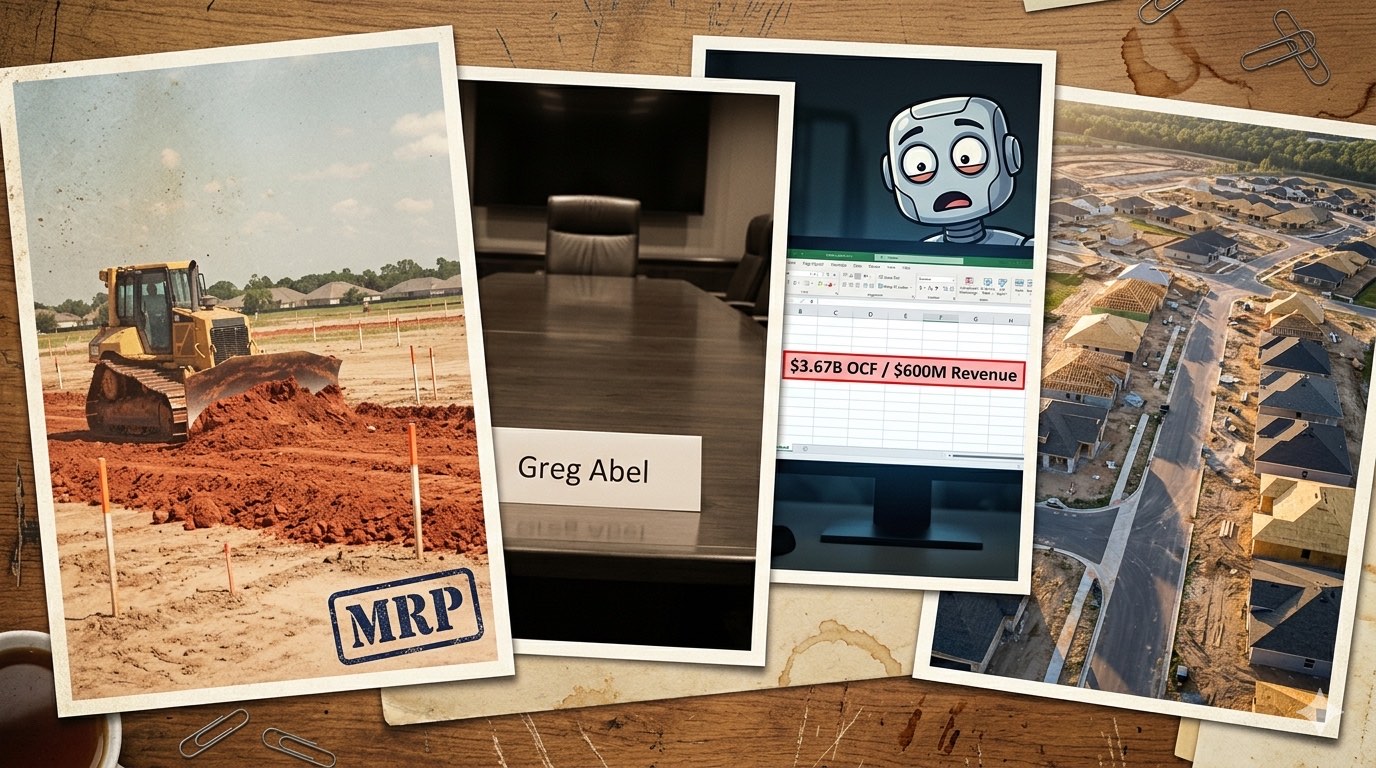
On this episode we hit episode 50 and celebrate with a portfolio update showing we’re nearly double the S&P 500 all-time, before diving deep into Millrose Properties (MRP) — a brand new REIT spun out of home builder Lennar that had the AIs screaming “stay away.” We dig into the weird world of land banking, shadow banking, private credit, and why a company can show $3.6 billion in operating cash flow while only pulling in $600 million in revenue — and whether that should ever pass the QAV sniff test. Spoiler: it doesn’t.
This week’s full episode is for QAV Club members only. The free episode is available below. Also check out our podcast archives link and our pages on Apple Podcasts or Spotify or watch clips on TikTok. Or visit our homepage to learn more about QAV and how it works as a value investing system that you can learn and apply to beat the market.
Transcription
QAV America 50 Club
Cameron: [00:00:00] Welcome to QAV America, Tony, episode 50, big five zero.
Tony Kynaston: Wow.
Cameron: Yeah, Tony. Um, it’s been an interesting week in the, uh, stock markets and in the news and in, uh, presidential affairs.
Tony Kynaston: hmm. Always is.
Cameron: Failed assassination attempt on Donald Trump.
Tony Kynaston: But it’s, it’s like, what was that, uh, movie Edge of Tomorrow where Tom Cruise gets like moves one step closer to his goal of killing the, the aliens, but gets killed and then next day wakes up again and does it, bearing in mind what he knows isn’t gonna work. So we’re like, we’ve had the guy on the roof, blah, blah.
He’s gone. We got the guy running fast through the checkpoint, so he made it through but didn’t get a shot away. So
kind of the golf course. So like the next one is gonna run through quickly and get the shot off. Knows what’s coming.
Cameron: Yeah. [00:01:00] Well, listen, I, uh, as I said to you on the last show, I dunno what the Secret Service is doing. Um, I think they should all be fired, but I think
Tony Kynaston: Hey,
they saved.
They saved the president. How much of those guys getting paid though to go and stand in front of JD Vance and between him and a poet?
Cameron: The guy shouldn’t have been, you know, able to get into the hotel with a
Tony Kynaston: Oh yeah,
Cameron: Should have security on the front of the hotel. Like not a guy running through the place with a, how did he get a shotgun into a, how do you get a shotgun into a Hilton hotel? That’s what I wanna know. I know it’s America, but still. Anyway.
Tony Kynaston: Hmm.
Cameron: I just think it was fascinating that Trump didn’t do any of the White House correspondents’ dinners during his first term. Didn’t do one in the first year of his second term, agreed to do this one, doesn’t even get to get on stage before it all gets shut down and he goes home. It’s, uh, [00:02:00] very strange. Any who,
Tony Kynaston: The universe doesn’t want him to talk to White House Correspondents, obviously.
Cameron: Yes, some people, some people are saying it’s staged, Tony, a lot of people, a lot of
Tony Kynaston: Really?
Cameron: A lot of people, Tony, a lot of people are saying they’re staged
Tony Kynaston: to distract. Okay. Yep.
Cameron: from the Iran war, to distract from the economy, to
Tony Kynaston: Ah,
Cameron: you know,
Tony Kynaston: hadn’t thought of that.
Cameron: who made money off of Polymarket betting that there would be an assassination attempt on that day, which
it literally happened.
Tony Kynaston: Well, that’s one of the difficulties of Polymarket, isn’t it? If you bet there’s gonna be an assassination attempt, you could be the assassin.
Cameron: Yeah. Check the alleged assassin’s, uh, bank account. Anyway, let’s, uh, so the market, uh, in the last week in the US, Tony, is up. In Australia the market is down significantly. In the last week in the US it’s [00:03:00] had a few dips, but it’s ended up, despite the fact that the latest news today is that offered some sort of a deal.
Trump said he doesn’t like that deal. Nothing’s moving forwards with the Strait of Hormuz as far as we know, but the US market does not care. It’s just trundling along, happy campers.
Tony Kynaston: Cares more about forecast earnings, I think, which AI is driving up. So and
Cameron: driving up for seven businesses. What about the rest?
Tony Kynaston: Yeah.
That’s right. Big disconnect between those businesses and the, and the Main Street type businesses. Isn’t there?
Cameron: Now the, the, the deep dive I’m gonna do today is a tricky one. I’m not sure if you’re gonna like it. In fact, I was so unsure about it. I didn’t add it to our portfolio this time.
Tony Kynaston: Ooh,
Cameron: Uh, did my head in,
Tony Kynaston: really? I, I had a look at that. It’s definitely an interesting topic to talk about for sure.
Cameron: Very different from anything that we’ve done recently. [00:04:00] Um, I had lots of conversations with AIs and they were all trying to talk me out of it, telling me this
Tony Kynaston: Oh,
Cameron: stay away, really bad. I was like, I dunno.
Tony Kynaston: If AI tells you it’s bad and says to stay away, must be really bad.
Cameron: Well, maybe. Um, so we’ll get into that in a minute. Before we get into that, I just want to do a quick update on our portfolio. So in the last month, our main US portfolio is basically neck and neck with the S&P. They’re both up about 12%. We’re a little bit below, we’re up 11.76. The S&P 500 is up 12.64, slightly underperforming it. Uh, in the, uh, last 12 months, uh, our dummy portfolio is up about 36%, 37% versus the S&P up just under 30. So we’re outperforming [00:05:00] slightly,
Tony Kynaston: Mm-hmm.
Cameron: I don’t know, 20%, um, over the course of the last year all time. We are up now a hundred and, arrows not working on this thing. And uh, it looks like we’re up 90, 97% versus the S&P up a little bit less than 51%. So all time, not quite double, but almost double. So that’s, that’s not too bad.
Tony Kynaston: Yeah.
Cameron: with that.
Tony Kynaston: Yep. No Mag Seven stocks.
Cameron: Sorry, what?
Tony Kynaston: And we don’t have any Mag Seven stocks. Yeah.
Cameron: The QAV Light portfolio that’s only been running since just before Christmas is up about 8% since that time. Uh, versus the S&P’s up about, uh, four.
So it’s doing double,
only over a few months. Some of the, some of the big winners in [00:06:00] that one. Uh, Kodak is, uh, up
Tony Kynaston: Wow,
Cameron: is up
Tony Kynaston: That’s developed, hasn’t it?
Cameron: I know. It’s crazy. Oh, I see what you’re doing. I see what you did there. Very good. Yeah. Very, very good, Tony. Uh, yeah, all you know, Pitney Bowes is up 44, Quarters is up 44.
Scripps is up 33, Commercial Vehicle Group, CVGI is up 21. Nabs Industries is up 16. Um, so yeah, doing quite well considering it’s pretty new. Some of the stocks that we’ve done pulled porks on that aren’t in our portfolio though. But, um, we’ve covered in this, I just had incredible runs.
Of course, the, the big one is still Zep Health Corporation, which is up 466% since we talked about it in July last year. Um, ChemX, uh, we talked about in March last year, over a year ago, is up [00:07:00] 116%. Uh, just too many to talk about. So many winners. Lots of winners. Out of the 47 stocks that we’ve done a deep dive on, 34 are up, 13 are down.
It’s about a 30, no, 72% win rate and about 34% average profit of those over the last little bit over a year. We started doing deep dives in March last year,
Tony Kynaston: Pretty good.
Cameron: Yeah, like it’s just been a bonkers year.
Tony Kynaston: Hmm. Hey, before I forget too, we, I spoke about, uh, Berkshire Hathaway on the Australian show. Um, I think it’s the Berkshire Hathaway AGM May two, which must be this weekend in Omaha, Nebraska.
Cameron: Will he be there?
Tony Kynaston: Oh, I think, I think he’ll be there, but it’s actually gonna be run by Greg Abel who’s answering questions this year, not Warren.
Cameron: I mean,
Tony Kynaston: Interesting to see the turnout. Yeah.
Cameron: What will he do? Sit on the [00:08:00] stage and not talk? I don’t know.
Tony Kynaston: I
Cameron: Just eat his, uh, candies and drink his Coke.
Tony Kynaston: Maybe talk to Bill Gates in the, in the crowd, in the front row.
Cameron: I think he and Bill are on talking terms right now.
Tony Kynaston: Oh, okay.
Cameron: Uh, well, you know, he, he dropped out of the foundation after all of Bill’s, uh, problems came to light.
Tony Kynaston: What problems? Like, doesn’t Bill know how to launch spaceships around the moon to deflect from the problems, block the Strait of Hormuz and things like that.
Cameron: Assassination attempts,
Tony Kynaston: Yeah.
Cameron: make him popular again. So the company we’re gonna talk about today, Tony, is MRP, Millrose Properties. Now I, oh, I was gonna do a company called Vate, by the way, VATE is the ticker code. I started doing a deep [00:09:00] dive on them. Is the name of the business.
They were, uh, higher up in the buy list. But then when I was running my analysis, I found out they actually had a problem with their audit. Claude actually flagged that they had a
Tony Kynaston: Oh
Cameron: problem with their audit. So, uh, that was good to find out. Not, it’s the first time since we’ve been doing these pulled porks and I’ve actually had a company that had a dodgy audit. So
Tony Kynaston: Wow.
Yeah.
Cameron: picked it up.
Tony Kynaston: Hey,
whoa, whoa. So I clicked on the link that you sent me, which was taking me to KLM,
not Millrose.
Cameron: What link did I send you?
Tony Kynaston: He sent me four links and the first one is to,
Cameron: Clem. Yes.
Tony Kynaston: Yes.
Oh, okay. Thank you. Because I looked at Clem. I haven’t looked at [00:10:00] Millrose. Yep.
Cameron: So they’re one of, or one of the companies behind Millrose,
one of the interesting ones. So let’s talk about Millrose. So.
Tony Kynaston: Yep.
Cameron: This is a bit of a weird one because they’ve only been around for a little over a year in this form.
You look, if you look at their chart, it’s uh, a year old. They became a standalone public company on the 7th of February, 2025. So only got really one full reporting year under their belt. And we’ve done stocks like this from time to time in Australia that have floated. Not often that we see a floated company turn up on our buy list,
’cause usually, you know, when companies float, you know, they’re, they’re startups or they’re whatever, tech companies and they, they don’t score well on our checklist. These guys do. Yeah, because they were spun out of an existing business.
Tony Kynaston: Yep.
Cameron: This is a, an [00:11:00] unusual one.
Well, for me. You, you might not find it so unusual, but for me it’s uh, an unusual one. Got spun out of a company called Lennar Corporation, LENNAR, who are one of the largest home builders in the United States. And what Millrose is, is what they call their land banking arm. You familiar with land banking, Tony?
Tony Kynaston: I am. Yeah.
Cameron: See there. I knew you would be. I, I figured that’s when you dig a hole in the ground and put your money in it.
Tony Kynaston: No, no, no. You, you buy up land and sit on it waiting for it to appreciate and then you develop it.
Cameron: Right. Well, that’s not exactly what these guys do, but part of it’s right. Yeah.
Tony Kynaston: Yeah. It’s often, often the case that like a golf course can be seen as a land bank because, uh, you know, it can be sold to a developer at exorbitant amounts compared to running it as a golf course.
Cameron: Right. Well, Lennar Corporation are developers, but they had to, they had to buy property [00:12:00] and then buy like vacant land and then sit on it until they were ready to build on it.
Tony Kynaston: Yeah.
Cameron: What they’ve done is just got that off their balance sheet and spun that off for somebody else to worry about that. So now they only buy it when they’re ready to build. They’re not carrying it on their balance sheet for a year or two years or whatever it might be. So Millrose is basically a real estate investment trust. Um, we’ve talked about REITs on the Australian show from time to time over the years. I think these are a little bit different the way this one runs, which is why I wanted to flag it with you and, and I dunno if this is the same in Australia, but the tax pass through structure that these guys have in the US is that they have to distribute at least 90% of taxable income to shareholders,
Tony Kynaston: A trust. Yep.
Cameron: In order to get tax benefits approved by [00:13:00] the, um, IRS in the US or whoever approves these things. Um, yeah, they have to check a bunch of boxes and one of those is they have to distribute all of the income to shareholders. But for people like me who don’t know what a land bank is, uh, here’s the basic setup.
So you have a home builder like Lennar, they identify land they wanna build homes on. Let’s say they’ve got 500 acres in Florida, but instead of buying it directly, they ask Millrose to buy the land. Millrose pays cash, takes the title, and then starts what is called horizontal development. Basically clear the land, grade it, they put in the roads, the water, the sewers, the utilities. The land is then broken into finished home sites ready for houses to actually be built on. Lennar don’t take it until all of that’s been done. In this case,
Tony Kynaston: Yep.
Cameron: Lennar come in when they’re ready to [00:14:00] go vertical, that’s when Lennar get involved and actually pay for the
Tony Kynaston: Right. Yep.
Cameron: Up until then, it’s Millrose’s problem and Lennar has an option to take the land, which they pay for, pay a rate to hold an option,
Tony Kynaston: A premium.
Cameron: at a pre-agreed price plus a fee called the option fee. And that’s how Millrose makes its money, is those, that sort of option fee that the builder pays. So the builder has a cleaner balance sheet, lower land risk, faster inventory turns, and Millrose gets a predictable cash yield that they’re getting off this, uh, you know, this, this rental fee, option fee, whatever
Tony Kynaston: Yep.
Cameron: on what is effectively one of the few scarce assets left, which is land that’s not gonna be replaced [00:15:00] by AI or robots. Um, or, you know, any other sort of technology. Um, it’s one of the only construction inputs that can’t be imported from China. Uh, so free from all that kind of stuff. So in the case of Millrose, when it was set up, uh, a year, well, it was set up officially, uh, a little bit before that when they started doing the planning, but when it went live in February last year, part of the deal was that Lennar is the, uh, anchor tenant.
Tony Kynaston: Right.
Cameron: Lennar has like 84% of their revenue. 84% of Millrose’s revenue in the last year came from Lennar.
Tony Kynaston: Right?
Cameron: They spun it off. They’re backing the majority of it, but the plan is for Millrose to bring on other builders and Lennar’s weighting, I guess, in their revenue to [00:16:00] decrease over time.
They have a multi-year contract with Lennar at an 8.5% yield. Could be renegotiated, I guess, when the contract is up, but that’s where it holds right now, and they have brought on. I think about 19 or 20 other builders in the last year who were paying a higher rate. Lennar gets the mates rates because they were the founding member of the whole thing. And then Millrose itself basically has no employees outside of a team of executives.
CEO, CFO, legal counsel, uh, I think a board of directors. That’s about it. Their CEO, a guy called Darren Richmond, doesn’t have a background in building. He’s the co-founder of Kennedy Lewis Investment Management.
Tony Kynaston: Yep.
Cameron: or your Clem, [00:17:00] Clem RA. According to their website, a multi-strategy private credit platform
Tony Kynaston: Hmm.
Cameron: with $30 billion in holdings. Private credit, you wanna call it that. They have a division called Home Builder Finance. They are a pioneer in land bank financing. So one of, if not the pioneers in this idea of, hey, you don’t need to buy the land, worry about all that. Give it to us. We’ll take care of it all.
We’ve seen this before in other companies that we’ve done deep dives on, like oil development companies that don’t own the oil rigs,
Tony Kynaston: Yep.
Cameron: somebody else comes in and we’ll just take care of all of that. You don’t have to worry about it. Or mobile phone companies that don’t own the mobile phone towers, they just, somebody else runs the infrastructure. Kind of [00:18:00] that kind of a play. Outsource the stuff that isn’t your core business to somebody else who can take it off the balance sheet. We did. We were talking about somebody, I can’t remember who it was, couple of episodes ago that doesn’t own their own factories or buildings anymore. They outsourced, they sold it
Tony Kynaston: Sale and leaseback. Yeah.
Cameron: that thing.
Tony Kynaston: Yeah.
It is similar, yeah.
Cameron: a common theme that we, uh, seem to come up in shows o over and over here.
Tony Kynaston: Oftentimes driven by ROE, the metric, which a lot of Wall Street analysts focus on, because if you don’t have as many assets on your balance sheet, then your return is quite high.
Cameron: so if you can get, if you can offload these sort of non-productive assets or things that Yeah. Sitting around for a long
Tony Kynaston: yeah, and classic management says why tie your capital in something earning 8% when you should be out there getting 15 from [00:19:00] other operations. Yeah. Yes.
Cameron: So Kennedy Lewis, uh, Clem actually run this, run the, the the land banking side of the business, for Millrose. So.
Tony Kynaston: Right.
Cameron: You’ve got Lennar, you’ve got Clem, you’ve got Millrose, which is the baby of the two of them. Millrose has no employees apart from small team of executives, and it’s the same executive.
So the CEO of Millrose is also of Clem, and
it’s a little bit incestuous.
Tony Kynaston: Clem’s, the Shadow Banker, it’s, it’s one of these private credit companies that. That listeners would’ve heard of, uh, from an Australian point of view, they’ve cropped up over the last few years because banks have gotten out of anything but asset backed lending. So they don’t lend to business very much any Well, they do, but they don’t lend [00:20:00] in the way they used to.
Um, they don’t lend to startups, all that kind of thing, which has opened up a void in the market. And so these companies have sprung up because generally they have deep experience in the niche that they’re operating in. So, uh, these guys, so Clem was a shadow bank. They’ve got all this, these billions of dollars to invest.
Um, one of the things that this opportunity gives them is they do have an asset backing. They’ve got the land that they’re, they’re buying and developing, and they’re just sort of slicing and dicing that they get. You know, they loan money to get the land purchased and then they get the holding cost paid for, ’cause it’s cleared.
And, and the, then the builder that they unsell it to is paying for it with the option in advance. So it’s, it’s kind of a neat model for Clem really. Yeah. Um,
cause one of the, when I was looking at Clem, um. Um, and, you know, not talking about them in particular, I started to do some research on this, on private credit and [00:21:00] what are the issues with it and, and, um, it calling them Shadow banks kind of tells you what the issues are.
They’re, they’re operating as, as lenders without having all the regulations that protect consumers from, um, either investing or uh, taking out the loans. Um, there is still a lot of regulations, but not as much as if, as if they were a bank. So, um, Clem, I think. From what I saw, I did a quick sort of sketch of them looks, you know, like they’re well managed and honorable, uh, and everything’s working fine.
But there must be other players out there who can use the fact that there’s less regulation in this, in the private banking industry, um, to their advantage. And uh, that’s something that I think will eventually come back to bite. The economy because, um, shadow bankers are still linked into the banking system at some stage often, uh, ’cause they’re borrowing money from banks to go and buy
the land banks that they’re getting options from [00:22:00] builders to clear, et cetera, et cetera.
Cameron: has never gone badly, ever in the history
Tony Kynaston: unregulated lending on a large scale. Yeah.
Cameron: Never ever, I dunno what you’re talking about. You’re just making shit up.
Tony Kynaston: like I said, this is probably a very good example of how shadow banking could work, but it doesn’t take much to tip people, um, you know, into negative territory with the whole industry. If, if there’s a, someone goes broke because they weren’t undertaking the risk adjusted pricing or the asset backing of a company like this is,
Cameron: And with these guys, like anything could go wrong, like a
Tony Kynaston: oh, yeah.
Cameron: the state of the global economy and the US economy, which you, you wouldn’t know if you just looked at the stock market. But as we’ve talked about on the show over the last few months,
are ringing alarm bells all over the place.
Tony Kynaston: Well the two big risks in this case that I can see straight off are interest rate moves. So if. F uh, interest rates rise [00:23:00] in the US that that Donald Trump’s trying to hold them down. But, and the new Fed chair’s trying to, you know, is coming in, saying he’s gonna hold them down, but eventually they may go up and that’ll change the.
Pricing risk for all of these kinds of assets. Um, I don’t know what the contract says about repricing, but they may have to. So that’s risk number one. Risk number two is that, um, you may have done your deal thinking that it would take five years to buy and clear the land and get the approvals, but as we know from experience here, councils don’t work to a timetable.
They may. Um, hold you up. They may put the price up for applications. They may like. The local green group might get involved and say that this is gonna spell the end of the line for the white spotted green tree frog that lives in the area and everything gets held up in court. So there are a lot of risks in this business model, even though it seems to make sense.
Cameron: Yeah. Not to mention collapse of the economy for a whole other reasons, and AI [00:24:00] taking people’s jobs
sorts
Tony Kynaston: Yep.
Yeah.
Cameron: but we can’t predict the future. Um, so. getting back to Clem their, their website, they say we partner with builders by acquiring and managing land on their behalf, enabling them to adopt an asset light model and focus on their core business of constructing homes. Our publicly traded REIT Millrose Properties is the dedicated vehicle for this innovative approach. That’s off the Clem website.
Tony Kynaston: Yeah. And so this is a, this is a model which developers have used for ages, and we see it in Australia too, that they form syndicates to go and buy the land. Um, oftentimes they’re off market, but there are listed syndicates in Australia and trusts. Um, so this is, you know, kind of happening on an industrial scale so it can, uh, be large enough to list and, and cover all the costs of listing and, and, uh, compliance and all those kinds of things.
Cameron: So, uh, what can I tell you? Okay, so here’s where it [00:25:00] gets, um, tricky from a QAV perspective. their total revenue in FY 25 was 600 million
Tony Kynaston: Sorry, Millrose or uh, Clem.
Millrose. Okay.
Cameron: Yeah,
Tony Kynaston: Okay.
Cameron: actually Millrose.
Tony Kynaston: Sorry, Millrose,
Cameron: but I see how
Tony Kynaston: we’ll call it Millhouse for now.
exactly. Thank you.
Cameron: uh, revenue was 600 million. As I said, 84% of that came from Lennar, but they brought on 15 other builders, nine of which are in the top 25 in the US.
Tony Kynaston: Mm-hmm.
Cameron: And they’re, uh, charging or earning higher rates from them than they are from Lennar.
11%. As I said
Tony Kynaston: Oh wow.
Cameron: across their book for year end 2025 was about 9.2%,
Tony Kynaston: Right?
Cameron: focused in the Sunbelt, Florida, Texas, Arizona, Carolinas, and Georgia. This was where most of the new home construction is [00:26:00] apparently happening in the US. And that’s all I’ve really got on the business and the business model. It’s not very complicated. Um, the main problem with these guys from a QAV perspective is the nature of their operating cash flow
Tony Kynaston: Yeah.
Cameron: they have a very attractive price to operating cash flow. Their 10-K shows their OCF as 3.67 billion. But their revenue was 600 million and
Tony Kynaston: Right.
Cameron: profit was about 380 million.
Tony Kynaston: Okay.
Cameron: So this is where the AI freaked out when I was getting them to do some research, they were like, well, this isn’t really operating
flow
Tony Kynaston: Yep.
Cameron: think operating cash flow
Tony Kynaston: Yep.
Cameron: it’s basically. They buy a bunch of land. They sell a bunch of land and all the money goes out and then they, you know, go borrow more money and they go buy more land. And so it says it’s operating cash flow, but it’s not. And I was like, well, [00:27:00] isn’t that what every business
Tony Kynaston: Yeah.
Cameron: and they
Tony Kynaston: Yeah.
Cameron: they value add to it, then they sell it, and then they get money and they go and spend it on more raw materials. And it was like, yes, but this is different. But I haven’t quite figured out how or why and how it impacts on our price to operating cash flow. So they’re basically rolling this money over every time they sell it, they’re buying dirt, clearing dirt, then selling the dirt, and then reinvesting all of that money into new dirt. Now. One of the reasons as far as Claude tells me this is different is under GAAP rules in the US. If your primary business is selling land, that land is inventory
Tony Kynaston: Yep.
Cameron: and inventory sales are operating cash [00:28:00] flow.
Tony Kynaston: Right?
Cameron: But if you have a standard REIT that owns an office building.
Tony Kynaston: Yes.
Cameron: The rent is operating cash flow,
Tony Kynaston: Huh.
Cameron: the value of the office building that you have. If you sell the building, that’s investment activity, not operating cash flow. The operating cash flow is from the rents, so Millrose is effectively treating the sale of the building as. Cash flow, as rent, as
Tony Kynaston: Yep.
Cameron: whole thing, so not really sure. I, I, I did try and do some analysis on how that’s different from Australian REITs. This is what I got under Australian accounting standards. A passive REIT selling an asset would almost always record the proceeds as investing cash flow. Their [00:29:00] operating cash flow is mostly pure rent. It’s clean and predictable, but with MRP, because their inventory is land, they record the entire sale price of the land as OCF. why their OCF is 3.6 billion, while their revenue is only 600 million. It makes the company look like a cash generating monster, in reality they’re just liquidating their assets to buy more.
Tony Kynaston: All right.
Cameron: In Australia an REIT is a landlord. Millrose is a shadow bank for home builders. It’s a high yield credit fund masquerading as a property trust, and it’s using US GAAP accounting rules to make its cashflow look significantly more efficient than it actually is. The truth is that MRP is a property company.
It’s a leveraged yield wrapper, so.
Tony Kynaston: wrap
Cameron: Yeah, this is from Claude
or Gemini,
Tony Kynaston: ra
Cameron: of the two. I can’t remember.
Tony Kynaston: max and
yield to the max.
Cameron: so the, so as I [00:30:00] said, 600 million total revenue, 486 million in operating profit, 380 million in net profit. The difference between the total revenue and the net profit seems to be the management fee. So there, Kennedy Lewis charges 1.25% of gross tangible assets, which is apparently outrageous according to my AIs, but that’s the deal. Um, so that’s where a big chunk of it’s going. Sort of 90 to a hundred million. And then there’s the financing and tax gap, which is about 106 million.
Tony Kynaston: Yeah.
Cameron: So the question at the end of the day, Tony, is, and if I look at, sorry, if I look at their 10-K, which I’ve got a screenshot here, flows for the years ended December 31st, 2025, 2024, and 2023. Can ignore the earlier ones because they weren’t really up and running. 2025 it says cash flows from operating activities, 3.672 [00:31:00] billion investing activities, negative 5.722 billion activities, 2.084 billion, net cash, 35 million. So they’re making money.
Tony Kynaston: Yeah. Yeah.
Cameron: me. But they score really well for us because their price to operating cash flow is 1.39
Tony Kynaston: Right.
Cameron: cash flow is massive. so I couldn’t, after spending all day in this yesterday, I couldn’t get my head around whether or not this was dodgy or, or fine from a QAV perspective. And I thought, bugger it. I’ll just throw it over to Tony.
Tony Kynaston: thanks. Yeah.
Cameron: your system.
Tony Kynaston: Well, uh, my first comment would be to do some more research, but, um, on the face of it, I think, I think it doesn’t look like [00:32:00] normal operating cashflow. To me, it looks more like investing cashflow. And the operating cashflow would be the fees and the option premiums and coupons.
Cameron: Right?
Tony Kynaston: Yeah.
Cameron: it
Tony Kynaston: Yeah.
Cameron: Yeah.
Tony Kynaston: And the
is, the rest is, even though it’s treated as inventory, it, it’d be lumpy, I would think. Um, which means if it’s had a good year, it, as long as they reinvest the cash, well it’s, we can still treat it as a good thing. But, um, yeah, I, I, I’m a bit suspicious of the, the way they’ve allocated operating cashflow there.
Cameron: So
Tony Kynaston: It’s a, it, well,
it, assuming that land banking is a perpetual motion machine, that they can always buy new land and, and therefore the operating cash flow keeps going. But I suspect that that won’t happen or that there’ll be lumpy lumpiness in the operating cash flow. So it’s, it’s kind of a misnomer, I think.
Cameron: but we [00:33:00] don’t score a business on its future operating cash flow. We score it on its past operating cash flow. But I guess there is an underlying assumption there that this is a. Healthy business that is
operating cash flow.
Tony Kynaston: correct. I mean, this, this is a healthy business from a, from how it’s classified. It’s operating cash flows as long as they sell some land and put that land, that money back into buying some land, and they can keep that going and that, that really is their business, I
Cameron: yeah.
Tony Kynaston: um, is that really operating cashflow or is that just like an investment?
Cashflow, but cycling through? Mm,
Cameron: Yeah. So no, we’re gonna say no to this one. This is the first time we’ve said, no.
Tony Kynaston: I think so.
Cameron: agreeing with the AIs, Tony? ’cause
Tony Kynaston: Oh, yeah, I don’t think
Cameron: They were, It’s a
skeptical
Tony Kynaston: one, isn’t it?
Cameron: [00:34:00] about this as being a good, good investment.
Tony Kynaston: We have had some other ones that we, I mean, if we look at it, the first analogy that comes to mind is the operating cash flow for a fund manager that we took out of QAV in Australia because the operating cash flow, the way they account for the operating cash flow, if someone does a big investment or a big redemption into the fund, it goes for operating cash flow.
Um, and that can make the fund manager look really good from a QAV point of view when in fact. They could be doing terribly from a, you know, a business point of view. So
Cameron: not revenue really.
Tony Kynaston: yeah, money moving.
Yeah. So yeah, I, I
think, I think it’s more of an investment cash flow myself, the land banking. But anyway,
Cameron: I started to think about it, you know, because you’ve taught me how to do this a little bit. I started to think about it yesterday as, okay, let’s, let’s break it down to something small that I can understand.
let’s
Tony Kynaston: yeah.
Cameron: Joe Blow has a business where he says, um, [00:35:00] people, people give me money and then I go and invest that money, for them
they pay me to invest that money for ’em. So it’s like, I dunno, it’s a fund or a
Hathaway
Tony Kynaston: Yep.
Cameron: and they
Tony Kynaston: Yep.
Cameron: you know, some, somebody gives me a million dollars. And then I go and invest that million dollars and then I get a fee out of that and I, and, and they off, they give me an opportunity to buy into it. You, you wanna take a share of the business
Tony Kynaston: Hmm.
Cameron: and they value it based on the million dollars, um, that they’re getting to invest. Uh, using that as the valuation metric.
It would be like. Well, no, you don’t actually own that million dollars. It’s not like million dollars you can do something with. You are, you are investing that on behalf of other people. not the, what I’m interested in is how much money are you getting out of that
Tony Kynaston: Yeah, correct.
Again, again, it’s, I think it’s treating an asset like an I like which is, which? It is inventory, but it’s treating an asset like a, [00:36:00] A cash flow. Like a revenue.
Yeah. And, and again, it is revenue that they are selling land, but they’ve gotta keep doing it on a perpetual basis for it to be really operating cash flow, I think.
And they’ve gotta be to have positive operating cash flow. The last land they sell has gotta be more than what they paid for the new land. Um, ’cause like they could go out and borrow some money and buy. Land, more land than what they sold last year, in which case the operating cash flow looks negative. So it’s a bit screwy.
I think
if I’m, I’m trying to put this in the coffee shop analogy somehow. It’s almost
it’s almost like the coffee shop is the end product at the end of a big pyramid where there’s a new sub development, um, where someone’s borrowed some money and cleared the land and then our developers come in and built housing and they put a.
Um, you know, a convenience store and some other shops at the middle of the housing development and one of them happens to be a coffee shop. [00:37:00] So,
Cameron: literally, you, you, did a deep dive
Tony Kynaston: yeah, Pete.
Cameron: week about that,
Tony Kynaston: Yeah, exactly. And, and it’s a similar sort of question that they had because they were successful in. In offloading their balance sheet. So Pete, the company, which was the developer, was, was successful because they would offload their balance sheet of land acquisitions or land banking, uh, into syndicates that were off the books, but they still controlled and took a management fee.
So similar sort of thing. I, you know, I wouldn’t think the operating cash flow for each syndicate was buying and selling the land.
It’s, it’s the, it’s the fee revenue, the management fee revenue is the operating cash flow. Um, yeah, so I, I’m saying no.
Cameron: Well, it’s interesting if, if I, um, if I look at the rest of their scoring, we couldn’t score ’em for quality rank or stock rank. They did score for F-score, score for IV number one, did score for IV number two, did [00:38:00] score for prices less than book and prices less than book plus 30. over three point uptrend.
Obviously have a new three point uptrend, um, yield. Is higher than bank debt, what’s their yield to 8.29%?
Tony Kynaston: Yep.
Cameron: yep. Uh, couldn’t score for forecast IV greater than price. Couldn’t score for PE less than yield. But if I take, but the, I and I haven’t recalculated the prop calf, but I, I’m assuming it would be, um, probably too high for us
Tony Kynaston: Yeah.
Six. Yeah, I would think so.
Cameron: 31 bucks. So, um,
Tony Kynaston: 50 odd times. Yeah.
Cameron: By, uh, 31, let’s say. Yeah. So it, it, it, it, yeah, it, the rest of the scoring might be okay, but it just would’ve been way too [00:39:00] expensive for us if that price to operating cash flow was readjusted.
Tony Kynaston: I mean, again, going back to the Pete example in Australia where they have a a different syndicate set up for each time they buy land to land bank.
Cameron: Hmm.
Tony Kynaston: This is almost like each syndicate rolls over into a new one. That’s, that’s what Millrose is, is doing, isn’t it? It’s saying that I’m gonna have a continuous cycle of inventory, which is I’m buying land, selling land, buying land, selling land.
But if you, if you break it down to kind of, it’s the equivalent is I have a syndicate to buy some land that takes five years. I sell that land, but the day after I start that syndicate, I start another syndicate and buy some more land. So I’m always on a cycle of every year selling some land and buying some land.
Cameron: Okay. So the question then, Tony, is uh, um. This doesn’t make the cut, but it was on our buy list. So what do I do move? Like if I hadn’t have done a deep dive on
Tony Kynaston: Yeah.
Cameron: look at it.
Tony Kynaston: Yeah.
Cameron: What can I [00:40:00] do to keep
Tony Kynaston: Well,
Cameron: list?
Tony Kynaston: again, I can’t speak to American, the American system in Australia, we used to click the box saying GICS, unclassified.
You know, wouldn’t appear in our downloads, which eliminated the fund managers. There must be a similar GICS coding that we could look at in the US to take those people out. That’s option number one.
Option number two would be, uh, if the revenue’s less than the operating cash flow.
There’s something screwy going on
different going on. I shouldn’t say it’s screwy. I mean, it makes complete sense, but it’s, it’s not how we’ve set up QAV to, to work. Yeah. So that’d be the, the other test is revenue lower than operating cash flow.
Hmm.
Cameron: I might, um, try and figure out how to add that into the checklist.
Good pickup.
Well, yeah, and it was Claude, so thank Claude for that. went, [00:41:00] whoa, I don’t think so. And I was like, Hmm. I know we’ve done REITs before
show, but then I was trying to
between ours and theirs.
Tony Kynaston: we very rarely have a REIT though
Cameron: Yeah.
Tony Kynaston: on the buy list.
Cameron: and
of
Tony Kynaston: Yeah.
Cameron: okay, but
Tony Kynaston: Yep.
Cameron: like that.
Tony Kynaston: Mm-hmm.
Cameron: Alright, well the show. I gotta go,
Tony Kynaston: All right.
Cameron: to kung fu. Thanks
Tony Kynaston: Yeah. I, I’ll have to find something else to add to QAV Light in America this week.
Happy Nasdaq everyone.
Cameron: Happy Izzy.
Previous Pulled Porks
Here’s the performance of the “pulled porks” (eg deep dives) we’ve done on the show in the past.
| Ticker | Company | Covered | Price then | Price now | Return | Ep. |
|---|---|---|---|---|---|---|
| SND | Smart Sand | 1 Sep 2026 | $5.27 | $5.35 | +1.5% | 68 |
| CRGY | Crescent Energy | 25 Aug 2026 | $13.85 | $13.56 | -2.1% | 67 |
| SLDE | Slide Insurance | 18 Aug 2026 | $21.60 | $24.14 | +11.8% | 66 |
| RJET | Republic Airways | 10 Aug 2026 | $21.39 | $17.06 | -20.2% | 65 |
| BBDO | Banco Bradesco SA | 3 Aug 2026 | $3.44 | $3.76 | +9.3% | 64 |
| RM | Regional Management | 27 Jul 2026 | $41.65 | $32.77 | -21.3% | — |
| PBR | Petrobras | 20 Jul 2026 | $17.97 | $24.14 | +34.3% | 62 |
| TEO | Telecom Argentina | 14 Jul 2026 | $13.47 | $12.51 | -7.1% | 61 |
| FG | F&G | 7 Jul 2026 | $28.55 | $22.01 | -22.9% | 60 |
| KSS | Kohl's | 1 Jul 2026 | $17.34 | $19.53 | +12.6% | 59 |
| CARE | Carter Bankshare | 23 Jun 2026 | $31.00 | $30.55 | -1.5% | 58 |
| AERO | Aeromexico | 18 Jun 2026 | $17.34 | $15.52 | -10.5% | 57 |
| NRIM | Northrim Bancorp | 1 Jun 2026 | $24.71 | $24.67 | -0.2% | 55 |
| MGA | Magna International | 27 May 2026 | $65.20 | $64.92 | -0.4% | 54 |
| BWLP | BW LPG Limited | 18 May 2026 | $21.06 | $25.94 | +23.2% | 53 |
| KNOP | Knot Offshore Partners Com Unt | 14 May 2026 | $10.78 | $10.39 | -3.6% | — |
| GSL | Global Ship Lease | 13 May 2026 | $41.79 | $45.86 | +9.7% | — |
| DB | Deutsche Bank | 4 May 2026 | $31.11 | $34.97 | +12.4% | 51 |
| UEIC | Universal Electronics | 29 Apr 2026 | $4.25 | $5.49 | +29.2% | — |
| OPRT | Oportun Financial Corp. | 20 Apr 2026 | $5.88 | $8.38 | +42.5% | 49 |
| PAGS | PagSeguro Digital | 13 Apr 2026 | $10.67 | $10.95 | +2.6% | 48 |
| CVGI | Commerical Vehicle Group | 6 Apr 2026 | $3.56 | $3.00 | -15.7% | 47 |
| PBI | Pitney Bowes | 30 Mar 2026 | $10.86 | $16.81 | +54.8% | 46 |
| KODK | Eastman Kodak | 23 Mar 2026 | $7.83 | $10.03 | +28.1% | 45 |
| GPRK | GeoPark | 17 Mar 2026 | $8.77 | $11.28 | +28.6% | 44 |
| MUR | Murphy Oil | 9 Mar 2026 | $34.55 | $38.39 | +11.1% | 43 |
| NBR | Nabor Industries | 3 Mar 2026 | $77.80 | $83.16 | +6.9% | 42 |
| BFH | Bread Financial | 28 Feb 2026 | $70.86 | $98.90 | +39.6% | 41 |
| SHG | Shinhan FInancial Group | 17 Feb 2026 | $69.83 | $78.46 | +12.4% | 40 |
| EC | Ecopetrol | 3 Feb 2026 | $12.57 | $17.25 | +37.2% | 38 |
| CHRD | Chord Energy Corporation | 24 Jan 2026 | $95.53 | $139.11 | +45.6% | 37 |
| AMTD | AMTD IDEA Group | 20 Jan 2026 | $1.02 | $1.02 | -0.4% | 36 |
| VLRS | Controladora Vuela Compania de Aviacion SAB de CV | 13 Jan 2026 | $9.45 | $6.45 | -31.7% | 35 |
| TUSK | Mammoth Energy Services, Inc. | 10 Jan 2026 | $2.45 | $2.84 | +15.9% | 39 |
| XIFR | Xplr Infrastructure | 6 Jan 2026 | $10.17 | $10.19 | +0.2% | 34 |
| AMCX | Amc Networks | 1 Jan 2026 | $9.52 | $11.14 | +17.0% | 33 |
| ZD | Ziff Davis, Inc. | 16 Dec 2025 | $36.48 | $55.98 | +53.5% | 32 |
| VALE | Vale SA | 11 Dec 2025 | $12.90 | $14.15 | +9.7% | 31 |
| AER | AerCap Holdings NV | 29 Nov 2025 | $131.82 | $143.29 | +8.7% | 30 |
| KEP | Korea Electric Power Corporation | 29 Nov 2025 | $16.74 | $11.17 | -33.3% | 29 |
| PCG | PG&E Corporation | 24 Nov 2025 | $15.67 | $12.35 | -21.2% | 28 |
| CALY | Topgolf Callaway Brands Corp. | 12 Nov 2025 | $10.60 | $14.28 | +34.7% | 27 |
| CALM | Cal-maine Foods, Inc. | 23 Oct 2025 | $94.56 | $64.99 | -31.3% | 25 |
| AAL | American Airlines Group Inc. | 20 Oct 2025 | $13.78 | $12.83 | -6.9% | 26 |
| DCH | Dauch | 9 Oct 2025 | $6.16 | $5.65 | -8.3% | 24 |
| CYH | Community Health Systems, Inc. | 3 Oct 2025 | $3.01 | $2.76 | -8.3% | 23 |
| MEOH | Methanex Corporation | 15 Sep 2025 | $39.81 | $60.65 | +52.3% | 21 |
| SUZ | Suzano Inc. | 1 Sep 2025 | $9.73 | $8.43 | -13.4% | 20 |
| KE | Kimball Electronics, Inc. | 26 Aug 2025 | $28.65 | $28.23 | -1.5% | 19 |
| TITN | Titan Machinery Inc. | 14 Aug 2025 | $18.98 | $25.33 | +33.5% | 18 |
| GTN | Gray Media, Inc | 7 Aug 2025 | $4.42 | $4.63 | +4.8% | 17 |
| SENEA | Seneca Foods Corporation | 30 Jul 2025 | $102.12 | $177.66 | +74.0% | 16 |
| BHC | Bausch Health Companies Inc. | 22 Jul 2025 | $6.32 | $5.89 | -6.8% | 15 |
| SSL | Sasol Limited | 17 Jul 2025 | $4.99 | $14.05 | +181.6% | 14 |
| ZEPP | Zepp Health Corporation | 11 Jul 2025 | $2.98 | $3.86 | +29.5% | 13 |
| PKX | POSCO Holdings Inc. | 1 Jul 2025 | $48.49 | $58.23 | +20.1% | 12 |
| PDS | Precision Drilling Corporation | 27 Jun 2025 | $47.78 | $88.22 | +84.6% | 11 |
| IX | Orix Corporation | 19 Jun 2025 | $21.00 | $37.34 | +77.8% | 10 |
| JXN | Jackson Financial Inc. | 11 Jun 2025 | $83.00 | $133.85 | +61.3% | 9 |
| IHS | IHS Holding Limited | 30 May 2025 | $5.38 | $8.45 | +57.1% | 7 |
| F | Ford Motor Company | 21 May 2025 | $10.80 | $12.15 | +12.5% | 6 |
| ENIC | Enel Chile SA | 14 May 2025 | $3.97 | $4.31 | +8.6% | 5 |
| CM | Canadian Imperial Bank Of Commerce | 8 May 2025 | $63.76 | $110.32 | +73.0% | 4 |
| DAC | Danaos Corporation | 2 May 2025 | $82.47 | $165.82 | +101.1% | 3 |
| CX | Cemex Publicly Traded Stock Corporation With Variable Capital | 28 Mar 2025 | $5.66 | $9.54 | +68.6% | 2 |
| ZIM | Zim Integrated Shipping Services Ltd | 13 Mar 2025 | $17.97 | $28.93 | +61.0% | 1 |
5 more recent picks from the last 30 days are available to QAV America members — members hear every deep dive a month before it appears here. Become a member
Returns exclude dividends and are measured from the price on the day each stock was covered on the show. Prices as of Tue 6 Oct 2026, 3:11 am ET. Updated automatically. Not financial advice.
0 Comments